

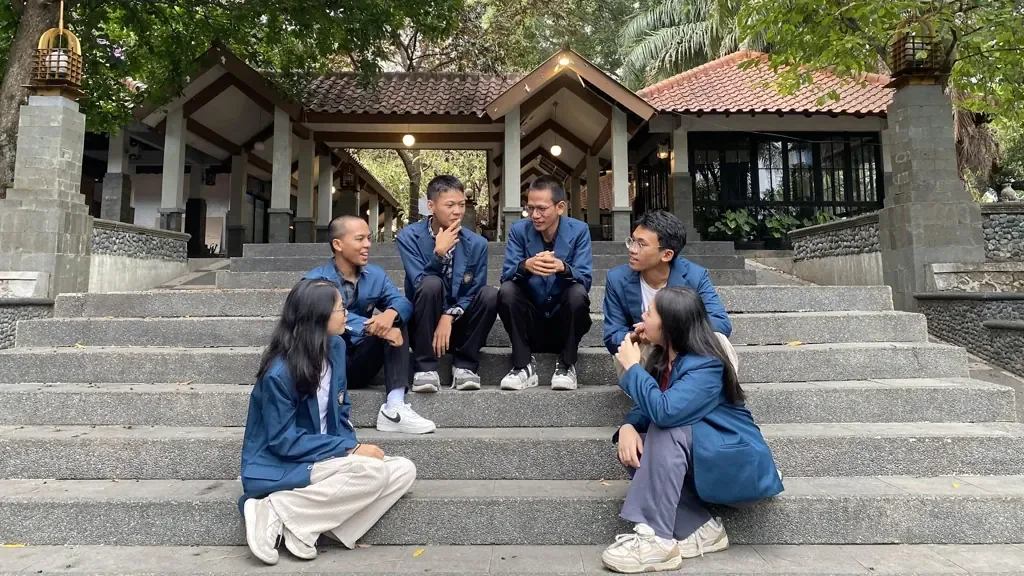
JurnalPost.com – New students in the Chemical Engineering program at Brawijaya University (UB) from the class of 2026 believe that using slang helps them bond more quickly and makes conversations more efficient. However, they noted that unfamiliar or ambiguous terms can sometimes lead to misunderstandings. These findings come from a survey conducted by six Chemical Engineering students at UB involving 43 respondents in October 2026.
The survey was developed as an assignment for a Citizenship course. The team examined the use of terms such as bestie, healing, relate, and gercep in direct conversation, group chats, and social media. The team also sought to understand how students adjust their language choices when speaking with lecturers, giving presentations, or writing laboratory reports.
After outlining the topic and introduction through online discussions on 21 September 2026, the team distributed a questionnaire via Google Forms on 8 October 2026 to new Chemical Engineering students at UB. Respondents rated statements on a five-point scale, ranging from strongly agree to strongly disagree. The questions covered the reasons for and frequency of slang usage, as well as respondents' perceptions of its impact on communication and formal language proficiency.
Practical and helpful for building rapport
Practicality and the desire to build rapport were the two most cited reasons, each selected by 28 respondents (65.1 percent). Peer environments influenced 26 respondents (60.5 percent), while 24 respondents (55.8 percent) cited the influence of social media platforms such as TikTok, Instagram, and X.
A total of 29 respondents (67.4 percent) admitted to frequently using slang when talking with fellow students. The desire to appear trendy received less support, with 16 respondents (37.2 percent) agreeing and 20 respondents (46.5 percent) remaining neutral.
Unfamiliar and ambiguous terms trigger misunderstandings
A total of 26 respondents (60.5 percent) believe that slang makes communication with peers more effective and efficient. 25 respondents (58.1 percent) felt that their messages were still clearly conveyed.
On the other hand, 17 respondents (39.5 percent) have experienced misunderstandings when the person they were speaking to did not understand the terms used. 21 respondents (48.8 percent) have misinterpreted a friend's meaning because the terms used had multiple meanings.
Experiences communicating with lecturers, seniors, or parents varied. 14 respondents (32.6 percent) felt hindered, 13 respondents (30.2 percent) remained neutral, and 16 respondents (37.2 percent) did not feel hindered.
Students adapt language to the situation
A total of 31 respondents (72.1 percent) claimed they could distinguish when to use slang and when to use formal language. 28 respondents (65.1 percent) felt their formal language skills had not declined due to slang usage. Meanwhile, 27 respondents (62.8 percent) did not feel any difficulty using formal language during presentations or class discussions.
The use of the Indonesian language on campus is also regulated by law. Article 29 paragraph (1) of Law Number 24 of 2009 governs the use of Indonesian as the medium of instruction for national education. Article 35 paragraph (1) regulates its use in the writing and publication of scientific papers in Indonesia, with exceptions for specific purposes or fields of study as regulated in paragraph (2). The same law mandates the use of Indonesian in official communication within government and private workplaces through Article 33 paragraph (1). Meanwhile, Article 35 paragraphs (3) and (5) of Law Number 12 of 2012 establish Indonesian as a mandatory course in undergraduate and diploma curricula, while Article 37 regulates its use as the medium of instruction in higher education.
The research team suggests that students use formal language when communicating with lecturers and completing academic assignments. In daily conversation, students should choose terms that are mutually understood, especially when speaking with peers from different regional backgrounds. The team also recommends that study programs provide guidance on language usage at the beginning of the academic term.
This survey reflects the experiences of 43 respondents from one cohort and one study program. The team proposes that further research involve students from other study programs or faculties and include interviews to explore the reasons behind their language choices.
Authors
Alicia Winfrey Sumbayak, Widhi Dwi Andika, Fachrian Andriansyah, Audrey Anya Siahaan, Fitrah Oryza Sativa, and Maulana Muhammad Zaid Annuri.
Department of Chemical Engineering, Faculty of Engineering, Brawijaya University, Malang.




Comments 0
Write a Comment Share your response