


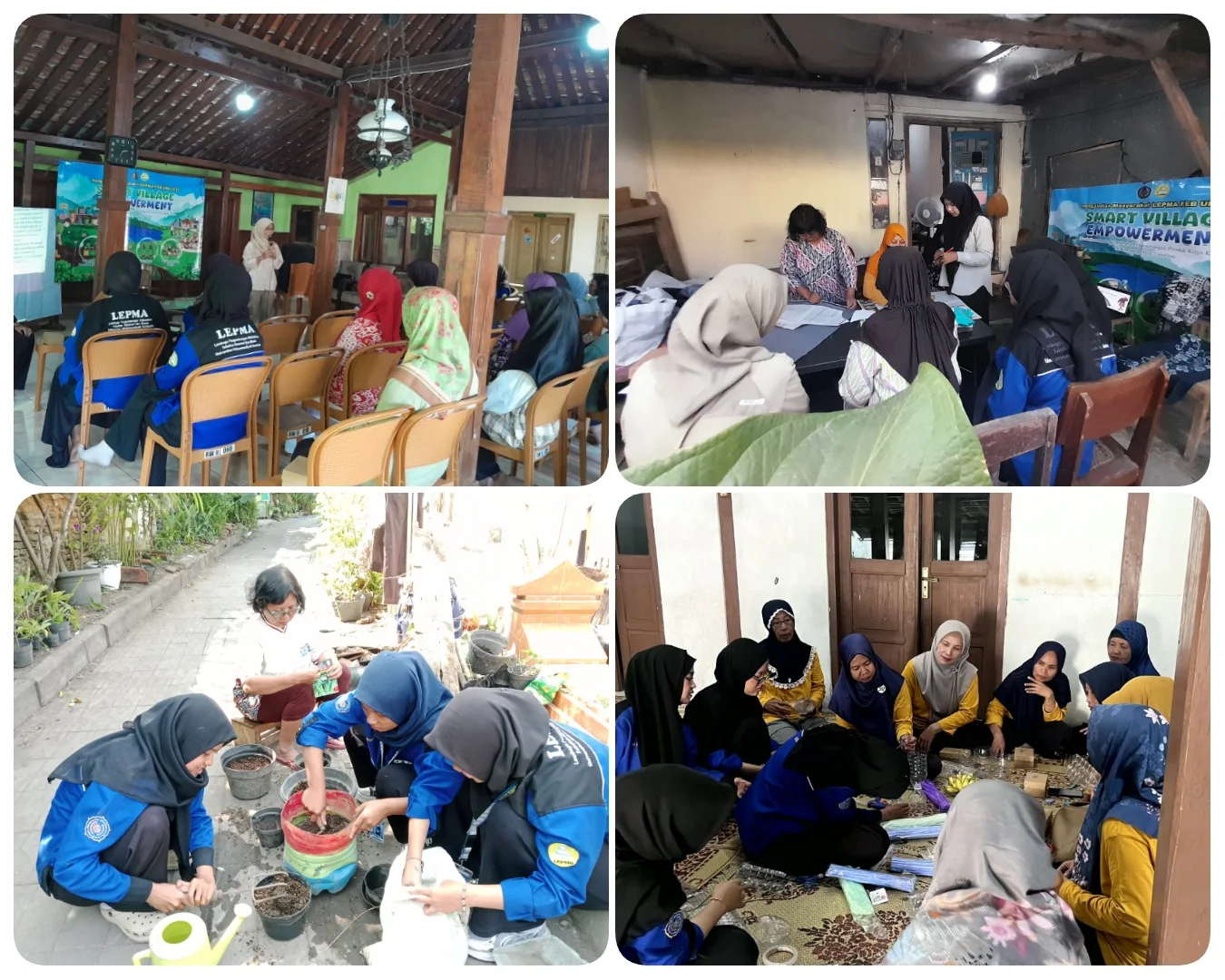
JurnalPost.com - The Student Organization Development Program (PPO) team from the Student Development Institute (LEPMA) of the Faculty of Economics and Business at Universitas Muhammadiyah Surakarta (FEB UMS) has launched a community service program in Laweyan Village, Surakarta. The initiative, titled "Smart Village Empowerment: Revitalizing Waste Banks and Developing Patchwork Craft Products in Kampung Batik Laweyan," focuses on strengthening local environmental potential and the creative economy.
Laweyan Village possesses significant potential for development, including its waste bank, patchwork artisans, the Kampung Batik Laweyan tourism area, and family medicinal plant gardens (TOGA). Based on observations and interviews conducted by the team in May 2026 with waste bank managers and local residents, several issues were identified that require attention.
These issues include the inactivity of the waste bank, the inefficient individual processing of patchwork fabric leading to waste accumulation, a lack of educational photo spots to support tourism, and the need for better organization of the TOGA area.
In response, the PPO LEPMA FEB UMS team, in collaboration with the community and the Laweyan Village government, designed a Smart Village program featuring four community empowerment corners: the Empowered Waste Bank Corner, the Patchwork Creation Corner, the Eco-Craft Corner, and the Healthy Plant Corner.
Ulfiyah Mufrih, the project lead for the PPO LEPMA FEB UMS team, stated that the program was designed to increase public awareness of environmental management while simultaneously developing the community's skills and economic potential.
"We designed this program not only to solve environmental problems but also to develop the potential that the community already possesses. Through these four empowerment corners, we hope the community will engage actively and be able to continue these activities independently," she said.
At the Empowered Waste Bank Corner, residents receive socialization and education on waste bank management and household waste sorting. The team also provided two types of waste bins and two composting barrels to facilitate sorting and encourage renewed community participation in waste bank operations.
Meanwhile, the Patchwork Creation Corner serves as an empowerment space, particularly for local women, to develop skills in utilizing fabric scraps. The patchwork, which previously accumulated as waste, is now being transformed into various creative products with both utility and market value.
The Eco-Craft Corner was developed to utilize organic and inorganic waste for creative products and environmental decoration. This activity is expected to encourage residents to repurpose waste while creating a more creative environment with added economic value.
The Healthy Plant Corner focuses on organizing and utilizing areas for herbal plants and family medicinal gardens, serving as a hub for health education.
The PPO program is being implemented in stages through a participatory approach involving waste bank managers and local residents. The process includes identifying potential and problems, socialization, group formation, training, mentoring, monitoring, evaluation, and the development of a program sustainability plan.
The Laweyan Village government has provided support through activity permits, facilitating coordination with the community and stakeholders, and providing locations for each empowerment corner. This support also includes mentoring, monitoring, and encouraging community participation at every stage of the program.
Afinda Tantri Kusuma Wardani, the coordinator for the PPO LEPMA FEB UMS activities, noted that collaboration with the community is essential for long-term sustainability. "The sustainability of the program does not depend solely on the student team. Therefore, we strive to involve the community from the planning stage through to implementation. We hope that after the program concludes, the community will be able to manage and develop these four corners independently," she said.
To ensure sustainability, the PPO team also established management groups, including the Waste Bank Management Unit, the Herbal Lestari Group, the Eco-Craft Crew, and the Perca Berkarya Community. These groups are expected to drive activities after the student mentoring period ends.
Additionally, the team has planned periodic mentoring for three months, from July to September 2026. Evaluations will be conducted through pre-tests and post-tests to measure improvements in the community's knowledge and skills. Through the Smart Village Empowerment program, the PPO LEPMA FEB UMS team hopes to establish an active and sustainable community learning center. The program is also aimed at increasing environmental awareness, enhancing community skills, promoting waste utilization, and creating economic opportunities through the development of local potential in Laweyan Village.
Through the collaboration between students, the village government, and the community, the program is expected to evolve beyond its initial implementation into a self-sustaining movement that manages the environment and develops the creative economy in Kampung Batik Laweyan.




Comments 0
Write a Comment Share your response