


BOGOR, JurnalPost.com — The Plantation Production Technology and Management (TMP) study program at IPB University's Vocational School held a community service project with the Muara Jaya Tani Youth Farmer Group in Mulyaharja Village, Bogor City, on Wednesday (23/9/2026).
This session focused on the practical application of biochar production, as well as inspecting and preparing the land for upcoming planting activities.
The event began around 14.00 WIB and was opened by Merry Gloria Meliala, S.P., M.Si., a lecturer from the TMP study program at IPB University's Vocational School, who led the proceedings.
Following the opening and a shared lunch, participants received an explanation of the biochar production stages before engaging in hands-on field practice. The activity was also supported by Field Agricultural Extension Officer (PPL) Agus Faisal and Mulyaharja Village Secretary Taufik Hidayat.
During the session, participants were introduced to various materials that can be used as biochar feedstock, including rice husks, coconut shells, coconut coir, and sawdust.
For this practice, sawdust was selected as the primary material. The production process utilized a reactor drum and a condenser drum connected by pipes to channel the gas and steam generated during the heating process.
Biochar Production Practice
Biochar production began by loading sawdust into the reactor drum. Meanwhile, the condenser system was prepared to process the steam produced during the pyrolysis stage.
Once the furnace was lit, the material inside the drum was heated under limited oxygen conditions. The resulting gas and steam were then channeled through pipes to the condenser unit.
The initial heating process lasted approximately three hours, from 14.00 to 17.00 WIB. After this stage, the pyrolysis process continued by utilizing the heat stored within the system to ensure a gradual reaction.
This method was introduced as an efficient way to convert biomass into biochar while minimizing fuel consumption.
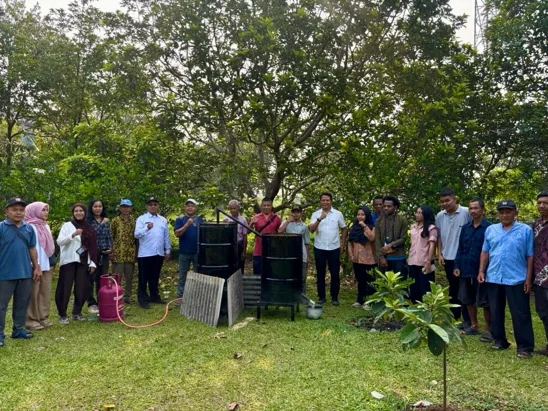
In addition to producing biochar, the pyrolysis process also yields a condensed liquid known as liquid smoke. This liquid is collected through a dedicated channel and can be utilized further, such as for pest control after undergoing appropriate processing.
Once the heating process was complete, the drum containing the biochar was sealed tightly and left to cool naturally.
The practice provided an opportunity for the farmer group members to observe the biochar production stages firsthand, from material preparation and heating to handling the final product.
Participants also received an explanation regarding the functions of biochar and the various types of biomass that can be used as raw materials.
Land Preparation for Planting
Following the biochar production practice, the activity continued with a land inspection involving both lecturers and participants.
Based on the inspection, there were approximately 12 planting beds at the site. Each bed measured approximately 6 meters by 1 meters, with a drainage width of about 80 centimeters.
This inspection was conducted as part of the preparations for the next phase of cultivation.
The application of mulch, biochar, manure, and dolomite is scheduled for Sunday, 27 September 2026. Once the land processing and preparation stages are complete, planting is planned for Friday, 2 October 2026.
The use of biochar in this project is part of the organic material management practices introduced to the farmer group.
Biochar is a carbon-rich material obtained by heating biomass under limited oxygen conditions. In agricultural practice, biochar can be used as a soil amendment to help improve various characteristics of the growing medium when applied with the correct methods and dosages.
Through hands-on practice, the farmer group members not only gained theoretical knowledge but were also able to observe the production process and the planned application on their land.
The community service project concluded with a group photo featuring the lecturers, facilitators, and members of the Muara Jaya Tani Youth Farmer Group.
This series of activities is part of the IPB University Vocational School TMP study program's commitment to supporting the community, particularly in introducing simple technologies that can be applied to biomass management and agricultural cultivation.
Through the biochar production and land preparation practice, participants are expected to gain experience that can serve as a reference for developing more effective agricultural land management and utilizing organic materials available in their surrounding environment.





Comments 0
Write a Comment Share your response