


By: Tsabita Fissilmi Yumna
JurnalPost.com - The development of Artificial Intelligence (AI) has made many tasks easier, including in the food business. Nowadays, vendors do not always have to conduct product photo shoots to create promotional materials. With a few commands or prompts, AI can generate food images that look neat, glossy, perfect, and even much more “beautiful” than the real thing.
At a glance, this sounds advantageous. The process of creating posters becomes faster, more practical, and cheaper. However, another question arises: does food that looks too perfect actually make people want to buy it?
In the culinary business, product photos play a vital role. A photo is not just a decoration for a poster; it serves as the consumer's first impression of the food being offered.
Before purchasing, potential customers usually observe the color, shape, texture, portion size, and how the food is presented. From these visuals, they begin to imagine the taste, aroma, and quality of the food.
Therefore, when the photos used look too unrealistic, consumer trust can diminish.
When AI Images Look Too Perfect
The use of AI-generated images in food promotions has become a topic of discussion on social media platforms like TikTok and X. Some netizens feel that AI-made food images are actually unappetizing.
The problem is not that AI technology always produces poor visuals. On the contrary, AI images sometimes look so perfect that they lose the essence of being real food.
The shape of chicken can look too round, cheese may appear to melt in unnatural patterns, meat textures can feel like plastic, or vegetables may look overly glossy. In some cases, the food details can even result in strange shapes that make people feel uncomfortable when looking at them.
Instead of stimulating hunger, these images can give the impression of toys, artificial objects, or something that is hard to imagine actually eating.
This is where the main issue with using AI for culinary promotion arises: attractive visuals are not necessarily appetizing.
Food is a product deeply connected to sensory experience. Consumers want to imagine how it will taste when eaten. Therefore, a display that is too far from reality can break the connection between the image and the real experience the consumer expects.
Realistic Can Be More Marketable Than Perfect
In food promotion, being realistic is sometimes more attractive than being perfect.
Consumers certainly want to know what the food will actually look like once they place an order. When the image on a poster looks too far from the actual condition, there is a concern that the product delivered will not match what was displayed.
This is different when a business uses original product photos. Even if the lighting is not perfect or the presentation is simple, consumers can get a clearer picture of the product.
They can see the actual color of the fried chicken, the texture of the crispy bits, the shape of the omelet, the size of the chili sauce, and the portion of rice they will receive.
Such authenticity has its own value.
In the food business, consumers do not just buy something that looks beautiful. They also buy expectations. When the visuals feel real, those expectations are easier to build.
“Old-School” Posters Often Feel More Honest
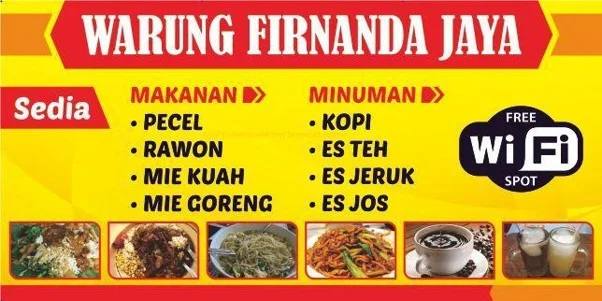
Interestingly, simple or even “old-school” food menu posters are sometimes more appetizing.
We may have seen food stall posters displaying photos of crispy fried chicken, crispy catfish, omelets, fried rice, or various other menus with very simple designs.
Aesthetically, these posters might be less modern than AI-based designs. The lighting is not perfect, the composition is simple, and some photos even look like they were taken with a regular mobile phone camera.
However, that is precisely why these posters feel more real.
Consumers can imagine that the chicken seen on the poster is likely very similar to the chicken that will arrive at their table. The crispy texture looks like real food. The color of the chili sauce looks natural. The shape of the food is not overly engineered.
There is a sense of honesty that emerges from such photos.
In a culinary context, visual honesty can be a very strong attraction.
The Human Touch Is Still Important
The emergence of AI is certainly not something to be rejected. This technology can greatly assist business owners in creating promotional designs.
AI can be used to find conceptual ideas, arrange layouts, generate supporting illustrations, help create slogans, improve design composition, and speed up creative work.
However, its use needs to be adapted to the character of the product.
For food, original product photos should remain the main element. AI can help beautify the surrounding design without having to replace the actual appearance of the food.
For example, a vendor can photograph real crispy fried chicken using a mobile phone, then use technology to improve the lighting, remove distracting backgrounds, or arrange the poster to look more professional.
In this way, technology is used without sacrificing the authenticity of the product.
AI as a Tool, Not a Replacement for Real Products
The use of AI in creating food posters does offer speed and convenience. In a short time, one can produce professional-looking promotional visuals.
However, food promotion has a different character from other products.
When the appearance of food is too perfect, too glossy, or has an unrealistic texture, these visuals can actually reduce the interest of potential buyers. Consumers may feel doubtful, uncomfortable, or even lose their appetite.
Conversely, simple, original food photos can provide a more honest, relatable, and trustworthy impression.
Therefore, the use of AI in culinary promotion should be positioned as a creative tool, not as a replacement for product authenticity.
Ultimately, in selling food, the most perfect is not always the most attractive.
Sometimes, fried chicken that is not symmetrical, messy crispy bits, chili sauce that looks genuinely spicy, or an omelet with browned edges is far more appetizing.
Because when it comes to food, what consumers are looking for is not just something that looks beautiful on a screen, but something that feels real and ready to be eaten.









Comments 0
Write a Comment Share your response