

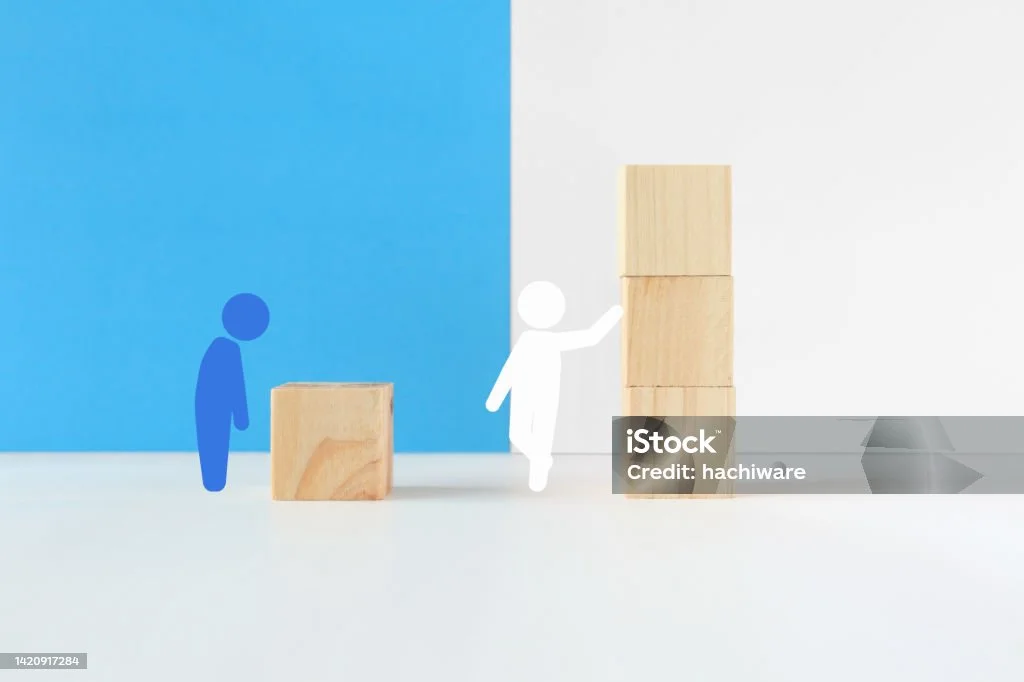
Whether we realize it or not, humans are often too busy chasing the deadlines of their own life schedules. We scroll through screens, watching friends earn degrees, secure corporate positions, or even marry and build ideal households. From a young age, many feel like failures for not achieving the same milestones as their peers, failing to get into a university, or simply finding themselves standing in a different place than everyone else.
From a psychological perspective, this can be explained by social comparison theory, which posits that humans have an innate drive to compare themselves with others to build a strong self-assessment (Festinger, 1954). Ideally, this comparison should provide information about one's own abilities, achievements, attitudes, and physical traits. However, in the modern era, comparisons tend to be 'upward.' This means individuals evaluate themselves against those perceived as superior. While this can sometimes be motivating, it generally leads to feelings of envy, anxiety, frustration, and even depression (Wheeler & Miyake, 1992).
Social media triggers extreme upward comparisons because users tend to present strategically curated versions of themselves, projecting an ideal image (Gonzales & Hancock, 2011). Research shows that the comparisons made while scrolling social media impact subjective well-being, which refers to a person's cognitive and affective evaluation of their life. This includes three elements: life satisfaction, positive affect, and negative affect (Diener et al., 1999). Consequently, when someone views images or videos online, they perceive a gap in their own life—a void in well-being caused by the feeling that they have not achieved what they 'should' have by a certain time.
This gap does not just reside within the individual; it can spiral into mental health struggles, leaving one feeling like a failure or frustrated with their own existence. So, is one forced to just sit and lament their fate? Or should they turn themselves into a workhorse that never knows when to stop?
How, then, should one respond to a life that does not follow the so-called 'normal schedule'?
Comparing oneself to peers of the same age or family members makes reality feel even harsher. It often feels as though everyone starts from the same point, when in truth, every individual has a different starting line. Age and blood relations can make someone seem like a relevant benchmark, even though the posts displayed on their social media are merely curated snippets of life, not the entire journey. These journeys likely contain hidden failures and anxieties—the dark circles under their eyes that they hide—and other secrets that would never be shared if you were in their shoes.
As previously explained, social comparison triggers feelings of inferiority, signaling that one's self-worth has been anchored to others. Through the lens of philosophy, social comparison can be reinterpreted to help us view tomorrow with more optimism. Three philosophical perspectives are offered here: Stoicism, active nihilism, and amor fati.
Stoicism: The Dichotomy of Control as an Antidote
The dichotomy of control is a Stoic concept that divides life into two categories: things within our control and things outside our control. In this context, the achievements of others are outside our control, while our emotional response to those comparisons is entirely within our control.
Happiness, sadness, fear, and other emotions depend on one's ability to manage their response to external phenomena. Humans need to prepare their minds to accept all possibilities rather than expecting absolute outcomes. By applying the Stoic principle of the dichotomy of control, one can reorganize their inner space so that the 'normal schedule' no longer dictates their validation system, leading to more stable self-worth.
Active Nihilism as a Path to Creating Meaning
Nihilism comes from the Latin word for 'nothing.' After Nietzsche articulated the meaning of nihilism, he rejected the idea of passive resignation. Friedrich Nietzsche proposed 'active nihilism,' meaning that life should not be met with despair simply because one is not following a predetermined path. In this view, humans have the freedom to choose their own paths and desires.
On this basis, failure should not be seen as proof of one's worthlessness. Instead, failure should be viewed as a lesson that helps one develop into a better person for the future. However, it is important to emphasize that this does not mean ignoring the pain. If the distress becomes overwhelming, one should seek appropriate professional support; it should not be dismissed as a trivial matter.
Amor Fati as Empowering Acceptance
Amor fati helps build a perspective of loving one's fate. Practicing amor fati means learning to make peace with one's life journey. Even if one has not yet achieved certain things, it does not mean they are a failure. Amor fati helps individuals face problems actively, seek lessons from various perspectives, acknowledge their feelings, and determine steps for the future. However, accepting negative experiences does not mean suppressing them or refusing help. Letting go of unhappy circumstances does not mean pretending that everything bad is good and simply leaving it at that.
Therefore, these three philosophical concepts offer steps to address feelings of inferiority caused by a life path that deviates from the 'normal schedule' (social comparison). Stoicism helps distinguish between what can and cannot be controlled. Others cannot dictate your schedule or your life outcomes, and vice versa; you are responsible for your own actions and attitudes. Through active nihilism, one is encouraged not to simply dismiss failure or pain, but to acknowledge it and build new goals or values from the experience. Finally, amor fati provides the perspective that we must learn to accept our life journey, both the pleasant and the unpleasant. Here, acceptance is not surrender, but rather fuel for the motivation to change tomorrow for the better.
Humans need to accept every experience and recognize their feelings, while never forgetting to learn how to choose the best way to face them.










Comments 0
Write a Comment Share your response