

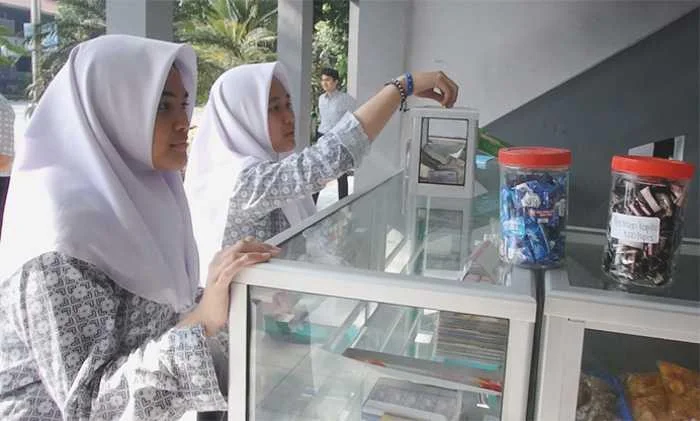
JurnalPost.com – Honesty is a fundamental moral value that forms the basis of a person's character and sense of responsibility. This value is reflected not only in words but also in daily actions, especially when one must make decisions without direct supervision.
In such situations, integrity becomes the foundation for acting in accordance with the principles of honesty, even when no one else is watching.
One practical application of this value can be found in the existence of 'Honesty Canteens' on university campuses.
Unlike conventional canteens, the Honesty Canteen operates on a self-service transaction system. Students are trusted to select their food, check prices, calculate their total bill, and make payments without the assistance of a cashier.
This system grants freedom to the buyer while placing the responsibility for payment on individual conscience.
More than just a place to buy food, the Honesty Canteen serves as a tool for character education and the habituation of anti-corruption values. Through these simple activities, students have the opportunity to practice honesty, responsibility, and respect for the rights of others.
However, the success of the Honesty Canteen does not rely solely on individual awareness. Adequate transaction facilities, clear price information, and transparent management systems also play a crucial role in maintaining its sustainability.
Challenges of Self-Service Transactions in Campus Canteens
The practice of self-service transactions at a university in Indonesia provides insight into the various challenges of building a culture of integrity on campus.
Based on a limited survey of 53 students who have shopped at the Honesty Canteen, 40 respondents, or 75.5 percent, are accustomed to using QRIS as a payment method.
Meanwhile, 10 respondents use a combination of cash and digital payments, while three other respondents are accustomed to using cash payments.
Although digital payment methods are quite dominant, their implementation still faces several obstacles.
A total of 31 respondents, or 58.5 percent, admitted to having experienced difficulties when calculating their total bill.
Of that number, 13 respondents mentioned that price details were unclear, 10 respondents experienced difficulties due to the lack of a calculator, while eight respondents struggled to calculate the total for large purchases.
Other obstacles were found regarding payment facilities and product information availability.
A total of 32 respondents, or 60.4 percent, cited unstable internet connections as a transaction obstacle experienced or observed. Meanwhile, 25 respondents, or 47.2 percent, highlighted that product price lists were incomplete or confusing.
These findings indicate that the implementation of self-service transactions requires support from adequate payment facilities and clear information presentation.
On the other hand, 49 out of 53 respondents, or about 92.5 percent, rated the importance of paying the correct amount—even without direct supervision—very highly.
These results show that most respondents understand the importance of responsibility in self-service transactions. However, an understanding of the value of honesty does not necessarily eliminate all technical obstacles during the transaction process.
Observations of 15 transactions during two observation sessions in October 2026 also provided insight into the payment process at the canteen.
Of that total, 14 transactions used QRIS and one transaction used cash.
Confirmation of successful payment was observed in 12 transactions, while three other transactions could not be visually verified by the observer.
However, the lack of visible payment confirmation does not mean the transaction failed or that it indicates dishonesty on the part of the buyer.
Interviews with management also revealed that discrepancies between actual and expected profits have been found. However, the exact amount or frequency of these discrepancies remains unknown.
Management has actually been recording stock, operational capital, and sales results routinely. However, the recording of sold products has not been separated by cash and QRIS payment methods.
This condition highlights the need to strengthen transaction procedures and recording systems so that the management of the Honesty Canteen can be more orderly and easier to evaluate.
Honesty Needs to be Supported by an Adequate System
These various obstacles show that the success of the Honesty Canteen is not determined solely by the character of the buyer, but is also influenced by the quality of the available transaction system.
Students who intend to pay honestly may still face difficulties if price information is incomplete, products are difficult to identify, or the payment network experiences disruptions.
In daily life, a person's behavior is influenced not only by their intentions but also by environmental conditions and their ability to perform certain actions.
In the practice of the Honesty Canteen, a student's desire to pay the correct price needs to be supported by the ease of identifying products, knowing the payment amount, and understanding transaction procedures.
The use of QRIS, for example, provides convenience because students can pay without having to prepare cash.
However, this digital payment system still requires precision when entering the nominal amount and ensuring that the transaction has been successful.
Technological convenience does not automatically eliminate the possibility of errors in the payment process.
In addition, complete and easy-to-read product names and prices are essential requirements for supporting self-service transactions.
Without adequate information, buyers may become confused even if they understand the general payment procedures.
Therefore, strengthening the culture of honesty is not enough through moral appeals or posting messages about the importance of paying the correct price.
Such messages need to be complemented by technical instructions, clear product information, well-functioning payment facilities, and orderly recording mechanisms.
In this regard, students and management have complementary responsibilities. Students are obligated to complete payments correctly, while management needs to provide a system that makes transactions transparent.
GERAK JUJUR as an Effort to Build an Anti-Corruption Culture
Based on these issues, one proposed improvement is the program GERAK JUJUR (Student Honest Transaction Movement).
This program is designed to increase student awareness while improving the technical aspects that remain obstacles in the implementation of self-service transactions.
GERAK JUJUR has three main activities that support each other.
First, the preparation of purchase and payment flow guides placed in the food shelf area and at payment points.
These guides contain transaction steps, starting from selecting products, checking prices, calculating the total bill, determining the payment method, and ensuring the transaction is successfully completed.
The presence of these guides is expected to assist students, especially those who are not yet accustomed to using cashier-less transaction systems.
Second, the creation of educational videos regarding the correct transaction procedures using QRIS and cash payments.
These videos can demonstrate how to calculate the total bill, enter the payment amount, check transaction status, and apply honest and responsible attitudes during the purchasing process.
The use of audiovisual media is expected to make information easier to understand while attracting student attention.
Third, the preparation of posters or information media containing a complete list of products and their prices.
This activity is intended to address the issue of price information that is not always available or easy to identify.
Presenting clear information is expected to help students calculate their total bill more accurately and reduce the possibility of payment errors.
In addition to these three activities, the implementation of GERAK JUJUR also requires coordination between students and canteen management.
Management needs to pay attention to updating price information, the availability of payment facilities, and separating the recording of cash and QRIS receipts so that the evaluation process is easier to conduct.
Transaction guides can also be equipped with alternative procedures in case the internet network experiences disruptions.
However, GERAK JUJUR is currently still a proposal that requires further approval, implementation, and evaluation.
The success of the program can later be assessed through observations of student understanding, the ease of obtaining price information, and the smoothness of transactions after the educational media are implemented.
Instilling Integrity through Simple Habits
Efforts to build a culture of integrity on university campuses are linked to the values of Pancasila.
Honesty and responsibility are part of applying moral values in daily life.
Paying the correct price reflects respect for the rights of others, while the involvement of students and management in determining improvement steps shows the importance of deliberation and cooperation.
This idea is also in line with the Sustainable Development Goals (SDGs), specifically Goal 16 regarding peace, justice, and strong institutions.
Target 16.5 emphasizes the importance of reducing corruption and bribery, while target 16.6 relates to the development of effective, accountable, and transparent institutions.
Although the Honesty Canteen is not a direct indicator of the success of anti-corruption efforts, this practice can serve as a learning space to instill integrity values through actions performed consistently.
The role of students in building an anti-corruption culture does not always have to be realized through large-scale activities.
The willingness to pay the correct price, respect the rights of others, and maintain trust are forms of responsibility that can start from one's immediate environment.
Through these habits, students can understand that anti-corruption values are not just lecture material, but principles that need to be applied in daily life.
Ultimately, the Honesty Canteen is not just a place to buy food without a guard. Its existence can be a learning space regarding trust, responsibility, and respect for the rights of others.
Honesty indeed begins with individual awareness, but its sustainability requires a supportive environment and system.
Building a culture of integrity is not just about reminding someone not to cheat, but also about creating conditions that make it easier for everyone to do the right thing.
Through the practice of self-service transactions, students have the opportunity to prove that integrity is not just a value that is spoken, but a responsibility that is realized through concrete actions.
References
Ajzen, I. (1991). The theory of planned behavior. Organizational Behavior and Human Decision Processes, 50(2), 179–211. https://doi.org/10.1016/0749-5978(91)90020-T
Astuti, A. T., Anderson, I., & Candra, A. A. (2025). Honesty canteen as an anti-corruption education medium to form honest character in grade VII students of SMP Negeri 7 Jambi City. Jurnal Pendidikan Kewarganegaraan, 9(1), 1–12. https://doi.org/10.31571/jpkn.v9i1.7613
Bank Indonesia. (n.d.). Quick Response Code Indonesian Standard (QRIS). https://www.bi.go.id/id/fungsi-utama/sistem-pembayaran/ritel/kanal-layanan/qris/default.aspx
Davis, F. D. (1989). Perceived usefulness, perceived ease of use, and user acceptance of information technology. MIS Quarterly, 13(3), 319–340. https://doi.org/10.2307/249008
DeLone, W. H., & McLean, E. R. (2003). The DeLone and McLean model of information systems success: A ten-year update. Journal of Management Information Systems, 19(4), 9–30. https://doi.org/10.1080/07421222.2003.11045748
Nirwasita, K. S., Jannah, R. K., Situmorang, A. T., & Nurwidya, R. P. (2024). Student preferences in using QRIS as a payment tool at the canteen of Universitas Pembangunan Nasional Veteran Jakarta. Accounting Student Research Journal, 3(1), 42–54. https://doi.org/10.62108/asrj.v3i1.7276
Pruckner, G. J., & Sausgruber, R. (2013). Honesty on the streets: A field study on newspaper purchasing. Journal of the European Economic Association, 11(3), 661–679. https://doi.org/10.1111/jeea.12016
United Nations. (n.d.). Goal 16: Peace, justice and strong institutions. https://sdgs.un.org/goals/goal16

Comments 0
Write a Comment Share your response