

Abstract
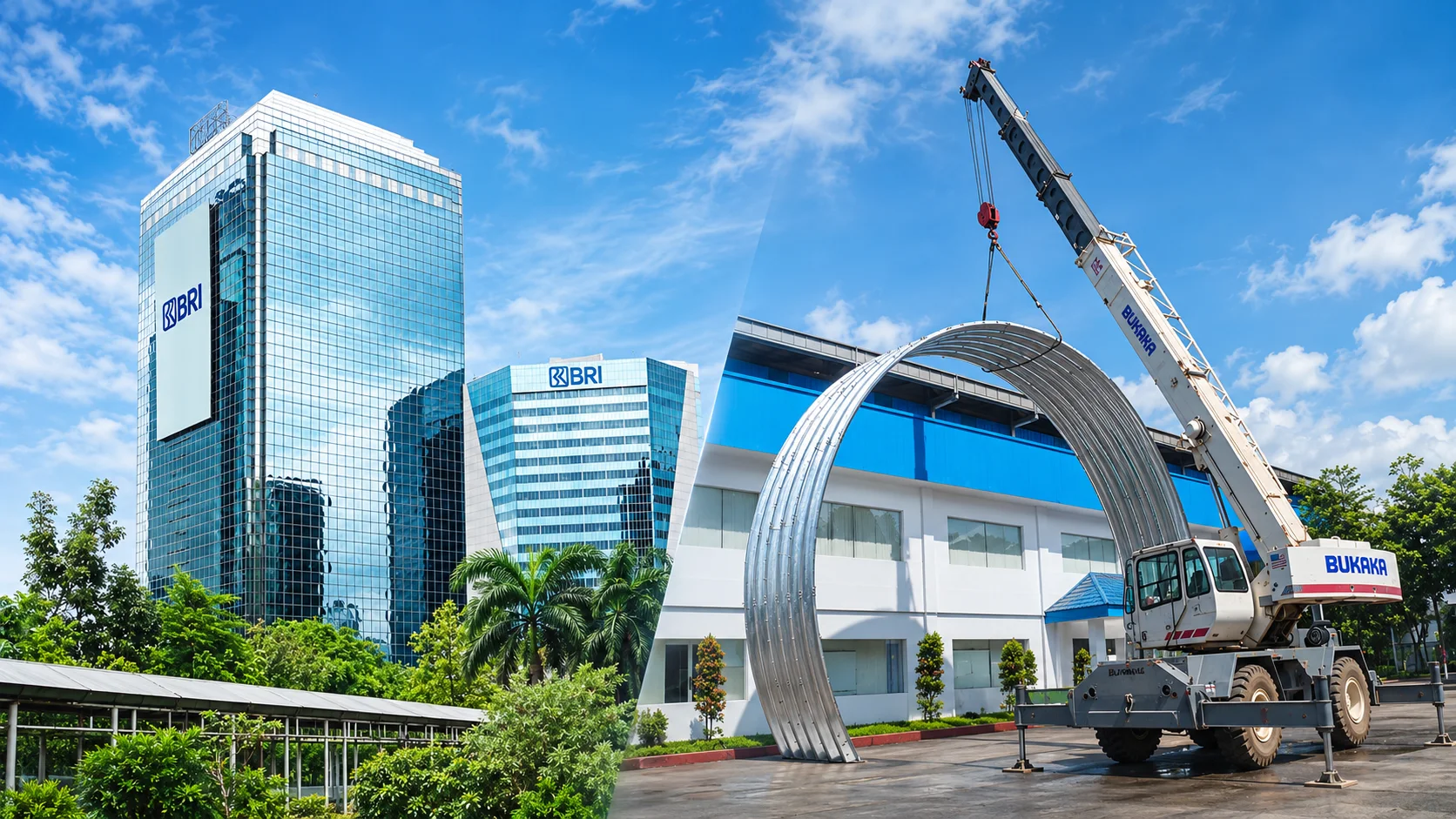
This report is designed to compare the financial conditions of companies operating in the banking financial services sector and non-banking sectors. The subjects of this study are PT Bank Rakyat Indonesia (Persero) Tbk, representing the banking sector, and PT Bukaka Teknik Utama Tbk, as a non-banking construction company.
The data used is sourced from the financial statements of both companies for the period ending on 31 December 2025, covering financial positions, operating results, and financial ratio calculations, such as Return on Equity (ROE), Return on Assets (ROA), and debt-to-equity ratios.
The analysis results indicate significant differences between the two companies. Based on the data used in this study, BRI has total assets reaching Rp2,256,840 billion, with primary funding sourced from public deposits, and generates a return on equity of 30.8 percent.
Conversely, PT Bukaka Teknik Utama Tbk has total assets of Rp25,306 billion with a relatively more balanced capital structure and a return on equity of 3.6 percent.
These differences arise due to the nature of their distinct business activities. A bank functions as a financial intermediary managing third-party funds, whereas a construction company focuses on providing services and executing projects that rely on its own capital and loans.
Thus, it can be concluded that the type of business helps determine the structure of financial statements, sources of income, profit levels, and the risks faced by each company.
Keywords: Financial analysis, banking performance, non-banking performance, BRI, Bukaka Teknik Utama, profitability ratios.
CHAPTER I INTRODUCTION
1.1 Background
The national economy functions thanks to the roles of two mutually supportive groups of business actors: financial institutions and the real sector.
Banks function by bridging the flow of public funds by collecting deposits and then channeling them back in the form of financing to drive economic activity.
On the other hand, non-financial companies produce goods and services, create jobs, and provide added value to the economy.
Although interconnected, these two sectors have different ways of operating, financial structures, sources of income, and regulatory requirements.
PT Bank Rakyat Indonesia (Persero) Tbk, or BRI, is one of the largest banks in Indonesia, prioritizing services for micro, small, and medium enterprises (MSMEs).
As a banking institution, BRI's activities center on the collection and management of public funds, so its financial statement format follows characteristics and regulations that differ from typical companies.
Meanwhile, PT Bukaka Teknik Utama Tbk operates in the fields of construction services, engineering, and the manufacturing of infrastructure equipment.
The company's activities require relatively large capital and are highly dependent on the completion of projects based on contracts, with revenue derived from providing services and selling physical products.
These differences in business characteristics are reflected in the financial statements of each company. However, not all parties understand how these differences appear in financial data and their impact on company performance.
Therefore, this report is compiled to compare the financial condition of BRI as a representative of the banking sector with PT Bukaka Teknik Utama Tbk as a non-banking company to obtain an overview of the characteristics of each sector.
1.2 Problem Formulation
Based on the background description, the problem formulation in this study is as follows:
How is the comparison of the structure of assets, liabilities, and equity between PT Bank Rakyat Indonesia (Persero) Tbk and PT Bukaka Teknik Utama Tbk in the year 2025?
What are the differences in financial performance visible from the income statements and financial ratios of both companies?
How does the difference in the type of business activity influence the structure and financial performance results of each company?
1.3 Writing Objectives
The preparation of this report aims to:
Determine the differences in the financial position statement structure between banking companies and non-banking companies.
Analyze the comparison of profit levels, efficiency, and capital structure of both companies.
Explain the relationship between the type of business and the preparation of financial statements as well as the performance results achieved.
1.4 Benefits of Writing
This report is expected to provide the following benefits:
For the author, to deepen the understanding regarding the differences in the preparation and interpretation of financial statements between banking institutions and non-banking companies.
For readers, to serve as a reference for recognizing how to read, understand, and compare the financial statements of companies operating in different fields of business.
CHAPTER II DISCUSSION
2.1 General Overview of Research Objects
This writing highlights two companies with different business fields as objects of comparison.
PT Bank Rakyat Indonesia (Persero) Tbk (BRI) is a company engaged in banking financial services. Its main activity is to collect public funds and then channel them back in the form of credit or financing. Its operational activities are under the supervision of the Financial Services Authority (OJK).
PT Bukaka Teknik Utama Tbk is a company operating in the real sector, specifically construction services, engineering, and the manufacturing of infrastructure equipment. The company's revenue is obtained through the execution of projects based on contracts and the sale of physical products.
The data used as the basis for analysis are the financial statements of both companies for the period ending on 31 December 2025 as compiled by the author.
2.2 Comparison of Financial Position Structure
Table 2.1 Summary of Financial Position for the Year 2025 (in Billions of Rupiah)
| Description | Bank BRI | PT Bukaka Teknik Utama Tbk |
|---|---|---|
| Total Assets | Rp2,256,840 | Rp25,306 |
| Total Liabilities | Rp2,071,240 | Rp16,611 |
| Owner's Equity | Rp185,600 | Rp8,696 |
| Debt-to-Equity Ratio | 9.38 times | 1.91 times |
Source: Financial statement data compiled by the author.
A. Scale of Business Activities
BRI's asset value is nearly 90 times larger than that of PT Bukaka Teknik Utama Tbk based on the data used in the study.
This difference is understandable because banks do not only manage their own capital but also collect and manage large amounts of public funds.
Conversely, construction companies have assets related to operational needs, project execution, equipment, and company investments.
B. Sources of Business Funding
BRI has liabilities reaching approximately Rp2,071 trillion, most of which are related to third-party funds, including customer deposits.
These funds are the bank's obligations to customers that must be managed with attention to the principles of prudence, liquidity, and security.
Meanwhile, PT Bukaka Teknik Utama Tbk's liabilities of Rp16,611 billion come from various sources, such as debts to suppliers, loans from financial institutions, and obligations related to project execution.
C. Capital Structure
BRI's funding structure is heavily influenced by the collection of funds from external parties, especially public deposits.
In the research table, BRI's debt-to-equity ratio is listed as 9.38 times, while PT Bukaka Teknik Utama Tbk's is 1.91 times.
Construction companies have a funding structure that is relatively more balanced between liabilities and own capital based on the research data.
However, this difference in ratios needs to be understood by considering the industry characteristics of each company as well as the consistency of the calculation basis.
D. Differences in Financial Statement Presentation
BRI presents its statement of financial position by considering the liquidity characteristics of assets and liabilities in accordance with the nature of banking activities.
Meanwhile, PT Bukaka Teknik Utama Tbk presents assets and liabilities based on short-term and long-term classifications in accordance with the characteristics of non-financial companies.
These differences show that the form of financial statement presentation is influenced by the nature and information needs of each business sector.
2.3 Comparison of Operating Results and Profit Levels
Table 2.2 Summary of Income Statement for the Year 2025 (in Billions of Rupiah)
| Description | Bank BRI | PT Bukaka Teknik Utama Tbk |
|---|---|---|
| Core Revenue | Rp217,380 | Rp3,941 |
| Gross Profit | Rp89,500 | Rp1,080 |
| Net Profit | Rp57,132 | Rp311 |
| Return on Assets (ROA) | 2.53% | 1.23% |
| Return on Equity (ROE) | 30.8% | 3.6% |
Source: Financial statement data compiled by the author.
A. Differences in Revenue Sources
BRI obtains its main revenue from credit interest and various financial service fees.
In banking operations, interest expenses paid to depositors are a significant component in determining operating results.
Conversely, PT Bukaka Teknik Utama Tbk obtains revenue from the execution of construction projects and product sales.
The company also incurs various operating costs, such as costs for raw materials, labor, equipment, and project execution expenses.
B. Profit Levels Achieved
Based on the research data, BRI recorded a net profit of Rp57,132 billion. The magnitude of this profit is related to the scale of operational activities and the volume of banking transactions.
Meanwhile, PT Bukaka Teknik Utama Tbk recorded a net profit of Rp311 billion.
As a company operating in the construction and engineering sector, Bukaka's profit level is influenced by various factors, such as raw material costs, labor, operational efficiency, and project completion.
The difference in nominal profit needs to be analyzed by considering the company size, asset structure, and the characteristics of its business activities.
C. Efficiency and Return on Capital
Return on Equity (ROE) is a ratio used to measure a company's ability to generate profit based on the capital or equity it possesses.
Based on the calculations in this study, BRI's ROE of 30.8 percent indicates that every Rp100 of equity generates a profit of approximately Rp30.80.
Meanwhile, PT Bukaka Teknik Utama Tbk's ROE of 3.6 percent indicates a lower return on equity based on the research data.
This difference needs to be understood by considering the characteristics of construction companies that carry out activities based on projects and require time for work completion.
BRI's Return on Assets (ROA) was recorded at 2.53 percent, while PT Bukaka Teknik Utama Tbk's was 1.23 percent.
Based on these calculations, BRI generates a higher profit relative to its total assets. However, assessing efficiency between sectors still requires consideration of asset characteristics, funding structures, and the business risks of each company.
2.4 Differences Based on Business Activity Characteristics
Table 2.3 Comparison of Banking Sector and Construction Sector Characteristics
| Aspect | Banking Sector (BRI) | Construction Sector (Bukaka) |
|---|---|---|
| Main Activity | Connecting fund owners with fund users | Producing services and physical products |
| Funding Sources | Public deposits and owner's capital | Own capital, loans, and trade payables |
| Main Assets | Credit provided to customers | Project receivables, work equipment, and material inventory |
| Business Risk | Credit risk or the inability of customers to repay loans | Project delays, cost increases, and uncollectible receivables |
| Supervision | Financial Services Authority | Financial Services Authority and Indonesia Stock Exchange |
| Activity Cycle | Occurs daily and is repetitive | Occurs based on the project execution timeline |
The fundamental difference between the banking sector and the construction sector lies in the characteristics of their operational activities.
Banks manage public funds, so trust, fund security, liquidity, and risk management are important aspects in conducting business activities.
The banking asset structure is dominated by financial instruments, including credit extended to customers.
Conversely, construction companies manage various activities related to the execution of physical work. Therefore, equipment, raw materials, and receivables arising from project execution become important parts of their operational activities.
Construction company profits are obtained from project revenue and product sales after deducting various costs related to the execution of the work.
Although they have different characteristics, both sectors can support each other.
Banking can provide financing facilities to construction companies to assist in project execution, while construction companies contribute to infrastructure development and economic growth.
2.5 Conclusion
The differences in financial statement structure and performance results between PT Bank Rakyat Indonesia (Persero) Tbk and PT Bukaka Teknik Utama Tbk do not merely indicate the strengths or weaknesses of one company, but rather reflect fundamental differences in their business activity characteristics.
BRI operates by collecting and managing public funds on a large scale, thus having a relatively high structure of assets and liabilities.
Meanwhile, PT Bukaka Teknik Utama Tbk operates with project-based business characteristics, focusing on the provision of construction services, engineering, and infrastructure development.
Based on the research data, BRI has higher ROA and ROE levels compared to PT Bukaka Teknik Utama Tbk. However, this comparison cannot be used as the sole basis for determining the quality of a company's performance.
Each sector has different funding structures, asset characteristics, operational cycles, and risks.
Therefore, financial statement analysis needs to be conducted comprehensively by considering industry characteristics and using consistent ratio calculation methods.
Understanding these differences is important so that financial performance assessments can be conducted objectively and not by applying the same assessment metrics to companies with different business characteristics.
Bibliography
PT Bank Rakyat Indonesia (Persero) Tbk. (2026). Consolidated Financial Statements as of 31 December 2025. Accessed on 2 October 2026 via the official BRI Investor Relations website.
PT Bank Rakyat Indonesia (Persero) Tbk. (2026). Annual Report 2025. Accessed on 2 October 2026 via the official BRI Investor Relations website.
PT Bukaka Teknik Utama Tbk. (2026). Annual Financial Statements as of 31 December 2025. Accessed on 2 October 2026 via the Indonesia Stock Exchange.
Kasmir. (2018). Financial Statement Analysis. Edition 11. Depok: Raja Grafindo Persada.
Hanafi, M. M., & Halim, A. (2014). Financial Statement Analysis. Yogyakarta: UPP STIM YKPN.
Financial Services Authority. (2025). OJK Regulation Number 42/POJK.03/2016 regarding Published Financial Statements of Commercial Banks. Accessed on 2 October 2026 via the official Financial Services Authority website.


Comments 0
Write a Comment Share your response