

Dia Raudatul Jannah3 . Rahma Anisa2, Zahrotunnur 3, Istinaria4 1,2,3,4 Early Childhood Education Study Program, UNSRI, Indralaya, Palembang 1[email protected],2[email protected],3Zahratunnur06@g mail.com,4[email protected]
Abstract
Abstract Social emotional development is an important aspect of early childhood growth as it relates to a child's ability to interact and manage emotions positively. The family as the closest environment has a big role in shaping the basis of this development through parenting, communication and daily interactions. This study aims to analyze the role of family in early childhood social emotional development through literature review. The method used is a literature review of 17 scientific articles from 2020 to 2025, obtained from various trusted sources such as Google Scholar, Garuda, and DOAJ. The analysis focused on the family's contribution to children's social-emotional aspects, taking into account the factors of parenting, home environment, and parental involvement. The results of the study show that the active role of the family has a significant effect in supporting children's social-emotional development optimally. This result can serve as a basis for parents and educators in building positive interactions with children from an early age. Keywords: Early childhood, family, social-emotional, parenting, parental roleINTRODUCTION
Early childhood is a child aged 0-6 years, has unique and distinctive characteristics. Early childhood is a child who has certain age limits, unique characteristics and is in a process of rapid development and is fundamental to the child's life in the future (Syahrul & Nurhafizah, 2021) . According to Mansur in (Ningrum et al., 2022) early childhood is a group of children where they are in a fairly unique growth and development process. Children have patterns of growth and development (fine and gross motor coordination), thinking power, creative power, language and communication, which are included in intellectual intelligence (IQ), emotional intelligence (EQ), spiritual intelligence (SQ) or religious or religious intelligence (RQ), according to the level of growth and development of children. Early childhood growth and development needs to be directed at laying the right foundations for the growth and development of the whole person. The early age period is a golden period, where at this time the child is experiencing an extraordinary growth and development process. Because at this time too, the child has not had many negative influences from outside or the environment. In other words, parents and educators will find it easier to direct children to be better. Early age children is a very bright period to do and be given education (Nurhasanah et al., 2021) . Children have several aspects of development, one of which is the social-emotional aspect. Although social and emotional are two words that have different meanings, these social-emotional aspects cannot be separated. According to Mayar, social development is defined as the child's ability to interact with peers, adults, and the wider community in order to adjust well in accordance with the expectations of the nation and state while Emotions are feelings that exist in humans whether happy or sad, or good or bad (Fitriya et al., 2022) . The development of socialization in children is characterized by the child's ability to adapt to the environment, making friends that involve emotions, thoughts and behavior. Socialization development is the process by which children develop their interpersonal skills, learn to establish friendships, increase their understanding of people outside themselves, and also learn moral reasoning and behavior. Emotional development is related to the way children understand, express and learn to control their emotions along with the growth and development of children. children's emotions need to be understood by teachers and parents in order to direct negative emotions into positive emotions in accordance with social expectations (Ummah & Fitri, 2020) . The development of social emotional is very important for children because it relates to interactions that will be established with others. In addition to being able to socialize, the expression of emotions released by children must also be directed towards positive emotions. Khoironi in (Pujianti et al., 2021) reveals that a person's success in the future can be seen from his ability to manage emotions. The following are the stages of emotional development proposed by Eric Erickon in Santrock as cited by (Fuadia, 2022)- Trust vs Distrust (age 0-1 years). At this stage, the child must learn to trust others, such as his mother. If the child does not succeed in this stage, then he will become a child who is easily afraid and cranky.
- Autonomy vs Shyness and Indecision (1-3 years old). At this stage the child begins to learn autonomy, such as eating or drinking on their own. If the child is not successful at this stage because they are always reprimanded harshly during the learning process, then the child will become a shy person and always hesitate in doing something.
- Initiative vs Guilt (3-6 years old). At this stage the child starts to have ideas (initiative) in the form of simple If the child fails at this stage, they will continue to feel guilty and unable to present themselves.
METODE
This research uses the literature review method. The selection of this method is based on the main objective of the research, which is to analyze the role of the family in early childhood social emotional development through the study of various relevant and current literature. The researcher has reviewed 17 scientific literatures related to the research topic, especially those that discuss the contribution or influence of the family from the aspects of parenting, communication, home environment, and parental involvement on the social-emotional aspects of early childhood. Data sources were obtained from scientific journals published in the last five years (2020-2025) from trusted scientific platforms such as Google Scholar, Garuda, and DOAJ. The research flow is as follows: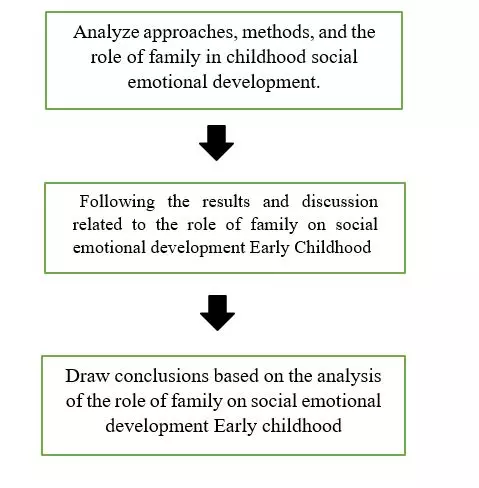
RESULTS AND DISCUSSION
Based on the results of a literature review of 17 scientific articles analyzed, it was found that the role of the family has a very significant influence on early childhood social emotional development. The main influencing factors include parenting, parental involvement in children's activities, home environment, and communication patterns in the family..A. Parenting
According to Sochib, parenting is a parental effort that is actualized towards structuring the physical environment, internal and external social environment, internal and external education, dialogue with their children, psychological atmosphere, behavior displayed during meetings with children, control over children's behavior, determining moral values as the basis for behavior that is pursued to children. There are several types of parenting, namely permissive parenting, authoritative parenting, democratic parenting, oteritarian parenting (Windayani & Putra, 2021) . Authoritative and democratic parenting have been shown to be most effective in supporting positive social emotional development. Authoritative parenting is characterized by a warm approach, open communication, and giving freedom with clear boundaries. Parents with this style encourage children to be independent while still providing balanced guidance and control. Children raised with this parenting style tend to be more confident, independent, able to control their emotions, and have good social skills and achievement motivation. Meanwhile, democratic parenting also pays attention to children's needs. Parents encourage two-way communication, explain rules rationally, and reward good behavior without using physical punishment. Children raised in this way form a positive self-concept and are able to establish healthy social relationships (Dhani et al., 2023). In contrast, authoritarian and permissive parenting tends to have a negative impact. Authoritarian patterns are rigid, demand absolute compliance, and are often accompanied by punishment. Children with authoritarian parenting tend not to be independent, lack confidence, have difficulty socializing, and have unstable emotions (DHIU & FONO, 2022). Permissive patterns give too much freedom without adequate supervision. Children from this pattern often lack discipline, do not have clear boundaries, and have difficulty regulating emotions and responsibilities. Authoritative and democratic parenting are the most effective parenting styles in supporting children's positive social emotional development (Sari et al., 2020) . A warm approach, open communication, and balanced application of rules help children grow into individuals who are independent, confident, able to control emotions, and have good social skills. In contrast, authoritarian and permissive parenting patterns tend to have a negative impact on children's emotional and social development, such as lack of independence, self-confidence, and social skills..B. Parental Involvement
Parents' involvement in children's daily lives greatly influences the formation of social emotional aspects. Hurlock states that parents' positive attitudes have a direct impact on children's behavior. Research by Nokali, Bachman & Drzal in Ummah & Fitri (2020) shows that children of parents who are active in social functions have fewer behavioral problems and are more adaptable in the social environment.The role of parents is not only as caregivers, but also as friends and mentors. Effective communication, emotional presence, and support in children's activities have a major impact on children's personality development, self-confidence, and social skills (Rianti et al., 2023).C. Home Environment
A stable and supportive home environment supports the formation of healthy emotions in children. In families that teach children to express feelings, listen with empathy, and communicate openly, children tend to grow up with good emotional resilience. Conversely, an environment full of conflict can trigger anxiety and obstacles in socializing (Marsari & Neviyarni, 2021).The family environment is also the first place for children to get to know values, norms, and habits. Socialization that occurs in the family provides a strong basis for the formation of children's personality and social skills.D. Communication Patterns
Democratic family communication contributes to a child's healthy emotional development. Children learn that every action has consequences and the importance of personal responsibility. Open interactions between parents and children allow children to know themselves, understand feelings, and form empathy for others. Cultural values socialized through family communication, such as courtesy, patience, and tolerance, strengthen children's emotional intelligence, which is the foundation for social, moral, and spiritual intelligence. Thus, effective communication patterns in the family are very important in supporting early childhood social emotional development (Denisa et al., 2024) . Communication includes the ability to speak, listen and understand others. In early childhood, these skills can be developed through various interactive activities (Ali, 2022) . For example, parents can invite children to talk about their daily experiences, listen attentively and show interest in what they have to say. Reading storybooks can also be an effective way to develop communication skills. After reading, engage the child in a discussion about the story , ask their opinions about the characters and plot, and encourage them to express their thoughts and feelings. In addition, role-playing with children can help them develop speaking and listening skills in a fun and educational context (Tahirah et al., 2024) .CONCLUSIONS AND SUGGESTIONS
Conclusion
The role of the family, especially parents, has a significant influence in shaping and directing the social-emotional development of early childhood. Through proper parenting such as authoritative and democratic styles, children are able to develop an independent attitude, self-confidence, ability to control emotions, and have good social skills. In contrast, authoritarian and permissive parenting tends to have a negative impact on children's emotional development, such as the emergence of anxiety, lack of self-control, and difficulty socializing. In addition, parental involvement in children's daily activities, a supportive home environment, and open and empathic communication are proven to support the growth of children's emotional and social intelligence optimally.Advice
Based on the results of the study, it is recommended that parents are able to apply positive parenting, especially authoritative and democratic parenting, because it is proven to be effective in supporting early childhood social emotional development. Parents are expected to build open and empathic communication with their children, as well as be role models in managing emotions healthily. In addition, it is important for parents to increase active involvement in their children's daily activities, both in the home environment and in the educational process, so that children feel supported and valued. A stable and loving family environment is also an important factor in creating a sense of security and comfort for children to express themselves. Therefore, cooperation between families and early childhood education institutions needs to be strengthened to create synergy in monitoring and stimulating children's social-emotional development in a sustainable manner.LITERATURE
Ali, M. (2022). Innovative Leadership Management in Early Children Education. Jurnal Obsesi : Jurnal Pendidikan Anak Usia Dini, 6(4), 3007–3012. https://doi.org/10.31004/obsesi.v6i4.2198 Denisa, A., Amalia, D. R., Faiqoh, E., & ... (2024). Pola Komunikasi Keluarga Untuk Mengembangkan Sosial Emosional Anak Usia Dini Di Desa Bungah Gersik. Jurnal Bocil: Journal of …, 2(2), 73–79. http://ojs.unublitar.ac.id/index.php/bocil/article/view/1552%0Ahttp://ojs.unublitar.ac.id/ind ex.php/bocil/article/download/1552/1165 Fitriya, A., Indriani, I., & Noor, F. A. (2022). Konsep Perkembangan Sosial Emosional Anak Usia Dini Di RA Tarbiyatussibyan Ploso Karangtengah Demak. Jurnal Raudhah, 10(1). https://doi.org/10.30829/raudhah.v10i1.1408 Fuadia, N. (2022). Perkembangan Sosial Emosi Pada Anak Usia Dini. Wawasan: Jurnal Kediklatan Balai Diklat Keagamaan Jakarta, 3(1), 31–47. https://doi.org/10.53800/wawasan.v3i1.131 Irma, C. N., Nisa, K., & Sururiyah, S. K. (2019). Keterlibatan Orang Tua dalam Pendidikan Anak Usia Dini di TK Masyithoh 1 Purworejo. Jurnal Obsesi : Jurnal Pendidikan Anak Usia Dini, 3(1), 214. https://doi.org/10.31004/obsesi.v3i1.152 Ningrum, N. P. W., Pane, F. M. J., Yani, S. I., & Khadijah. (2022). Pendidikan Anak Usia Dini: Perannya dalam Membangun Karakter dan Tumbuh Kembang Anak Usia Dini. Jurnal Penelitian Pendidikan Dasar, 1(1), 98–102. Nurhasanah, N., Sari, S. L., & Kurniawan, N. A. (2021). Perkembangan Sosial dan Emosional Anak Usia Dini. Mitra Ash-Shibyan: Jurnal Pendidikan Dan Konseling, 4(02), 91–102. https://doi.org/10.46963/mash.v4i02.346 Pujianti, R., Sumardi, S., & Mulyadi, S. (2021). Perkembangan Sosial Emosional Anak Usia 5-6 Tahun Selama Pembelajaran Jarak Jauh Di Raudhatul Athfal. As-Sibyan: Jurnal Pendidikan Anak Usia Dini, 6(2), 117–126. https://doi.org/10.32678/assibyan.v6i2.9843 Sari, P. P., Sumardi, & Mulyadi, S. (2020). Pola Asuh Orang TuaTerhadap Perkembangan Emosional Anak Usia Dini. Jurnal PAUD Agapedia, 4(1), 157–170. Syahrul, S., & Nurhafizah, N. (2021). Analisis Pengaruh Pola Asuh Orang Tua Terhadap Perkembangan Sosial dan Emosional Anak Usia Dini Dimasa Pandemi Corona Virus 19. Jurnal Basicedu, 5(2), 683–696. https://doi.org/10.31004/basicedu.v5i2.792 Tahirah, I., Isnawati, Megawato, Herman, & Rusmayadi. (2024). Pentingnya Peran Orangtua Terhadap Perkembangan Sosial Emosional Anak Usia Dini. Jurnal Usia Dini, 10(1), 19–26. Ulfa, M., & Na’imah. (2020). Peran Keluarga dalam Konsep Psikologi Perkembangan Anak Usia Dini Mutia. Aulad : Journal on Early Childhood, 3(1), 14–19. https://doi.org/10.31004/aulad.v3i1.46 Ummah, S. A., & Fitri, N. A. N. (2020). Pengaruh lingkungan keluarga terhadap perkembangan sosial emosional anak usia dini. Jurnal Program Studi PGRA, 6, 84–88. https://jurnal.stitnualhikmah.ac.id/index.php/seling/article/view/624/504 Windayani, N. L. I., & Putra, komang T. H. (2021). EdukasI: Jurnal Pendidikan Dasar Pola Asuh Otoritatif Untuk Membentuk Karakter Anak. Jurnal Pendidikan Dasar, 2(2), 173–- http://jurnal.stahnmpukuturan.ac.id/index.php/edukasi







Komentar 0
Tulis Komentar Bagikan tanggapan Anda