


JurnalPost.com, Batu — The International Relations Study Program at the Faculty of Social and Political Sciences, Universitas Brawijaya (FISIP UB), in collaboration with the Southeast Asia Neighbourhood Network (SEANNET), held a community service activity themed “Grassroots City Diplomacy: Photovoice as Visual Diplomacy in Advocating for Sustainable Urban Spaces” in Batu City, East Java, on Friday (9/11/2026).
The activity, led by Dian Mutmainah, S.IP., M.A., involved 13 young women aged 16 to 25 from Malang. Participants were invited to use the Photovoice method to record and share their experiences regarding spaces they consider safe or unsafe within the urban areas of Batu City.
The resulting documentation was then developed into individual and group photostories that depict the perspectives of young women on urban spaces.
This activity stems from questions regarding how young women experience life and activities amidst ongoing urban development.
While urban growth presents various opportunities, it simultaneously creates challenges in establishing public spaces that are safe, inclusive, and accessible to all groups, including young women.
Until now, the concept of city diplomacy has often been understood as an activity involving local governments or local elites. In reality, the community also possesses experiences and viewpoints that can be a vital part of building sustainable cities.
Through this activity, young women are positioned as subjects with the right to convey their experiences, views, and aspirations regarding urban spaces.
This approach aligns with the Sustainable Development Goals (SDGs), particularly SDG 11 on inclusive, safe, resilient, and sustainable cities and settlements, as well as SDG 17 on partnerships to achieve development goals.
Photovoice as a Medium for Visual Diplomacy
Photovoice is a participatory method that uses photography as a means to document and communicate various issues deemed important by participants.
By utilizing cameras or mobile phones, participants are not merely objects of research or activities, but play an active role in recording the reality around them based on their own experiences.
In its implementation, participants are guided through three stages of reflection: identifying, interpreting, and imagining.
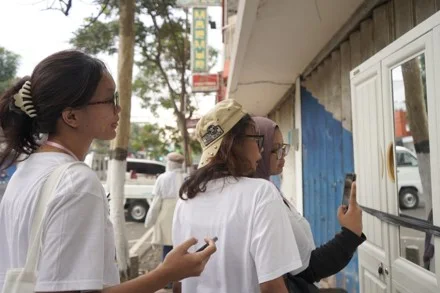
Participants are first invited to identify the urban spaces they traverse in their daily activities. Next, they attempt to understand the factors that make a space feel safe or cause discomfort.
In the following stage, participants are invited to imagine what a more friendly and safe urban space for young women would look like.
The Photovoice training began with an introduction to the concept of photography as a tool for visual diplomacy. Participants were introduced to the power of photos and narratives in building public perception and conveying aspirations to policymakers.
The activity also featured Puspitaningtyas Sulistyowati, affectionately known as Mba Tyas, from the Arkom Indonesia Foundation as a speaker.
ARKOM Indonesia is a Yogyakarta-based organization focused on urban transformation and community empowerment through housing and settlement issues, with a vision to create ecological and inclusive cities.
After receiving the briefing, participants explored several areas in the center of Batu City, ranging from the Batu City Square to the City Hall area.
Throughout the journey, participants observed environmental conditions and identified spaces that caught their attention.
The locations photographed were not only related to spaces considered comfortable and safe, but also places perceived as causing insecurity or vulnerability for young women.
Participants then captured these spaces using their own mobile phones. The selection of photo objects was based on the participants' personal experiences, observations, and feelings toward the urban spaces they traversed.
Photos and Narratives Compiled into Photostories
The series of activities continued with a workshop on compiling photostories guided directly by Dian Mutmainah, S.IP., M.A., as the head of the community service team.
In this session, participants selected several photos they had taken during the field activity. Each photo was then accompanied by a narrative explaining the depicted condition, the reason the space was considered safe or unsafe, and the message they wished to convey to the public and policymakers.
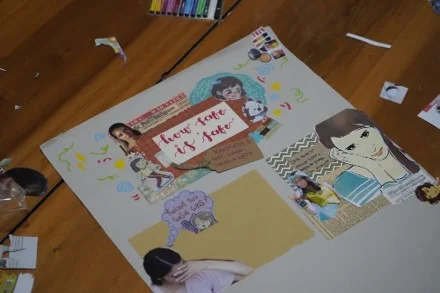
These photos and stories were then arranged into photostories that serve as visual testimonies of young women's experiences interacting with urban spaces.
Through this approach, daily experiences that might previously have been felt only on a personal level can be translated into visual narratives that are more easily understood by the public.
The International Relations Study Program at FISIP Universitas Brawijaya, together with SEANNET, hopes this activity will help young women become more sensitive to the conditions of the spaces around them, recognize various forms of vulnerability, and have the courage to express their views on the need for safe and inclusive urban spaces.
The photostories
produced are also expected to develop into media for communication and advocacy capable of conveying the aspirations of young women to the public and stakeholders. Thus, city diplomacy does not only take place through intergovernmental or formal institutional relations, but can also grow from the experiences of citizens at the grassroots level through their own photos, stories, and voices.
The activity also demonstrates that photography can be more than just documentation. Through Photovoice, visuals can become a means to build awareness, solidarity, and encourage the creation of urban spaces that are safer, more inclusive, and sustainable for women.




Comments 0
Write a Comment Share your response