

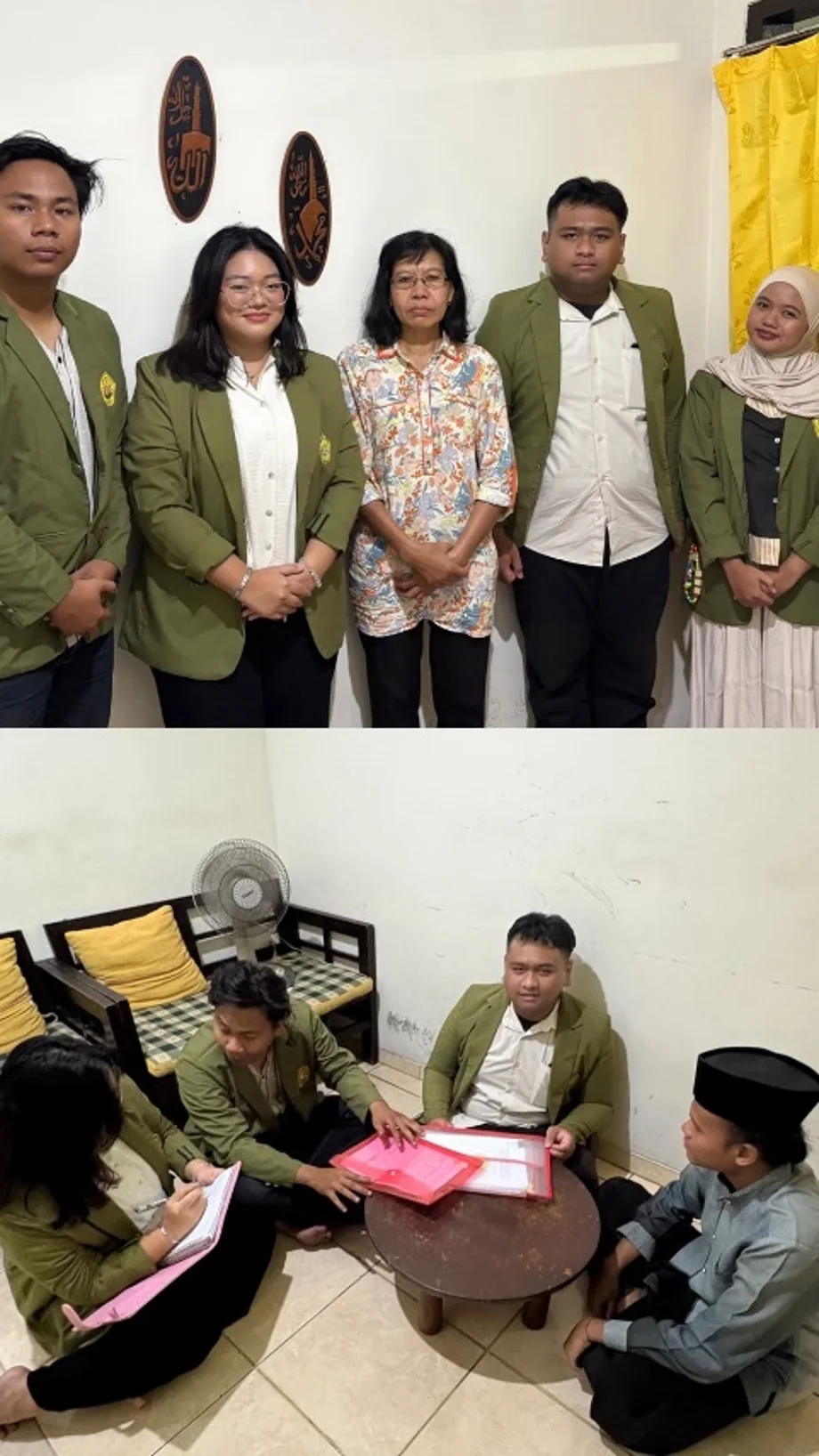
SURABAYA, JurnalPost.com – Access to legal consultation services remains a significant need for many, particularly those facing legal issues but lacking the means to obtain professional assistance. Addressing this need, students from the 3 Sahabat Desa (Village Friends) group at the Faculty of Law, Universitas Pembangunan Nasional (UPN) Veteran East Java, have introduced a mobile Legal Aid Post (Posbakum) in Bendul Merisi Village, Wonocolo District, Surabaya.
The activity, held on Tuesday (3/11/2026), offered a different approach from previous outreach efforts. While past activities were centralized at the village office, this time, students visited residents' homes directly to provide free legal consultations.
Starting around 18.00 WIB, the event provided an opportunity for residents to voice their legal concerns and receive information on potential resolution steps.
Visiting Residents' Homes to Provide Legal Assistance
Through the mobile Posbakum program, students from the 3 Sahabat Desa group aim to bring legal consultation services closer to the community, specifically targeting lower-to-middle-income residents.
This direct visit approach is intended to assist residents who face limitations in time, cost, or access to traditional legal aid services.
During this session, two Bendul Merisi residents, Pujiati and Fahmi, had the opportunity to consult directly with the UPN Veteran East Java law students.
The issues raised concerned digital financial transactions, including suspected misuse of QRIS payments and the risks associated with online loans.
Both issues are of growing concern as digital financial services become increasingly integrated into daily life.
Resident Complains of Rp1.4 million Bill After QRIS Transaction
One of the issues raised during the consultation came from Fahmi, who reported receiving an online loan bill for Rp1,400,000 after using a QRIS code to pay for a meal.
Fahmi expressed confusion, as he claimed never to have applied for a loan through any application or digital financial service.
“I wanted to ask about the QRIS issue that is currently rampant. When I scanned a QRIS code for a food payment, it turned out to be linked to an illegal gambling QRIS, and I received a bill for Rp1,400,000, even though I never took out an online loan,” Fahmi said during the consultation.
This experience serves as an example of the concerns residents have regarding the security of digital transactions.
However, the cause of the bill cannot be confirmed based solely on initial statements. Further investigation into transaction history, the identity of the bill sender, and the services involved is required.
Responding to the complaint, the student representatives advised Fahmi to first seek clarification from the merchant where the transaction took place.
“The first step is to ask the merchant whether the scan originated from them or another party. There is a risk that the merchant's system or device may have been compromised. This can be resolved through civil channels, where the merchant could be held accountable,” the student representative stated.
This guidance was provided as an initial step. Any potential legal liability for specific parties would still require evidence regarding the source of the problem and the involvement of each party.
Fahmi’s experience highlights the importance of caution when using digital payment methods, including verifying the recipient's name and keeping transaction records.
Educating on the Dangers of Online Loans and Personal Data Misuse
In addition to QRIS payment issues, students also consulted with Pujiati regarding the risks of using online loan services, particularly those that are not officially licensed.
During the discussion, Pujiati mentioned the pressure often experienced by the public due to aggressive online loan collection tactics, including threats to expose personal information.
“The threats from online lenders are all online, involving the spread of personal data, making it feel like they are constantly slandering you,” Pujiati said.
This complaint served as an entry point for students to provide understanding on the importance of safeguarding personal data and recognizing the risks of illegal digital loan services.
The public needs to understand that the misuse of personal data can lead to both financial and social harm.
Therefore, residents are urged to be more cautious when providing identity information, accessing suspicious links, or using financial services whose legality is unknown.
Through direct consultation, students strive to help residents understand the problems they face and identify resolution options in accordance with legal provisions.
Mobile Posbakum as a Means of Student Service
The mobile Posbakum activity is part of the Sahabat Desa program by the Faculty of Law at UPN Veteran East Java, which prioritizes community service.
This program provides students with the opportunity to apply the legal knowledge gained during their studies while understanding the issues that arise in real-life community settings.
Beyond providing information on legal regulations, students also strive to build closer communication with residents so they feel comfortable sharing the problems they face.
This approach is expected to increase public awareness regarding rights, obligations, and the importance of seeking legal information before making decisions.
For residents, the availability of free consultation services can be a first step toward identifying legal issues and knowing which institutions or authorities can provide further assistance.
For students, this activity serves as experience in bridging legal theory with real-world conditions in the community.
Through the implementation of the mobile Posbakum, the 3 Sahabat Desa group of the Faculty of Law at UPN Veteran East Java hopes that the residents of Bendul Merisi will better understand the importance of legal literacy, especially in dealing with digital financial transaction issues and personal data protection.
The activity is also expected to encourage the public to be more proactive in seeking help when facing legal problems, ensuring that access to information and legal consultation is not limited only to those with sufficient financial means.





Comments 0
Write a Comment Share your response