


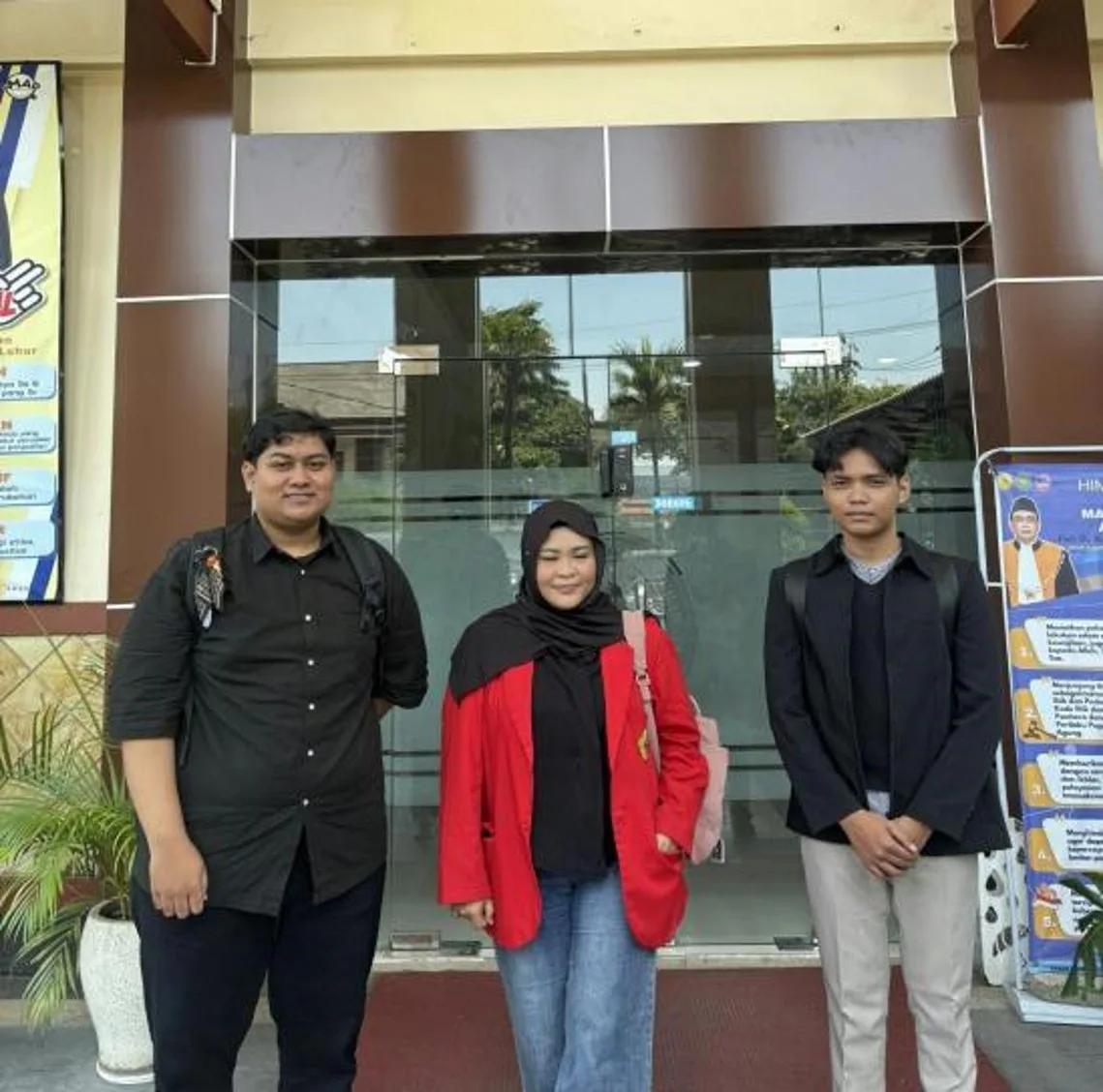
Surabaya, JurnalPost.com — Law students from the University of 17 Agustus 1945 (UNTAG) Surabaya participated in a courtroom observation session at the Surabaya Religious Court on Wednesday (14/10/2026). This activity is part of the Religious Court Litigation Skills Education and Training program, designed to provide practical understanding of procedural law and courtroom mechanics.
Through this activity, students had the opportunity to observe the judicial process firsthand, ranging from the examination of parties and witness testimony to the presentation of evidence and the reading of the verdict by the panel of judges.
Joe Martin Santoso, a student at the UNTAG Surabaya Faculty of Law, observed a contested divorce case. This experience provided him with a clear picture of how the religious court procedural law he studied in class is applied in practice.
This observation also served as an opportunity to understand the roles of judges and litigants, as well as the critical importance of evidence in the case examination process.
Observing the Stages of Religious Court Proceedings
During the observation, students closely followed the various stages occurring within the courtroom.
The process began with court officials calling the parties to enter the courtroom. Once the litigants were present, the panel of judges opened the session and verified the attendance of all parties.
This initial stage is a crucial step in ensuring that the examination process adheres to the applicable procedural law.
Subsequently, the panel of judges conducted an examination by posing a series of questions to the attendees. These questions were intended to gather information and clarify the core issues of the dispute.
During the examination, the judges did not merely listen to the parties' explanations but also delved deeper into the information provided to gain a comprehensive understanding of the case at hand.
One aspect that particularly drew the students' attention was the witness examination.
Before providing testimony, witnesses were required to take an oath in accordance with court procedures. Following this, the panel of judges questioned them regarding their knowledge of the case.
From this stage, students learned that witness testimony plays a vital role as a form of evidence that judges consider when examining and deciding a case.
Understanding the Evidentiary Process in Divorce Cases
In addition to observing witness testimony, students also monitored the process of presenting statements and submitting evidence by the plaintiff.
In the divorce case observed, the plaintiff provided testimony and submitted evidence to support the arguments presented in their petition.
The panel of judges then reviewed the testimony and evidence as part of the evidentiary process.
This observation highlighted that case examination does not rely solely on the statements of one party. Judges must evaluate facts, testimony, and evidence in accordance with the prevailing legal provisions.
For law students, the evidentiary process is a critical aspect to master, as it is directly linked to the application of procedural law in judicial practice.
Through this activity, students were also able to see how judges lead the proceedings, direct the examination, and ensure that every stage is conducted in an orderly manner.
Observing Judicial Deliberation and the Reading of the Verdict
Another focal point of this activity was the decision-making process by the panel of judges.
In deciding a case, judges consider the facts revealed during the trial, including the statements of the parties, witness testimony, and the evidence that has been examined.
This process demonstrates the importance of evidence and legal reasoning in determining the resolution of a case.
Students also had the opportunity to observe the reading of the verdict by the panel of judges once the examination phase was declared complete.
The reading of the verdict is a significant part of the trial as it contains the panel's final assessment of the case.
After the verdict was read, the session was closed. The litigants can subsequently obtain information regarding the case through official court services, including available electronic systems as per regulations.
Through this observation, students gained insight into the relationship between case examination, evidence, legal reasoning, and court rulings.
Field Experience as a Foundation for Legal Proficiency
For Joe Martin Santoso, the courtroom observation at the Surabaya Religious Court provided a learning experience distinct from classroom lectures.
Procedural law material that was previously studied theoretically could be understood more deeply after witnessing its direct application.
This observation also demonstrated that litigation skills require not only an understanding of legislation but also meticulousness in following examination processes, evaluating evidence, and scrutinizing legal reasoning.
Furthermore, students were able to appreciate the importance of professionalism, order, and objectivity in the administration of justice.
The Religious Court Litigation Skills Education and Training program is expected to strengthen the readiness of UNTAG Surabaya law students for legal practice, particularly within the religious court environment.
This experience serves as a foundation for students to develop case analysis skills, understand trial procedures, and prepare themselves for the legal profession after completing their education.






Comments 0
Write a Comment Share your response