

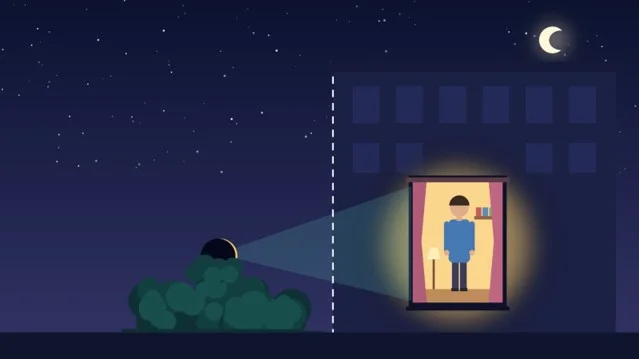
JurnalPost.com - Have you ever heard of cases where someone secretly peeps at or records others without consent, even in places that should be private?
Such actions are sometimes dismissed as mere mischief. Others immediately label them as "peeping tom" behavior or a psychological disorder. However, the issue is not as simple as it seems.
Behind the act of peeping and recording without consent lie critical issues regarding privacy, personal boundaries, and individual safety. Furthermore, technological advancements have made the misuse of cameras and the distribution of private recordings increasingly easy.
But can everyone who has ever peeped be considered to have a psychological disorder?
This question is why it is essential to understand Voyeuristic Disorder more accurately, without disregarding the rights of victims and without rushing to stigmatize individuals.
Between Peeping Behavior and Psychological Disorders
In daily life, peeping behavior often draws various judgments. Some people consider it a bad habit, while others immediately link it to mental illness.
To understand how the public perceives this issue, we, students from the Psychology Study Program at the University of Jambi, conducted an educational initiative that began with gathering public perspectives.
On 27 October 2026, we held a poll and question box via Instagram. The activity continued with interviews on 10 November 2026 with five people: four at the Jambi Town Square mall and one at a cafe in Jambi.
The results showed that the term voyeuristic is still not widely known by some respondents.
Out of 69 poll participants, 49 percent claimed to have heard the term, while the other 51 percent had never heard of it.
When asked to explain their understanding, 10 out of 18 respondents admitted they did not know the meaning. Meanwhile, eight other respondents were able to associate the term with the act of secretly peeping at someone's privacy.
The interview results showed a similar picture. Four out of five interviewees had never heard the term Voyeuristic Disorder.
Interestingly, in the question box which was participated in by 28 respondents, 26 people considered the act of peeping at someone who is dressing as a psychological disorder, while two others answered that it was not necessarily so.
These findings reveal a discrepancy in understanding regarding peeping behavior and the clinical conditions associated with it.
However, the results of this activity are exploratory and cannot be considered representative of the entire public's views.
What Is Voyeuristic Disorder?
Voyeuristic Disorder is a paraphilic disorder characterized by intense and recurrent sexual urges to observe an unsuspecting person, particularly when that person is undressed, changing clothes, or engaging in sexual activity.
These urges can manifest as fantasies, intense desires, or behaviors.
According to the Diagnostic and Statistical Manual of Mental Disorders, Fifth Edition, Text Revision (DSM-5-TR) published by the American Psychiatric Association on 2022, there are several criteria that must be met to establish a diagnosis of voyeuristic disorder.
First, the recurrent and intense sexual urges or arousal must have lasted for at least six months.
Second, the individual has acted on these urges toward a non-consenting person, or the urges and fantasies cause significant psychological distress or impairment in daily functioning.
Third, the diagnosis is only made for individuals aged at least 18 years old.
These criteria show that not all acts of peeping are automatically categorized as Voyeuristic Disorder.
Peeping behavior, privacy violations, and mental health diagnoses are distinct matters. Likewise, not all acts of recording without consent have sexual motives that align with the clinical profile of voyeuristic disorder.
Nevertheless, actions that violate the privacy of others remain unjustifiable, regardless of whether a psychological diagnosis exists.
What Does Research Say About Voyeuristic Behavior?
Research by Lister, Gannon, and Olver (2026) on 492 men in the UK found that 32.3 percent of respondents in the study sample reported having engaged in voyeuristic behavior.
This figure indicates the presence of voyeuristic behavior in some respondents, but it does not mean that all individuals who reported it meet the diagnostic criteria for Voyeuristic Disorder.
These findings also cannot be directly used to describe the prevalence of voyeuristic disorder in the general population.
This distinction is important to understand so that the public does not easily conclude someone's mental health condition based on a single behavior.
Diagnosing a psychological disorder requires a comprehensive examination by professionals competent in the field of mental health.
Why Does Voyeuristic Disorder Occur?
To date, no single cause has been found to explain the emergence of voyeuristic disorder.
Several studies discuss the potential link between various biological, psychological, and environmental factors.
From a psychological perspective, difficulties in impulse control, emotional regulation, and the use of unhealthy coping strategies are among the factors being studied.
Meanwhile, from an environmental perspective, difficult childhood experiences, interpersonal relationship issues, life stressors, and substance abuse are also discussed in various studies.
In the interviews we conducted, some interviewees also linked peeping behavior to the influence of media and the availability of opportunities.
However, these views cannot be used as evidence that media or opportunity directly cause voyeuristic disorder.
Research on the causes of this condition still has limitations. Some findings are derived from groups of sexual offenders, so the results cannot always be applied to all individuals experiencing voyeuristic urges.
Therefore, understanding risk factors must be done carefully and should not be used to label individuals.
The Impact Should Not Be Underestimated
Privacy violations are often considered less harmful because they do not always involve physical contact.
In reality, the psychological impact experienced by a person can last for a long time.
Imagine when a place previously considered safe, such as a bedroom, bathroom, or changing room, becomes a location where someone is observed or recorded without consent.
Such an experience can cause fear, shame, anxiety, hypervigilance, and even a loss of trust in the surrounding environment.
In our interviews, several participants also highlighted the loss of a sense of safety as one of the impacts victims might experience.
Every person may have a different response to the experience of a privacy violation. Therefore, the victim's experience needs to be heard and treated seriously.
On the other hand, individuals who experience recurrent voyeuristic urges may also face psychological distress.
Some individuals may feel shame, struggle to control their urges, experience problems in interpersonal relationships, or worry about the consequences of their actions.
It is important to understand that having an urge is not the same as acting on it.
However, if those urges lead to behavior that potentially harms others, professional help becomes a crucial step to prevent violations from occurring.
Can Voyeuristic Disorder Be Treated?
Voyeuristic disorder can be treated through mental health approaches, although scientific evidence regarding the effectiveness of various treatment methods remains limited.
One approach used is psychotherapy, including cognitive-behavioral therapy or Cognitive Behavioral Therapy (CBT).
This approach can help individuals understand their thought patterns and behaviors, develop skills to control urges, and build strategies to avoid actions that harm others.
In certain conditions, psychiatrists may also consider prescribing medication, such as antidepressants from the Selective Serotonin Reuptake Inhibitors (SSRI) class.
For severe cases, other medical treatments may be considered based on clinical examination, patient consent, and strict monitoring.
All medical actions must be under the supervision of professionals and should not be attempted through self-medication.
The goal of treatment is not merely to reduce the urges that disturb the individual, but also to help prevent actions that could violate the rights and safety of others.
Understanding Without Justifying Privacy Violations
Building an understanding of Voyeuristic Disorder does not mean justifying the act of peeping or recording others without consent.
On the contrary, education is necessary so that the public can distinguish between behavior that crosses boundaries and psychological conditions that require professional examination.
Two things must go hand in hand.
First, everyone's right to privacy, safety, and consent must be respected.
Second, individuals who struggle to control their urges and wish to seek help need to have the opportunity to access psychological support without being shamed.
Excessive stigma can make someone reluctant to seek help, while dismissing privacy violations can ignore the victim's experience.
Therefore, the public needs to adopt a firm stance against harmful actions while remaining open to the importance of mental health treatment.
Have We Created Space?
Through the polling, question box, and interviews we conducted, it is evident that understanding of Voyeuristic Disorder is still varied.
Some respondents were unfamiliar with the term, while others tended to immediately link peeping behavior to a psychological disorder.
This condition highlights the importance of education that is more open, accurate, and non-judgmental.
For the public, understanding voyeuristic disorder can serve as a reminder to always respect privacy, avoid making casual diagnoses, and realize that professional help is available for those who need it.
For individuals who feel they are experiencing recurrent urges to peep and are struggling to control them, consulting a psychologist or psychiatrist is a responsible step.
Meanwhile, for those who have experienced a privacy violation, it is important to know that such experiences deserve attention, protection, and support.
Ultimately, creating space does not mean allowing someone to violate the boundaries of others.
Creating space means building an environment capable of listening, understanding, providing help, and maintaining the safety of every individual.
Because a society that cares about mental health should also be a society that values the privacy and rights of others.
So, have we created space?
Note: This article is prepared for psychological education purposes and cannot be used as a tool for self-diagnosis. Examination and diagnosis require the assessment of a competent professional.


Comments 0
Write a Comment Share your response