

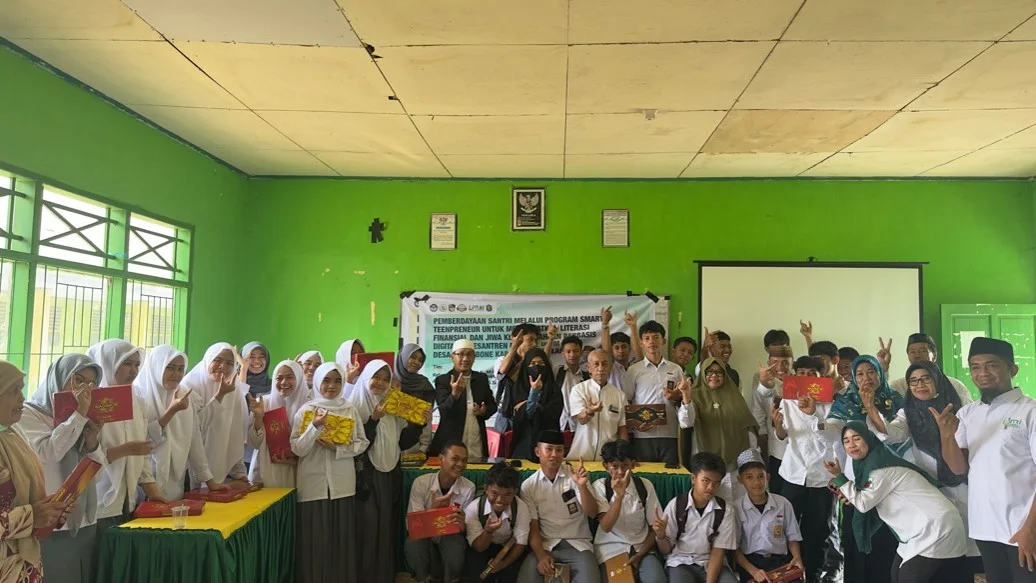
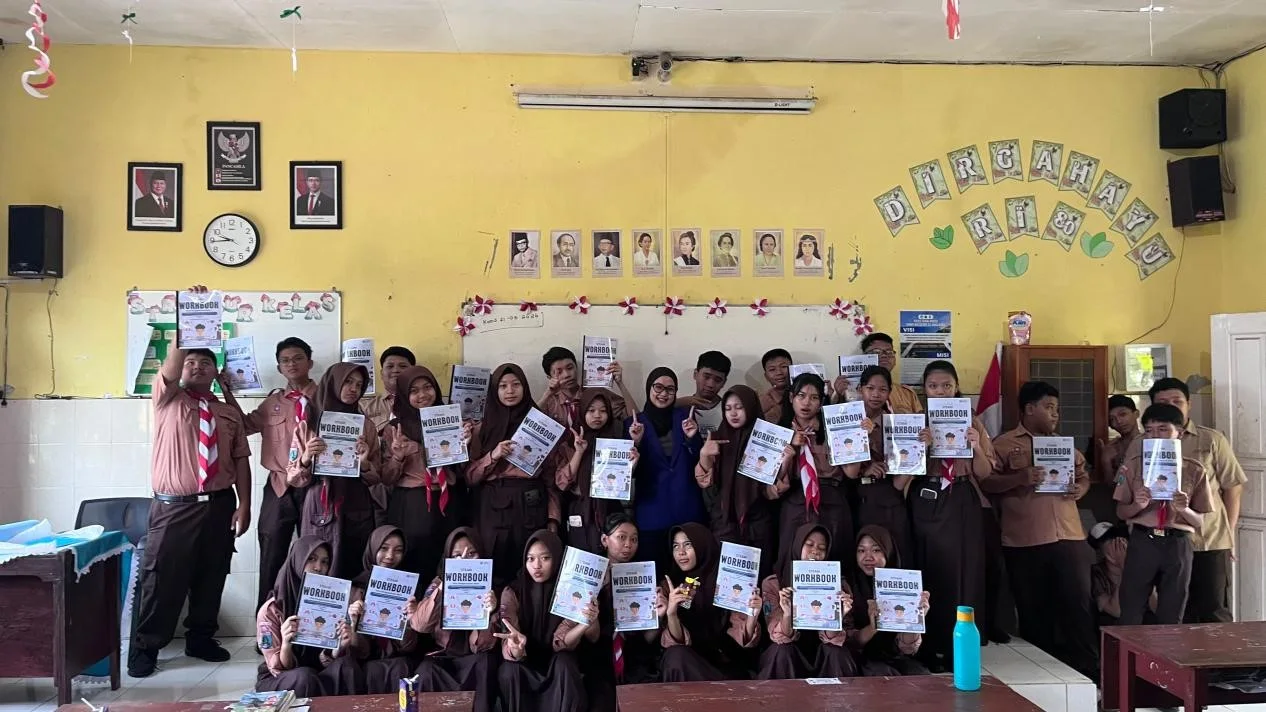
Takalar, JurnalPost.com — A total of 30 Quranic students (santri tahfidz) from Mizanul Ulum Islamic Boarding School participated in a financial literacy and digital entrepreneurship training session organized by a team of lecturers from Universitas Muslim Indonesia (UMI) in Sanrobone Village, Sanrobone District, Takalar Regency, South Sulawesi, on Tuesday (10/13/2026).
The training was part of a Community Service Program (PKM) titled “Empowering Students through the Smart Teenpreneur Program to Improve Financial Literacy and Digital-Based Entrepreneurial Spirit at Mizanul Ulum Islamic Boarding School, Sanrobone Village, Takalar Regency.”
Through this activity, the students were encouraged not only to strengthen their religious education but also to acquire skills in managing personal finances and identifying business opportunities that can be developed using digital technology.
The Smart Teenpreneur program involved three lecturers from different faculties at UMI: Dr. Amir, S.E., M.Ag. from the Faculty of Economics as the team leader, Dr. H. Andi Sumardin, S.Ag., M.A. from the Faculty of Islamic Studies, and Fitriyani Umar, S.Si., M.Eng. from the Faculty of Computer Science.
This cross-disciplinary collaboration provided material on financial management, principles of muamalah (Islamic economic transactions) and business ethics, as well as the use of digital media to introduce and market business products.
Quranic Students Encouraged to Be Economically Independent
The Head of Mizanul Ulum Islamic Boarding School, Baso Udin, S.Ag., welcomed the implementation of the activity. According to him, equipping students with economic skills is a necessity for them to be prepared for life after completing their education at the boarding school.
He believes that the ability to manage finances and engage in entrepreneurship can be developed without compromising the Quranic education that remains the school's top priority.
“We are very grateful and thankful for the presence of the UMI lecturers. Our children have been focused on memorizing the Quran, and that remains the main priority. However, they also need to be equipped with the ability to manage money and run a business so that they can eventually be independent and beneficial to the community. Activities like this open the students' horizons, showing that a hafidz (Quran memorizer) can also be an honest and successful entrepreneur,” he said.
Baso Udin hopes that similar training can be carried out sustainably so that the students have the opportunity to further develop the skills they have acquired.
In addition to building economic independence, the activity is expected to foster the students' self-confidence in identifying business potential in their surrounding environment.
Learning to Manage Pocket Money and Market Products
The Head of the Community Service Team, Dr. Amir, S.E., M.Ag., explained that the Smart Teenpreneur program was designed to introduce financial management and entrepreneurship to students from a young age.
According to him, the ability to manage finances does not have to start only when someone has an income. Such habits can be built through simple things, such as managing pocket money, setting aside savings, and determining spending priorities.
“We want students to understand how to manage their pocket money, distinguish between needs and wants, and start daring to look for business opportunities. In this digital era, opportunities are very wide open. With a smartphone in hand, students can already market products anywhere. Most importantly, all of this is carried out based on sharia values, namely being honest, trustworthy, and not harming others,” he said.
During the training, participants were invited to practice creating simple financial records to understand income, expenses, and the importance of saving.
The students were also introduced to ways to identify business ideas that suit the conditions and needs of the boarding school environment.
In addition, the lecturer team provided an introduction to the use of social media and digital platforms as a means of marketing products. The material aimed to broaden the participants' perspectives on business opportunities that can be started on a small scale.
The discussion on entrepreneurship was also linked to Islamic values, especially honesty, trustworthiness, responsibility, and the principle of not harming other parties in transactions.
The discussion session was interactive. The students asked questions and presented various business ideas that could potentially be developed with their peers.
Students Interested in Trying Small Businesses
One of the participants, Muhammad Fadil, admitted to gaining new experiences after attending the training.
The Mizanul Ulum student said that the material on pocket money management and digital marketing made him interested in trying simple business activities.
“Alhamdulillah, I now know how to manage my pocket money so it doesn't run out quickly and I can save. I also just found out that you can sell things via a mobile phone. God willing, I want to try starting a small business with my friends at the boarding school, while still maintaining my memorization,” he said.
The experience gained by the participants shows that entrepreneurship learning can be introduced through activities that are close to the students' daily lives.
Basic knowledge of finance and digital marketing is expected to be a foundation for participants to start planning business activities in a more directed manner.
Strengthening Religious Education and Entrepreneurial Skills
The implementation of the Smart Teenpreneur program is part of the community service conducted by Universitas Muslim Indonesia lecturers through the application of knowledge and skills within the Islamic boarding school environment.
This activity also demonstrates an effort to connect religious education with practical skills needed by the younger generation, especially in facing the development of the digital economy.
The service team expressed their appreciation to the UMI Waqf Foundation for the support and facilities provided during the implementation of the activity. Gratitude was also extended to the leadership, teachers, and students of Mizanul Ulum Islamic Boarding School who participated.
Through this program, students are expected to develop habits of managing finances responsibly, identifying business opportunities, and using digital technology productively.
This training is an initial step toward fostering a generation of santripreneur, namely students who have a strong foundation in religious education, understand financial literacy, and are capable of developing entrepreneurial potential without abandoning Islamic values.






Comments 0
Write a Comment Share your response