

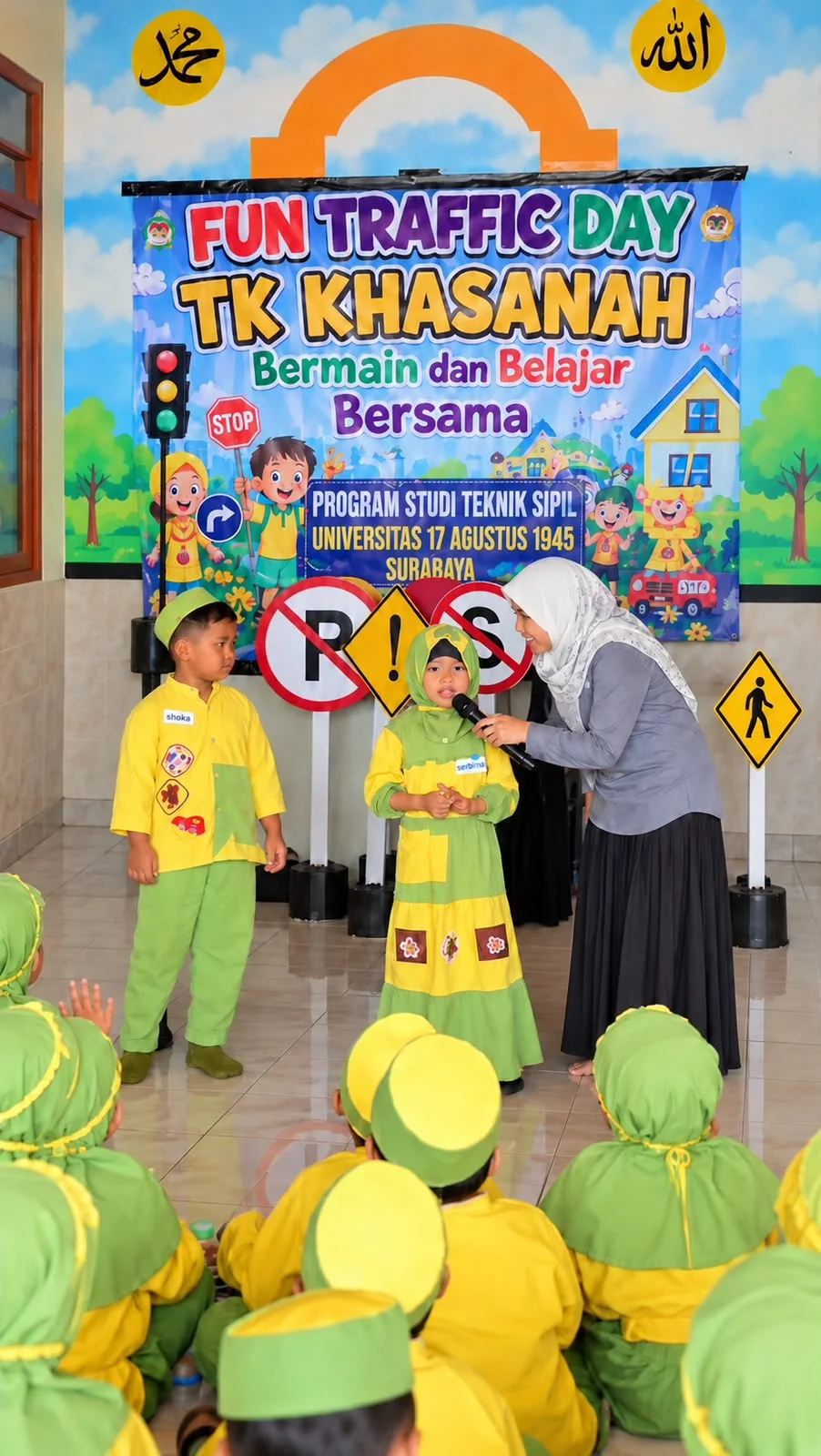
Surabaya, JurnalPost.com — The atmosphere at TK Khasanah in Jambangan, Surabaya, was suddenly lively on Friday (16/10/2026). Dozens of children ran around with their arms outstretched like airplane wings, mimicking the “vroom… vroom!” of cars, then collectively stopped when a toy traffic light turned red. They were participating in Fun Traffic Day, a community service activity organized by a team of lecturers from the Civil Engineering Study Program at Universitas 17 Agustus 1945 (UNTAG) Surabaya.
The activity, themed “Getting to Know Types of Vehicles,” was led by project head Cahyo Aji Roliono, S.Tr.T., M.T., alongside Dr. Ir. Faradlillah Saves, S.T., M.T., Dr. Andi Patriadi, S.T., M.T., and Dr. Ir. Ony Frengky Rumihin, M.M., M.T., IPU.
Why learn about vehicles?
Vehicles are the objects children see most often every day, from the motorcycles that take them to school and buses on the highway to airplanes passing through the sky. According to the team, learning about vehicles is the simplest entry point for instilling safe behavior on the road.
“Children need to know the vehicles first before they can understand the rules. Once they know this is a motorcycle, it is easy to teach them that they must wear a helmet when riding one. If they know it is an ambulance, they understand that an ambulance must be given the right of way,” said Cahyo Aji Roliono, the project team leader.
This effort is also in line with Law Number 22 of 2009 concerning Traffic and Road Transportation, which identifies traffic education from an early age as a way to build a culture of safety.
Five stations, five ways to learn
The students were divided into five small groups that took turns visiting five game stations.
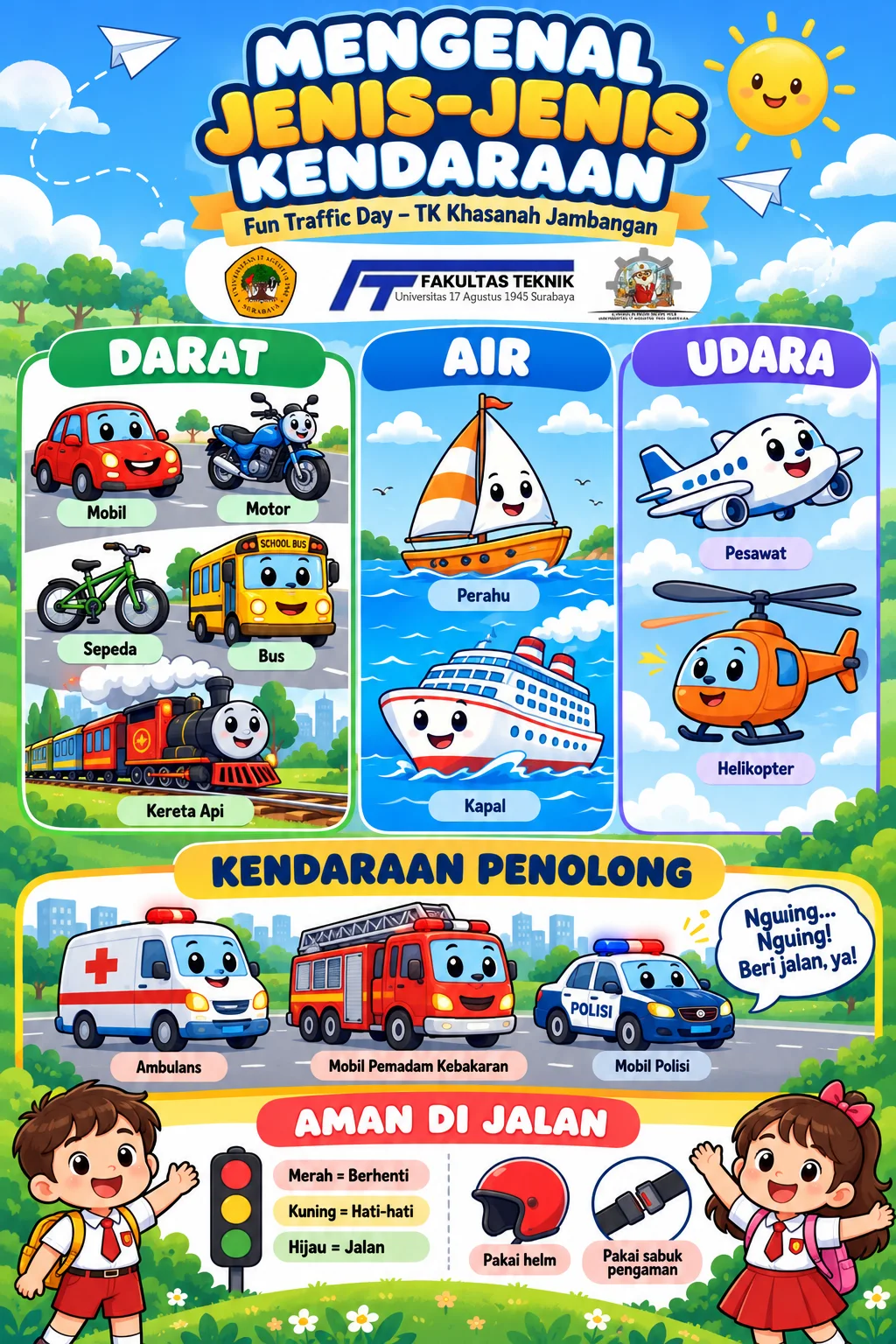
- Station 1, “Hello, Vehicle!”: children listened to an illustrated presentation about land, air, and sea vehicles while mimicking their sounds and movements.
- Station 2, “Land, Air, Sea”: children attached vehicle picture cards to a board according to their environment. Cars, buses, and trains were placed in the land group, ships and boats in the water group, while airplanes and helicopters went into the air group.
- Station 3, “Guess the Sound and Emergency Vehicles”: children guessed vehicles by their sounds and were introduced to ambulances, fire trucks, and police cars. The message was simple: “Nee-naw, nee-naw! Give way, okay!”
- Station 4, “Mini Highway”: children practiced on a mock road track, stopping at red lights, wearing helmets and seatbelts, and pulling over when an “ambulance” passed by.
- Station 5, “My Vehicle Creation”: children colored pictures of their favorite vehicles and received a “Traffic Buddy” sticker.
Between games, the children were also encouraged to memorize a short, easy-to-remember message: red means stop, yellow means be careful, green means go.
Children's understanding increases
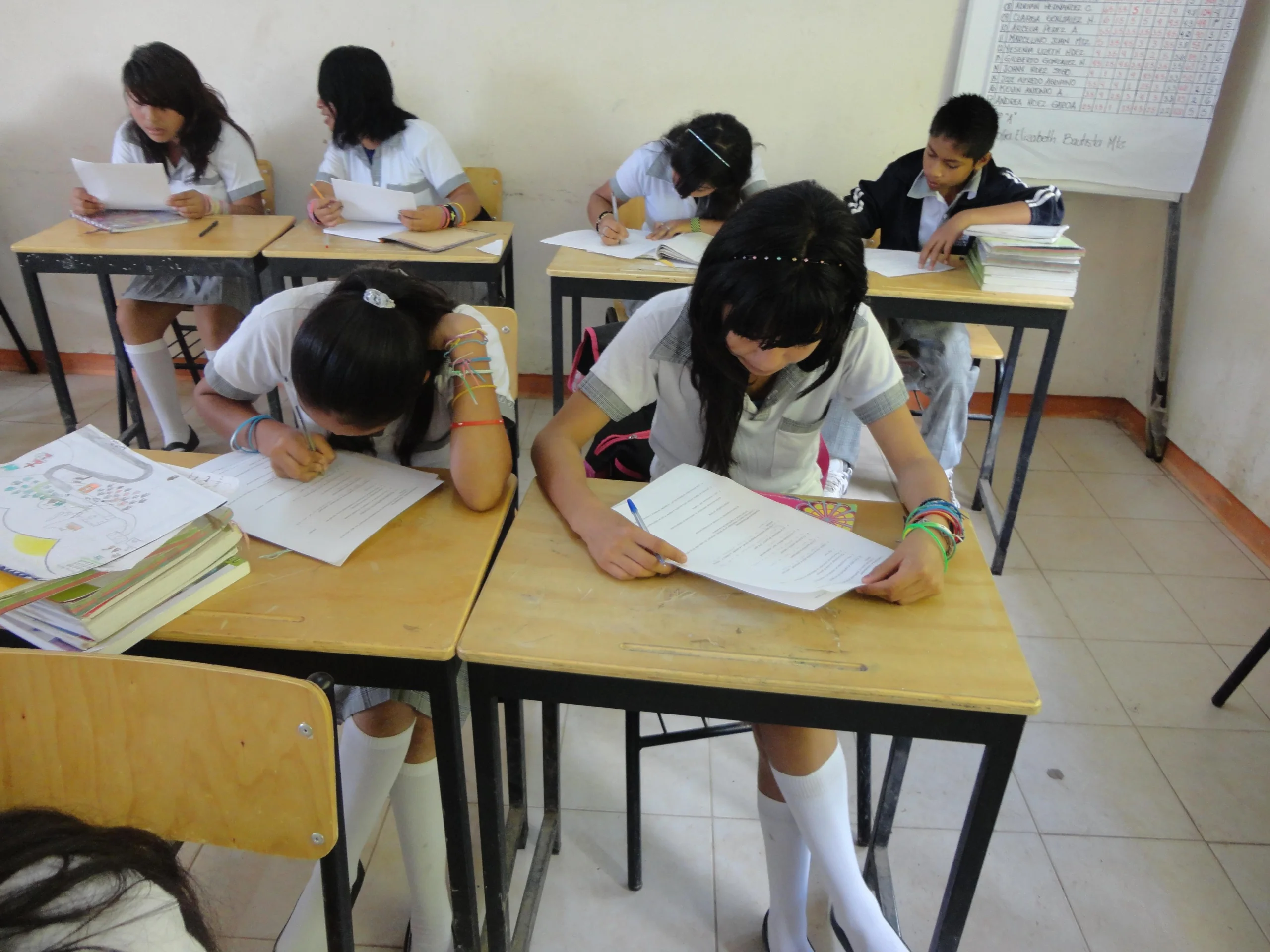
To measure the impact, the team administered a simple picture quiz before and after the activity. Facilitators read questions, such as “Which vehicle flies in the sky?” or “The red light is on, what should we do?”, and the children pointed to the corresponding picture.
The results were quite encouraging. The average number of correct answers rose from 75 percent before the activity to 93 percent afterward. In terms of learning improvement, this achievement is considered high.
Media left for the school
The activity did not end that day. For the Civil Engineering Study Program, this event holds special significance. Civil engineers design roads, sidewalks, and crossings, but even the best facilities are only useful if users behave safely. “We want a culture of traffic order to grow from the earliest age. These children can also serve as reminders for their parents at home,” added Cahyo.
Moving forward, the team plans to continue similar activities with themes focused on pedestrian behavior and safe ways for young children to cross the street.
(Author: Cahyo Aji Roliono – Civil Engineering Study Program, Universitas 17 Agustus 1945 Surabaya)




Comments 0
Write a Comment Share your response