

JurnalPost.com Observing the dynamics of Indonesian politics today often evokes a sense of unease. On one hand, our democratic atmosphere appears vibrant with the clamor of discourse in the public sphere, both digital and physical. Various social media platforms are filled with citizens' debates regarding policies, laws, and the direction of national development.
However, on the other hand, there is a widening psychological rift between policymakers and the society they lead. As a student delving into the intricacies of message exchange, media, and persuasion, I see that one of our nation's greatest problems today is not merely a difference in ideological views, but a communication crisis that is becoming increasingly entrenched within the power structure.
Ironically, amidst demands for society—particularly the youth and academics—to convey criticism politely, civilly, and based on intellectual reasoning, some political elites and public officials are displaying communication standards that are far from exemplary.
This phenomenon demands that we reflect on the direction of our nation. When spaces for public dialogue are marred by defensive attitudes, elitist rhetoric, and the disregard of public aspirations, public trustpublic trustin state institutions risks suffering an erosion that is dangerous.
For students, this situation is not just material for classroom discussion, but a moral calling to respond to various national issues critically and constructively.
The Paradox of Ethics and Communication Asymmetry
In a healthy democratic tradition, criticism and input are the oxygen that prevents power from becoming arbitrary. However, in the context of recent Indonesia, the process of conveying public aspirations is often trapped in a one-way moral debate.
Society and students are expected to always maintain politeness, use refined word choices, and adhere to academic principles when offering corrections to government policies.
These demands are not inherently wrong. The academic world does teach the importance of objectivity, respect for differing opinions, and mature argumentation ethics.
However, a fundamental problem arises when these standards of politeness are applied unevenly. The people are expected to be obedient and polite, while some power holders display communication that lacks empathy, is defensive, or even appears to belittle the public's critical reasoning.
From the perspective of communication studies, ideal political communication should be transactional and dialogical, not merely a hegemonic monologue of power.
When a public official responds to substantive criticism with diversionary narratives or an arrogant attitude, the communication process risks losing its primary function as a means for exchanging ideas and seeking collective solutions.
This inequality in communication standards can create a chasm between state and society . The people feel their voices are ignored, while the elites risk becoming trapped in the echo chamberecho chamberof their own power.
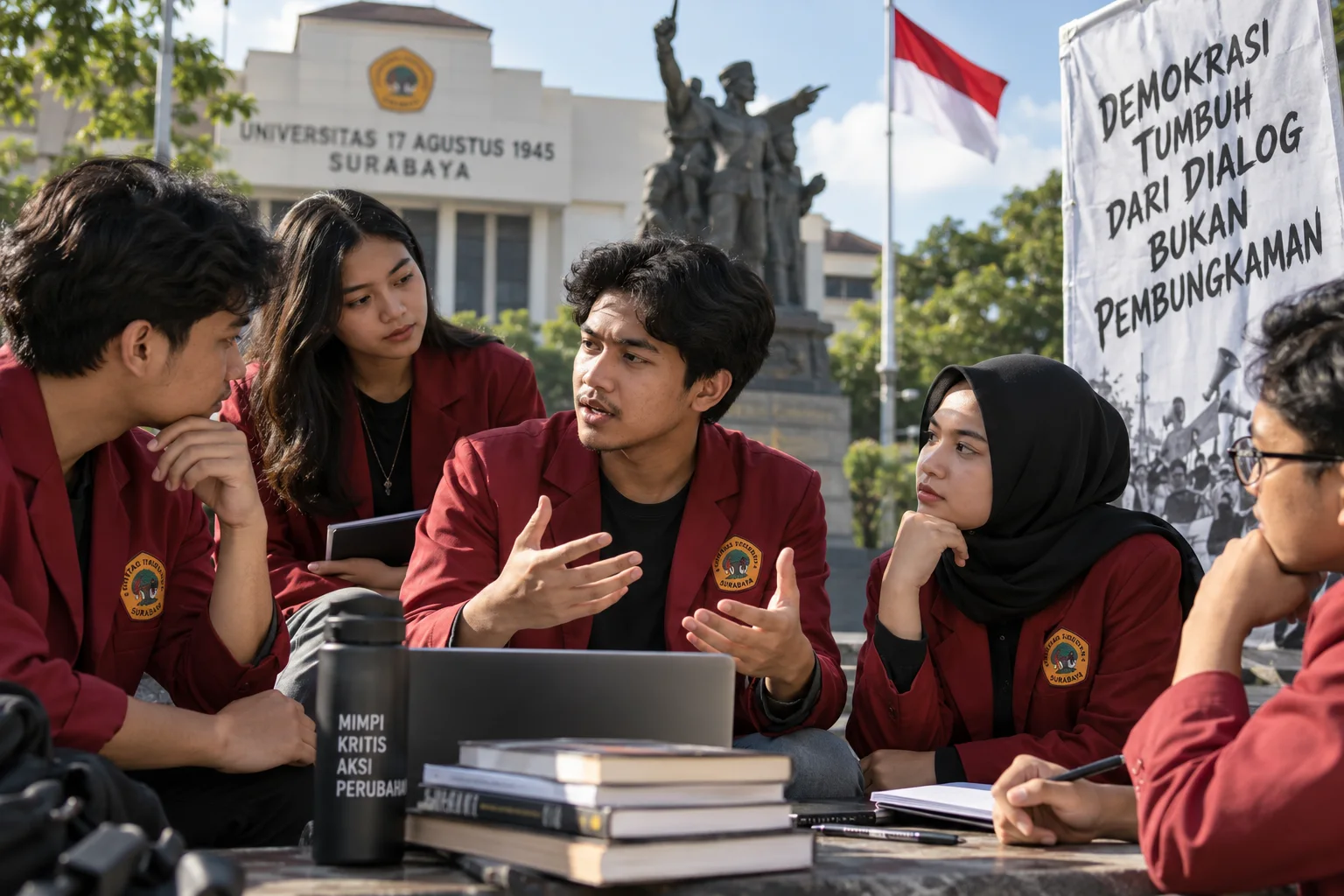
In this context, Communication Science students, including those at Untag Surabaya, have the space to play a role in encouraging national political communication that is once again grounded in the principles of openness, equality, and mutual respect.
Reflections on Local and National Public Spaces
If drawn into a context closer to daily life, East Java and Surabaya have long been known as one of the most dynamic centers of social and political movement.
Throughout its history, the City of Heroes has produced many thinkers and national fighters who upheld human values, the courage to express opinions, and a spirit of struggle rooted in the interests of the people.
This historical legacy should be the moral foundation for building public communication that is humanistic and civilized.
However, in the current practice of democratic life, the communication relationship between the government—at both regional and central levels—and civil society elements still faces various challenges. One of these is the limited space for truly meaningful participationmeaningful participation.
When strategic policies are rolled out without adequate public involvement, the potential for social tension becomes even greater.
In the digital space, such tension can develop into sharp polarization between groups supporting the government and those expressing criticism.
Instead of being resolved through persuasive communication and open dialogue, differences in views are sometimes exacerbated by narratives that do not address the substance of the issue.
This condition shows that the idea of deliberative democracy, namely a democracy that places rational conversation, the exchange of arguments, and public participation as the foundation for decision-making, still faces major challenges in Indonesia's political communication governance.
Democracy is not enough if it only provides space for the public to speak. More than that, democracy must ensure that public aspirations are truly heard, considered, and have the opportunity to influence the policy-making process.
When a Communication Crisis Leads to Loss of Trust
The crisis of trust in state institutions does not arise in a vacuum.
From the perspective of modern communication management, a crisis can escalate not only because of the substance of the policy in question, but also due to the communicator's failure to manage information, build understanding, and respond to the situation empathetically.
When a public policy reaps a wave of rejection, the initial response of state institutions becomes one of the important factors determining whether tension will subside or escalate further.
Unfortunately, in a number of public debates, the responses that emerge do not always prioritize transparency and accountability.
Some public officials sometimes choose a defensive approach, use issue-diversion narratives, or label groups of people who express criticism negatively.
In fact, the legitimacy of a democratic state depends heavily on the extent to which the people feel heard, valued, and involved in the political process.
When political communication is perceived as an instrument to limit criticism, rather than a means to build dialogue, the relationship between the state and society risks becoming increasingly fragile.
Declining public trust can also impact the social and political resilience of a nation.
A state that loses its moral legitimacy in the eyes of some of its citizens risks facing increased apathy toward the democratic process as well as an accumulation of social disappointment.
Therefore, policymakers need to understand that every statement, decision, and political gesture has communication consequences that can influence public perception of state institutions.
Public communication is not just the ability to convey information, but also the willingness to listen, acknowledge shortcomings, and account for decisions openly.
Re-weaving Public Reason: The Strategic Role of the Younger Generation
Facing a political reality colored by various communication problems, the student movement should not be trapped in apathy or undirected emotional reactions.
Armed with theoretical understanding regarding media, mass communication, persuasion, and communication ethics, Communication Science students have the opportunity to take a constructive role as a bridge for dialogue within society.
The expression of aspirations and criticism must continue to be carried out, but with measured strategies, strong arguments, and intellectual responsibility.
Actions in the public sphere and discussions through social media need to be supported by valid data, in-depth analysis, and narratives capable of providing understanding to the public.
Such steps are important to show that the political participation of the younger generation is based on an understanding of national issues, not just following trends or momentary dynamics.
In addition, strengthening media literacy and critical political education needs to be a shared concern.
Amidst the swift flow of digital information, the public must have the ability to distinguish between facts, opinions, propaganda, and disinformation.
Without that ability, the public sphere will be increasingly vulnerable to information manipulation and polarization that can be exploited for the interests of certain groups.
Higher education institutions also have a moral responsibility to maintain the tradition of critical thinking and academic freedom.
Campuses should be spaces that allow students to test ideas, question policies, and develop solutions through scientific approaches and civilized dialogue.
Thus, students do not only act as observers of political dynamics, but also as part of civil society that helps maintain the quality of democracy.
Toward a Future of Civilized Democracy
Caring for the nation amidst the complexity of the digital era and the ever-evolving political dynamics is not an easy matter.
Such efforts require a collective commitment from all elements of the nation, both the government as the holder of policy authority and the public as the party overseeing the exercise of power.
The state should not walk alone by ignoring the aspirations of the people. Conversely, the public also needs to continue to nurture a culture of criticism that is rational, responsible, and based on the values of Pancasila.
Politeness in communication does not mean eliminating firmness in conveying criticism. Likewise, the authority held by public officials should not be an excuse to ignore communication ethics and respect for the public.
Through this critical note, I want to emphasize that the future of Indonesia's democracy is highly determined by the quality of public communication built today.
A strong democracy requires not only good legal and institutional rules, but also a communication culture that upholds honesty, empathy, openness, and equality.
If the public sphere can become a place where various views meet in a healthy and dignified manner, public trust in state institutions has the opportunity to be continuously strengthened.
Ultimately, the ideal of realizing a just, democratic, and civilized Indonesia must not stop as a normative expression. That ideal must be reflected in the way the government listens to the people and the way the public exercises its democratic rights and responsibilities.







Comments 0
Write a Comment Share your response