


Authors:
Nadia Fatimah Azzahrah (Lecturer, Wood Engineering Study Program – Politani Samarinda)
Teguh Rizali Zahroni (Lecturer, Wood Engineering Study Program – Politani Samarinda)
Zahrotul Isti’anah Marroh (Lecturer, Wood Engineering Study Program – Politani Samarinda)
Syafi’i (Lecturer, Wood Engineering Study Program – Politani Samarinda)
Abdul Rasyid Zarta (Lecturer, Wood Engineering Study Program – Politani Samarinda)
Eva Nurmarini (Lecturer, Wood Engineering Study Program – Politani Samarinda)
Ita Merni Patulak (Lecturer, Wood Engineering Study Program – Politani Samarinda)
Muh. Akshar (Lecturer, Wood Engineering Study Program – Politani Samarinda)
Muhammad Tahrir (Lecturer, Wood Engineering Study Program – Politani Samarinda)
Ridwan (Lecturer, Wood Engineering Study Program – Politani Samarinda)
Penajam Paser Utara, JurnalPost.com – The Wood Engineering Study Program at the State Polytechnic of Agriculture in Samarinda (Politani Samarinda) has conducted a community service program in Suko Mulyo Village, Sepaku District, North Penajam Paser Regency, East Kalimantan.
The activity was themed “Utilization of Organic Timber Waste into Charcoal Briquettes as Renewable Energy in the Nusantara Capital City (IKN) Buffer Zone”.
Suko Mulyo Village possesses significant biomass waste potential derived from agricultural activities, plantations, plant pruning, and timber processing. Waste such as twigs, wood scraps, and sawdust has not yet been fully utilized.
Some of this waste is still piled up or burned in the open. However, these materials can be processed into alternative fuel in the form of charcoal briquettes, which offer both utility and the potential to provide added economic value for the community.
Through socialization and hands-on practice, the Wood Engineering Study Program team introduced a process for converting timber waste into charcoal briquettes using simple technology that is feasible for community-level implementation.
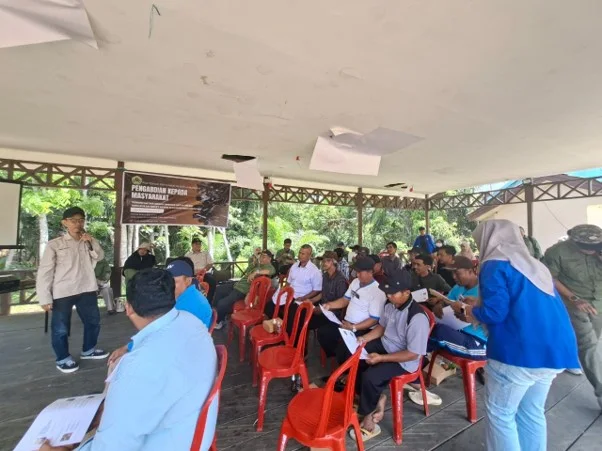
The activity involved lecturers, support staff, students, Suko Mulyo village officials, and local residents. Several representatives from the Nusantara Capital City Authority (OIKN) also attended the event.
The program began by identifying available raw material potential and community needs. The team then provided explanations regarding the use of biomass as a source of renewable energy, environmental management, and the application of circular economy concepts.
The community did not just receive theoretical explanations; participants were directly involved in the charcoal briquette production process to understand the stages from raw material handling to the final usable product.
Residents Introduced to Carbonization and Briquette Pressing Tools
In addition to the production process, participants received training on the use of carbonization equipment, briquette presses, and stoves that utilize briquettes as fuel.
The guidance focused not only on operating the equipment but also covered work sequences, safety aspects, production hygiene, and basic quality control.
This understanding is considered essential to ensure that the resulting briquettes have a relatively uniform shape, sufficient density, and good durability during use.
The technology introduced was designed to be as simple as possible so that the community could grasp the process and have the opportunity to implement it independently if the program is developed further.
Students Involved in Community Mentoring
Politani Samarinda students were actively involved throughout the activity. They helped prepare tools and materials, documented the event, assisted participants in the briquette-making practice, and helped explain technical aspects to the community.
This involvement also served as part of their off-campus learning process. Students were able to see firsthand how the knowledge gained in the field of wood engineering is applied to address real-world problems faced by the community.
The Suko Mulyo Village government also played a role in the implementation of the activity, including coordinating participants, providing the venue, and facilitating communication between the implementation team and the residents.
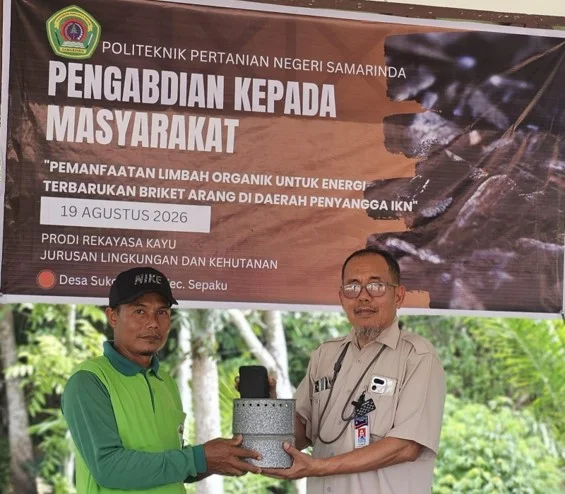
This collaboration between the university, village government, students, and the community is expected to be a first step toward more sustainable development of local resource utilization.
Potential for Development into Productive Activities
Processing timber waste into briquettes demonstrates that previously underutilized materials can be transformed into alternative energy products with practical value.
Beyond helping to reduce organic timber waste, the use of briquettes also opens opportunities to develop productive community activities if the production process can be carried out consistently and finds a market.
However, the development of charcoal briquettes in Suko Mulyo Village still requires several follow-up stages. These include establishing production process standards, product quality testing, production cost recording, and forming a community group responsible for its management.
Packaging and marketing aspects are also areas that need to be developed if the briquettes are to be directed toward becoming economically valuable products.
Ongoing mentoring is crucial to ensure that the use of this technology does not cease once the training concludes. With consistent management, timber waste that was previously considered valueless can be developed into an alternative energy source while creating local potential-based business opportunities in the IKN buffer zone.


Comments 0
Write a Comment Share your response