

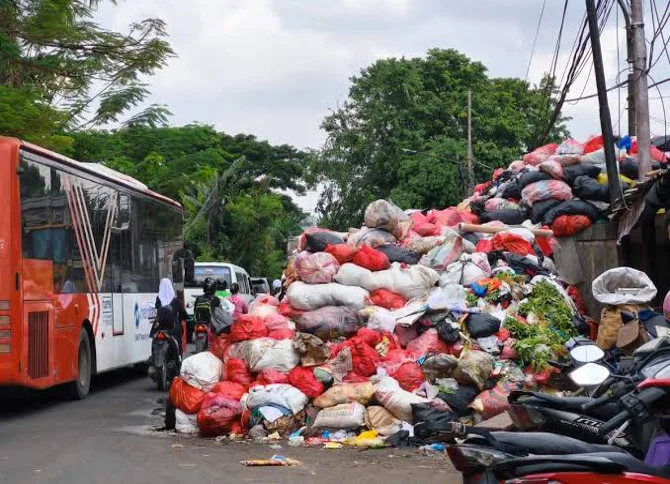
JurnalPost.com - Every time we throw away trash, we rarely think about where it ends up. Food wrappers go into the bin, collectors haul them away, and life goes on as usual. For us, the matter is settled once the waste is out of sight.
However, for the environment, that is precisely where the next problem begins. The waste we discard must be collected, transported, processed, and ensured not to cause new issues. If that process does not function properly, the waste simply moves to a different location, while the problem remains.
So, if we continue to generate waste every day, yet the problem remains unresolved, what is actually wrong: public behavior or the way we manage waste?
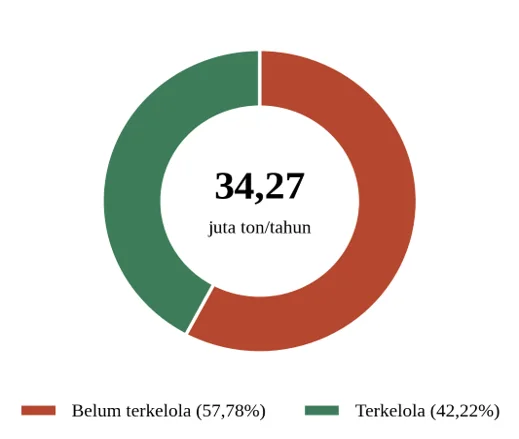
This question is not without reason. Data from the National Waste Management Information System (SIPSN) for 2024, based on reports from 319 regencies/cities, recorded approximately 34.27 million tons of waste generated per year. Of that amount, about 57.78% is recorded as unmanaged.
This figure shows that the waste problem is not just about someone throwing plastic into a river or leaving trash on the street. There is a larger issue: how the management system is capable of handling the waste continuously produced by the public.
While this data does not yet cover all regencies/cities in Indonesia, it still provides a serious picture of the challenges faced. When more than half of the waste generation in the reported data remains unmanaged, relying on appeals for the public to be more caring is clearly not enough.
Behavioral Change Must Be Supported by Management Systems
So far, the public has often been asked to be part of the solution through habits like disposing of trash in its place, reducing plastic, and sorting waste at home. In my opinion, while these steps are important, they should not be the only metric for concern regarding waste issues.
Imagine someone has separated organic and inorganic waste, only for both to be mixed again during collection. The efforts made at home ultimately do not yield the intended benefits.
This example shows that behavioral change must be supported by appropriate services. Local governments need to ensure that sorted waste can be collected and processed correctly. In this way, the public is not just asked to participate, but is also given the opportunity to see that their participation truly produces change.
Policy Must Go Beyond Just Collecting Waste
The problem becomes even more serious when waste management is too oriented toward handling waste after it has been generated. Collecting waste and taking it to a landfill is necessary, but neither eliminates the root cause if the volume of waste continues to grow.
As long as waste reduction at the source is not a strong priority, the government will continue to face an increasing need for collection, processing, and disposal space.
Therefore, policy should not just ask how to accommodate existing waste, but also how to prevent as much waste as possible from being created in the first place.
Reducing the use of single-use items, reusing items that are still viable, and sorting at the source need to function as a unified whole, rather than as fragmented programs.
Recycling and Producer Responsibility
In these efforts, recycling plays an important role, but it must be positioned correctly. Not all waste can be easily recycled, and waste that has been collected is not necessarily processed into materials that can be reused.
For recycling to be effective, it requires processing facilities, management personnel, market support, and a connected collection system.
The government also needs to ensure that responsibility does not stop with the public as consumers. Producers must be encouraged to reduce unnecessary packaging, use materials that are easier to recycle, and fulfill their responsibility for the waste generated by their products.
By doing so, efforts to address waste will not only focus on how to dispose of it, but also touch on how goods are produced, consumed, and managed after they are no longer in use.
Policy Improvements Must Have Measurable Results
Therefore, in my view, improvements in waste management policy must start with a clear division of responsibilities and measurable implementation.
The central government needs to strengthen policy direction and oversight, while local governments must provide collection, sorting, and processing services that meet the needs of their regions.
Waste banks and community-based recycling activities also need to receive sustainable support so they do not rely solely on voluntary initiatives.
At the same time, the implementation of producer obligations must be monitored, while budget utilization needs to be evaluated based on tangible results.
The success of a policy should not be measured by the amount of waste collected or the number of socialization activities held, but by the reduction of unmanaged waste and the increase in the amount of waste successfully reduced or recycled.
Waste That Disappears from View Is Not Necessarily Resolved
Ultimately, the waste problem teaches us that removing something from our sight is not the same as solving the problem it causes.
The public must change their habits, producers must be responsible for their products, and the government must ensure the entire management process runs consistently.
These three cannot be separated because awareness without facilities will struggle to produce change, while facilities without waste reduction will only continue to be burdened by new waste generation.
For me, the success of waste management policy is not when waste is successfully removed from sight, but when the state is able to ensure that the waste we produce today does not continue to be a problem that must be borne by the public and future generations.







Comments 0
Write a Comment Share your response