

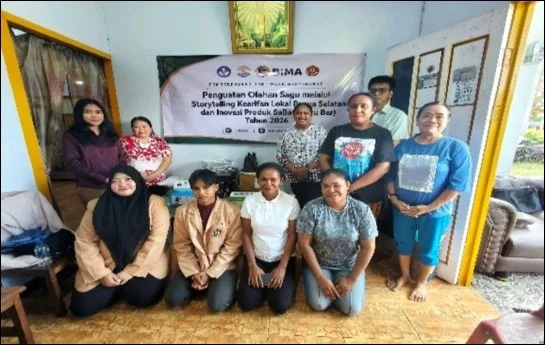
Merauke, JurnalPost.com — Sago has long been an essential part of life in South Papua. Beyond its role as a traditional staple, sago holds cultural value and economic potential that can be developed into various value-added processed products.
This potential prompted a team of lecturers from Musamus University (Unmus) to collaborate with the MSME Mama Maya in Merauke Regency to develop an innovative product called SaBar, or Sago Bar. This sago-based product comes in three flavors: peanut, banana, and coconut.
The development of SaBar is part of a Community Service (PkM) program titled “Strengthening Sago Processing through South Papua Cultural Storytelling and SaBar (Sago Bar) Product Innovation”.
The program was carried out in collaboration with MSME Mama Maya, managed by Maya Famia Maria Bapaimu, located on Jalan Garuda Mopah Lama, Rimba Jaya Village, Merauke Regency.
The service team is led by Ni Luh Putu Nita Yulianti from Musamus University. This activity also received support from the Ministry of Higher Education, Science, and Technology (Kemdiktisaintek).
Unlike typical food product development, this program does not focus solely on sago processing innovation. The team also integrated South Papua's local cultural wisdom into the packaging and promotional media to strengthen the product's identity.
Processing Sago into More Diverse Products
Before the service program was implemented, MSME Mama Maya had already produced several sago-based foods, including roasted sago, banana sago, and sago cendol.
Through mentorship from Musamus University, the business began developing SaBar as an alternative sago product with a different form and flavor profile than previous offerings.
The introduction of the three SaBar variants—peanut, banana, and coconut—is expected to provide more choices for consumers while expanding market opportunities for local food products.
To support the production process, the service team facilitated the use of five types of equipment: an oven, a mixer, a food chopper, a coconut grater, and a vacuum sealer.
This equipment is used to assist in the stages of raw material processing, mixing, baking, and product packaging.
In addition to providing equipment, the team also assisted in drafting standard operating procedures (SOPs) for SaBar production.
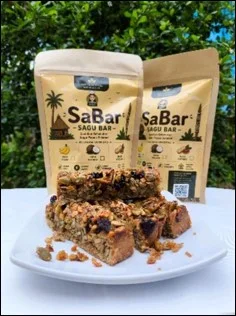
The implementation of SOPs is expected to help MSME Mama Maya maintain consistency in the production process, improve work efficiency, and simplify business management as production capacity increases.
Packaging and Branding as a Focus
Product innovation did not stop at recipe development and production processes. Packaging and brand identity were also key areas of focus during the service activities.
The Musamus University team helped MSME Mama Maya update its packaging design to make the products more recognizable to consumers.
SaBar uses pouchpackaging, while other sago-based products are packaged in boxes .
These packaging differences are tailored to the characteristics of each product and serve as part of a strategy to build a distinct business identity.
Logo development and promotional materials were also created to strengthen the image of MSME Mama Maya.
Through these updates, the sago-based products are expected to have a more attractive appearance and be better positioned to compete in a market filled with various snack options.
Storytelling of South Papua Cultural Wisdom
One of the interesting approaches in this program is the use of storytelling as part of the marketing strategy.
The service team sought to connect the sago-based products with stories about the lives, traditions, and local wisdom of the people of South Papua.
This approach was applied to the packaging of roasted sago and banana sago products, which are now equipped with cultural narratives and QR codes that direct consumers to storytelling videos.
By scanning the code, consumers can access digital content that introduces the stories behind South Papua's local food.
This method allows the packaging to serve a broader function. Beyond protecting and introducing the product, the packaging also becomes a medium for conveying cultural information.
The use of video and social media is also part of the digital marketing strategy introduced to the partners.
Through this approach, MSME Mama Maya does not just offer sago-based food, but also introduces the cultural values attached to the ingredient.
Training from Production to Financial Management
The series of service programs took place in several stages from July to August 2026.
Activities began on July 17, 2026, with a discussion with MSME Mama Maya regarding business potential, production constraints, and product development opportunities.
Subsequently, on July 24, 2026, the team conducted a production demonstration using the prepared processing technology. It was at this stage that the SaBar innovation with its three flavor variants was introduced and practiced with the partners.
The program continued with training on July 31, 2026, covering several aspects of business development.
Training materials included production, packaging, brand strengthening, storytelling, digital marketing, business management, and financial record-keeping.
Regarding financial management, the partners were also introduced to the BukuWarung application to assist in recording business transactions.
The training aimed to ensure that MSME actors not only have the ability to produce goods but also understand the importance of organized business management.
After the training, the team returned for follow-up mentorship on August 7, 2026, to review the implementation of the activities.
The mentorship covered the production process, equipment utilization, packaging, use of digital media, and financial record-keeping.
The series of activities concluded with a final evaluation on August 14, 2026.
Overall, the program successfully delivered five types of production equipment, three SaBar product variants, one production SOP, two types of packaging, and a logo and promotional materials based on storytelling.
Participant Satisfaction Survey Reaches 90 Percent Average
To gauge participant feedback, the service team conducted an evaluation survey of 20 respondents.
The survey covered five indicators: material relevance, material delivery, demonstration and practice, mentorship, and the benefits of the activity.
The results showed that the average percentage of satisfied and very satisfied responses reached 90 percent across the five indicators evaluated.
The material delivery indicator received the highest rating at 95 percent.
Meanwhile, material relevance, demonstration and practice, and mentorship each received 90 percent. The activity benefits indicator received a rating of 85 percent.
These results demonstrate a positive response from participants to the series of training and mentorship provided.
However, the level of participant satisfaction cannot be used as a direct measure of the business's economic success.
Increases in sales, revenue, and profits for MSME Mama Maya will still require separate monitoring and evaluation to determine the economic impact of the program.
Opening Economic Opportunities from Local Food
The development of SaBar shows that traditional food ingredients have the potential to be processed into products with more diverse forms, packaging, and marketing strategies.
Through a combination of food innovation, production technology, brand identity strengthening, and cultural storytelling, MSME Mama Maya has begun to build a foundation for more directed business development.
This program also highlights the role of universities in assisting the community to develop regional economic potential.
Moving forward, the sustainability of the SaBar innovation will depend on production consistency, quality control, marketing effectiveness, and the business owner's ability to reach consumers.
Sales evaluation and market feedback are also important steps to determine the extent to which the new product can grow.
For South Papua, the development of sago-based food has a broader meaning than just providing snacks.
Innovations like SaBar open opportunities to introduce the region's food wealth while preserving the cultural stories that accompany it.
From sago to SaBar, the collaboration between Musamus University and MSME Mama Maya shows how academic knowledge, business creativity, and local wisdom can be combined to open new opportunities for South Papua's signature food products.




Comments 0
Write a Comment Share your response