


JurnalPost.com — The aroma of turmeric and Java ginger slowly fills the air as sliced rhizomes begin to boil. Warm steam rises from the pot, carrying the distinct scent of medicinal plants that have long been a part of life in Timor.
From simple ingredients grown around residents' homes and gardens, a larger vision has emerged: establishing the Usapinonot Jamu Cafe as a business venue, an educational space, and a hub for preserving local knowledge.
This concept was developed through community empowerment activities in Usapinonot Village, North Central Timor Regency. The program is part of the University of Timor Village Empowerment Program designed to strengthen the community's ability to process local medicinal plants into value-added products.
The program not only introduces new products but also bridges two strengths already possessed by the community: traditional knowledge of medicinal plants and the use of appropriate technology to make production processes more effective.
The hope is that the rhizomes, which have long grown in the community's surroundings, will no longer remain mere raw materials but can be processed into products with higher economic value while creating business opportunities for residents.
From Local Rhizomes to Value-Added Products
The people of Usapinonot have long been familiar with various medicinal plants such as turmeric, Java ginger, ginger, white turmeric, and lemongrass.
However, this potential has not been fully developed into a business that provides optimal economic value. Some processing is still done manually, production capacity is limited, and product variety still needs to be expanded.
Through the 2026 Year III Village Empowerment Program, KUB Prima Mandiri and KUB Melati received guidance to improve their skills in processing herbal plants.
Group members were equipped with skills ranging from ingredient selection, washing, slicing, and drying to storage and the serving of herbal products.
Java ginger, turmeric, and white turmeric are the three main rhizomes being developed. After being cleaned, the ingredients are sliced and dried into simplicia, which can be stored as stock, used as ingredients for boiled jamu (jamu godog), or marketed as ready-to-process herbal materials.
This process provides added value. Rhizomes are no longer sold only in fresh condition but can be stored longer and developed into various products.
Appropriate Technology Aids Production
The use of appropriate technology is a key part of developing the herbal business in Usapinonot.
Equipment such as slicers, drying ovens, blenders, and various supporting devices help accelerate work that was previously done largely by hand.
Slicing can now be done with more uniform sizes, the drying process is more even, and dried materials can be stored as stock for use when needed.
With this system, the group does not have to process fresh rhizomes every time they receive an order.
The technology used is not intended to replace the community's traditional knowledge. Instead, it serves as a tool to strengthen that knowledge, making the processing more practical, organized, and efficient.
Empowerment Is More Than Just Providing Tools
The mentoring in Usapinonot did not stop at providing equipment.
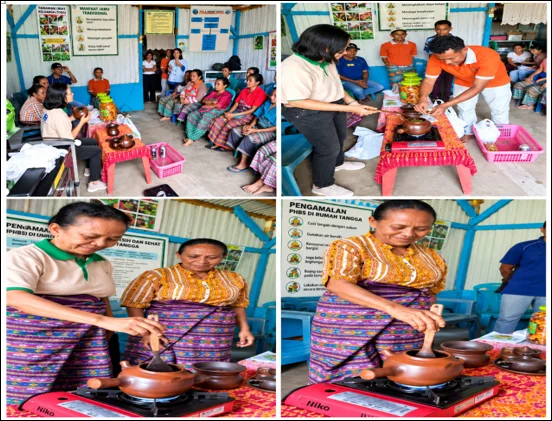
The community also received training and hands-on practice to ensure they could use the equipment and process herbal ingredients independently.
Group members were involved in every step, from preparing ingredients, slicing, and drying to processing the rhizomes and serving the jamu.
The mentoring, which initially focused on Java ginger and turmeric, expanded to include other ingredients like lemongrass and lime. The group was also introduced to making instant drinks from ginger and Java ginger.
Through this hands-on practice, the community not only produced goods but also gained skills that can continue to be used after the mentoring program ends.
These skills are expected to be the capital for the group to maintain production, create new product variations, and strengthen business independence.
Jamu Cafe: Where Tradition Becomes an Experience
The idea of the Usapinonot Jamu Cafe was then introduced to bring jamu into a broader experience.
Visitors do not just come to buy drinks; they can see the raw materials, learn about various types of rhizomes and simplicia, watch the boiling process, and enjoy the jamu while it is warm.
Boiled jamu (jamu godog) is one of the concepts being developed.
Unlike instant herbal drinks, the process of making boiled jamu can be witnessed firsthand. Slices of turmeric, Java ginger, and various other rhizomes are boiled until they produce their characteristic aroma and color.
This process becomes part of the experience of enjoying jamu.
With this concept, the Usapinonot Jamu Cafe has the potential to become both a business venue and an educational space. Visitors can learn about local ingredients, understand the processing methods, and discover the traditional knowledge held by the local community.
Preserving Tradition While Opening Business Opportunities
The development of the Usapinonot Jamu Cafe is one way to bridge the effort of preserving tradition with the community's economic development.
Amidst the growing number of modern beverage choices, jamu needs a new approach to remain relevant and accessible to the younger generation without losing its identity.
What has changed is not the base ingredients, but the way they are processed, stored, packaged, served, and introduced to consumers.
Turmeric, Java ginger, ginger, and other local rhizomes remain part of the community's traditional knowledge, while technology helps make the production process more practical and efficient.
It is this blend of tradition and technology that provides added value.
Rhizomes that were previously viewed only as garden produce can now develop into economic products, an experience for consumers, and a part of the identity of Usapinonot Village.
From Jamu Entrepreneurship Village to Jamu Cafe
The development of the Usapinonot Jamu Cafe is part of an empowerment process that has been ongoing for three years.
Throughout this journey, the community has been introduced to more than just one type of product. Various forms of rhizome-based preparations have been developed, ranging from jamu capsules and dried herbal materials to boiled jamu and herbal drinks.
This process shows that the development of community businesses happens in stages.
Training, production practice, the introduction of technology, and the development of product variations serve as the foundation for opening broader economic opportunities.
The Jamu Cafe then becomes the next step, uniting these various developments in one space.
At this location, visitors will not only be able to enjoy boiled jamu but also learn about simplicia, buy herbal products, and see how local medicinal plants are processed by the Usapinonot community.
Skills as Capital for Independence
The success of empowerment cannot be measured solely by the number of products produced or the volume of sales revenue.
One important indicator is the increased ability of the community to manage their potential independently.
Group members now have experience in using equipment, processing and storing herbal materials, and serving boiled jamu.
This knowledge and skill set are vital capital for the sustainability of the business.
Equipment may break and technology may continue to change, but the skills mastered by the community will remain an asset that can be used and passed on to other group members.
That is where the meaning of empowerment becomes truly tangible.
The community is not just placed as a recipient of aid, but grows as the primary actor capable of developing its own village's potential.
A Cup of Jamu and Hope from Usapinonot
In the future, visitors to the Usapinonot Jamu Cafe will be able to see rows of jars filled with slices of turmeric, Java ginger, white turmeric, and various other herbal plants.
Rhizomes are selected, processed, boiled, and then served warm with the distinct aroma of local medicinal plants.
However, that cup of jamu carries a story much larger than just its taste.
Inside it lies the richness of the Timor soil, the community's knowledge, the use of appropriate technology, collaborative work, and the hope of building a village economy from the potential growing in their own environment.
Usapinonot shows that tradition does not have to end as a memory.
Tradition can continue to evolve into products, create business opportunities, and serve as a way to maintain local identity amidst changing times.
From local rhizomes grows added value. From skills comes independence. And from a cup of jamu, a new hope grows for the people of Usapinonot.


Comments 0
Write a Comment Share your response