

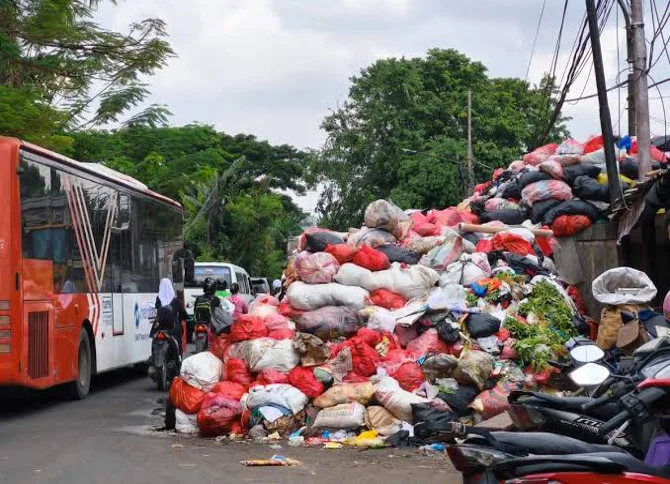
This is actually a simple matter, but due to bad habits, it has become a major problem that requires quick, precise, and immediate action. At the same time, we are essentially throwing away something that holds economic value.
Waste is not merely something to be discarded. It contains materials that can be reused, industrial raw materials, energy sources, fertilizers, biogas, and even new economic value potential that can be developed through a circular economy.
The issue is not just how to reduce waste, but how to change the way we view it. A landfill should not forever be the final destination for waste. It must be viewed as a starting point for value creation.
Landfills: From Disposal Sites to Assets.
So far, the measure of success for landfill management has been simple: waste enters, is buried, and causes no problems. This paradigm is no longer sufficient.
Regions need to start viewing landfills as economic and environmental assets. Incoming waste must be sorted, processed, and converted into valuable products. Materials that still hold value can be returned to the production chain.
Organic waste can be processed into compost or used to generate biogas. Certain fractions can be processed into refuse-derived fuel (RDF). Methane gas from landfill deposits can be utilized as an energy source if technical and environmental aspects allow.
Furthermore, in long-operating landfills, there is an opportunity for landfill mining, which involves recovering specific materials from old deposits for reuse or gradual restoration.
Thus, the logic changes: waste-cost becomes waste-raw material-product-revenue.
This simple shift in thinking could be the beginning of a transformation in landfill management in Indonesia.
But Commercialization Is Not Just Selling Waste
This is where the issue becomes more serious. Encouraging landfills to become sources of regional revenue should not be interpreted merely as building processing facilities and selling the output. Commercialization without governance can actually create new problems.
When waste begins to have economic value, important questions arise: Who weighs it? Who records it? Who determines the quality? Who sells it? Who sets the price? And who ensures that the proceeds from sales are truly recorded as legitimate revenue?
These questions are not merely administrative; they are matters of governance.
Imagine a landfill receiving hundreds of tons of waste every day. Each ton has consequences for transport costs, processing costs, facility capacity, and potential revenue.
Even a slight manipulation of scale data can result in a significant difference in value when multiplied by volume over the long term.
Risks can also arise in the sorting process, the recording of recovered materials, the sale of processed products, technology procurement, and third-party cooperation contracts.
This means that the higher the economic value of a landfill, the greater the need for an internal control system.
Do Not Let Waste Become a New Field for Fraud
Landfill commercialization must be designed with the awareness that there is potential for fraud in almost every link of the process.
Scale manipulation can occur when waste enters. Classification manipulation can occur when determining the type and quality of materials. Leakage can occur when sorted results or processed products are sold.
Conflicts of interest can arise in the selection of business partners. Even the procurement of waste processing technology can become a vulnerable point if not supported by adequate transparency and evaluation mechanisms.
Therefore, local governments should not only ask: “How much money can be generated from the landfill?”
An equally important question is: “How much money is potentially leaking if the oversight system is weak?”
This is where an anti-fraud approach must be implemented from the start, not after a problem occurs.
Digitalization Must Be the Oversight System.
One step that can be taken is to build a landfill based on data and digital traceability.
Every vehicle that enters can be recorded digitally. The weight of the vehicle and the waste can be measured through an integrated system. Data on the vehicle, arrival time, origin of waste, net weight, and processing destination can all be recorded.
This data must then be connected to the recording of processing results. Thus, the government can perform reconciliations: waste in - waste sorted - materials recovered - products produced - products sold - revenue received.
If there is a significant discrepancy, the system can provide a warning flag for investigation.
CCTV, vehicle GPS, digital weighing systems, monitoring dashboards, electronic transaction recording, and data-based audits are no longer luxuries.
In a commercialized landfill model, these instruments are essential parts of the governance infrastructure.
Furthermore, certain non-confidential information can be made public. The public has the right to know that the waste they pay for through taxes and levies is not just being dumped, but managed productively and responsibly.
Who Manages It?
Local governments do not have to do everything themselves. A model that can be developed is a collaboration between local government, regional-owned enterprises (BUMD), the private sector, universities, and the community.
The local government can act as the asset owner and regulator. BUMD can act as the business manager with professional governance. The private sector can provide investment and technology. Universities can contribute through research, innovation, and evaluation. The community becomes part of the ecosystem through waste sorting at the source.
However, such cooperation must be built through clear contracts. Targets for waste reduction, product quality, processing volume, environmental standards, payment mechanisms, risk sharing, revenue sharing, and contract termination mechanisms must all be measurable.
The government must not hand over public assets to third parties with contracts that benefit one side while burdening the region in the long term.
Regional Revenue Is Not the Only Metric.
Landfill commercialization can indeed be directed toward generating regional revenue. However, the orientation should not solely be on chasing local revenue (PAD). There are much broader economic benefits.
A productive landfill can create jobs, open new business opportunities, provide raw materials for industry, generate alternative energy, reduce the need for new land, and reduce environmental burdens.
Thus, the success of a landfill should be measured through several indicators simultaneously: how many tons of waste were successfully processed, how much economic value was generated, how much cost was saved, how much regional revenue was obtained, how much energy was produced, how much emissions were reduced, how many jobs were created, and how little leakage occurred.
These metrics are far more reflective of success than simply looking at the volume of waste buried.
Do Not Repeat the Same Mistakes
There is one principle that must be maintained. Do not turn landfills into a business that depends on increasing amounts of waste.
If the manager's profit increases as the volume of waste increases, then there is a perverse incentive.
The correct economic model must encourage more waste to be sorted, recycled, reused, and processed into valuable products.
In other words, landfill commercialization must be part of a circular economy, not an economy that maintains a culture of disposal.
Landfills must be a bridge toward waste reduction, not an excuse to continue producing waste.
Time to change the perspective
Indonesia is not short on waste. We are also not always short on technology. The issue that remains is how to combine technology, business models, policy, oversight, and governance integrity into one ecosystem.
Landfills that are viewed today as a budgetary burden can be transformed into regional economic assets. However, this transformation will only last if it is built with a transparent and accountable system.
Waste must have value, but that value must not be an excuse to create new leakages.
Because in the end, the biggest question is not how much money we can make from waste, but how much value we can create without sacrificing the environment and public trust.
Perhaps it is time we stop asking: “How do we dispose of waste?”
And start asking: “How do we turn waste into value?”
Because an ideal landfill is not a place where value ends. A landfill should be a place where new value begins.
Data Author
Data | Description |
|---|---|
Full Name | Samas Adimisa Mishbah Habibie |
Nickname Nickname | Samas / Habibie |
Place, Date of Birth | Sumenep, 2 December 1997 |
Gender Gender | Male |
Address | Surabaya, Rungkut Madya |
Institution/Affiliation | Universitas Pembangunan Nasional “Veteran” East Java |
Position/Status | Lecturer (Civil Servant) |
Field of Expertise/Interest | Economics, Accounting, Business, Education, Governance, Risk Management, Forensic Accounting, Sharia Economics, and Sustainable Creative Economy Sustainable |
Website/Social Media | IG/Tiktok: samhabibie |
Works/Publications | Books, Scientific Articles, Modules, Teaching Materials, Prototypes, Applications, and other academic works |
Brief Description | Academician, Practitioner, Writer, Researcher, and Developer of Academic Works |




Comments 0
Write a Comment Share your response