

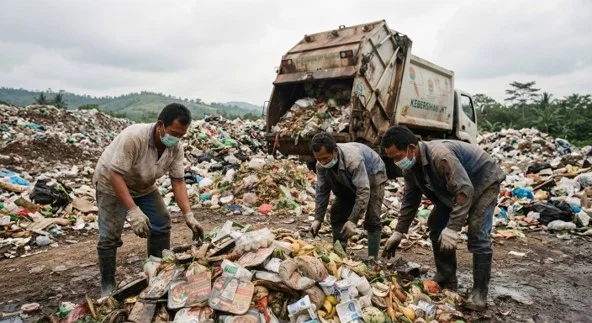
JurnalPost.com — Every year, millions of tons of food in Indonesia end up as waste. What is most troubling is not just the sheer volume, but the reality that some of it is still perfectly edible when discarded, while many people still struggle to access food.
Food Waste Is More Than Just a Kitchen Issue
Data from the Ministry of Environment (KLH), as cited by Katadata, shows that food scraps are the largest component of waste in Indonesia, accounting for 40.79 percent of national waste generation in 2025. Meanwhile, households are the largest source of this waste, contributing 56.82 percent.
Hermanu (2022) notes that food waste in Indonesia reaches approximately 300 kilograms per person annually, placing Indonesia second globally according to the data referenced in that study.
A literature review by Maemunah et al. (2024) also refers to the Food Waste Index 2021 which identifies Indonesia as the largest producer of food waste in Southeast Asia, generating approximately 20.93 million tons per year.
We have long focused too heavily on plastic waste, even though the proportion of food waste is significantly larger. This problem is not merely caused by individual habits but is deeply rooted in the food system.
Co-Founder of FoodCycle Indonesia, Herman Andryanto, states that the root cause is an imbalanced food system. Food surpluses from industry, retail, and agriculture occur simultaneously with a population that still struggles to access food.
It is not just individuals, but all parties involved in this issue. As long as the system makes it easier to discard food than to share it, food waste will continue to accumulate.
Efforts Needed at Three Levels
Several efforts to address the food waste problem have already begun. FoodCycle Indonesia runs a food rescue program, which bridges the gap between food surpluses in the business sector and communities in need.
Bank DBS Indonesia also launched the Food Rescue Warrior campaign in March 2024 in collaboration with FoodCycle Indonesia.
This approach aligns with the findings of Maemunah et al. (2024) that food banks, waste literacy, and 3R (reduce, reuse, recycle) programs need to be supported by the participation of the government, civil society, and multi-stakeholder collaboration.
With various initiatives already underway, food waste management needs to be addressed at three levels.
First, households.
Behavioral change at the household level remains the primary foundation, starting from buying only what is needed, taking portions according to needs, storing food ingredients correctly, to repurposing leftovers that are still safe to consume.
Hermanu (2022) also emphasizes the importance of a wiser lifestyle regarding food consumption. Because households are the largest source of waste, small changes made by many people can have a significant impact.
Second, business operators.
Restaurants, retail stores, and producers should distribute food surpluses through food rescue programs and avoid rejecting products that are still fit for consumption simply due to their appearance.
Concerns regarding food safety are indeed valid. FoodCycle Indonesia implements food inspection procedures, including checking the aroma, taste, and texture by two trained individuals.
However, such inspections must be accompanied by the implementation of food safety standards, including temperature control, shelf life, and hygiene during the distribution process.
Concerns about food safety must be addressed with appropriate standards and procedures, rather than being used merely as an excuse to discard food.
Third, the government.
Herman encourages the creation of regulations that protect food donors, similar to those implemented in Singapore and France, as well as the provision of incentives and the development of more efficient food surplus distribution systems.
In my view, these regulations and incentives are the most decisive factors. Without such support, the good intentions of business operators are easily halted by legal concerns and distribution costs.
This direction aligns with the message from Minister of Environment Hanif Faisol Nurofiq that the old 'collect-transport-dispose' model must be abandoned and replaced with waste reduction at the source.
Moving Together to Reduce Food Waste
Ultimately, food waste is a matter of the food system, surplus distribution, and consumption habits.
Discarded food is not just leftovers; it also represents a waste of the land, water, and energy used in its production process.
Therefore, households, businesses, and the government must move together to ensure that food which still holds value does not end up in vain.
References
Katadata. (2026, 23 January). Indonesia's Waste Generation Trend Until 2025. Databoks Katadata.
Katadata Green. (2026, 29 April). Stop Food Waste Day: Food Scraps Still Dominate Indonesia's Waste.
Ministry of Environment/BPLH. (2026, 25 February). National Coordination Meeting on Waste Management 2026: Minister of Environment Emphasizes Total Transformation of National Waste Governance.
Bank DBS Indonesia. (2024, 18 March). Bank DBS Indonesia Supports Sustainable Food Security Through Food Rescue Warrior.
Hermanu, B. (2022). Environmentally conscious food waste management (food waste). Jurnal Agrifoodtech, 1(1), 1–11. DOI: 10.56444/agrifoodtech.v1i1.52.
Maemunah, S., Agustin, D., & Carindra, R. R. (2024). Food waste management strategy to increase public awareness about food waste. Jurnal Agrifoodtech, 3(1), 1–8. DOI: 10.56444/agrifoodtech.v3i1.1559.







Comments 0
Write a Comment Share your response