


SURABAYA, JurnalPost.com — Medical emergencies can occur anytime and anywhere. In such situations, the initial actions taken by those closest to the victim can be a critical factor before medical personnel arrive.
Driven by this need, Dr. Dayu Satriya Wibawa, Sp.B, FINACS, and a team from the Faculty of Medicine at Nahdlatul Ulama University of Surabaya (FK UNUSA) organized Basic Life Support (BLS) Training and the Formation of Emergency Response Cadres in Wonocolo District, Surabaya, on Saturday, September 19, 2026.
The event, held at the Wonocolo District Hall, was aimed at improving public knowledge and preparedness in facing various emergency conditions in their immediate environment.
In an emergency, the speed of recognizing a victim's condition and providing an appropriate initial response is vital. Therefore, the public needs to understand basic actions they can take while also knowing the limits of their capabilities before professional help is available.
The Community as Part of the Chain of Survival
Through this training, participants received education on Basic Life Support, ranging from how to recognize emergency situations and provide initial responses to requesting help and activating emergency service systems.
Participants were also given an understanding that the community plays a crucial role in the chain of survival, as they are often the first to be at the scene when an emergency occurs.
A fast and procedurally correct response can help stabilize a victim's condition while waiting for medical personnel or emergency services to arrive.
“This training is expected to increase community readiness in facing emergency conditions. The most important thing is for the public to know the right initial steps, stay calm, immediately ask for help, and understand the rescue actions they can perform according to their capabilities,” said Dr. Dayu Satriya Wibawa, Sp.B, FINACS.
This message also emphasized that emergency training is not intended to make the public a substitute for medical personnel. Instead, the public needs to understand what actions are safe to perform and when professional help must be immediately involved.
Learning CPR through Hands-on Practice
The training did not just consist of theoretical delivery.
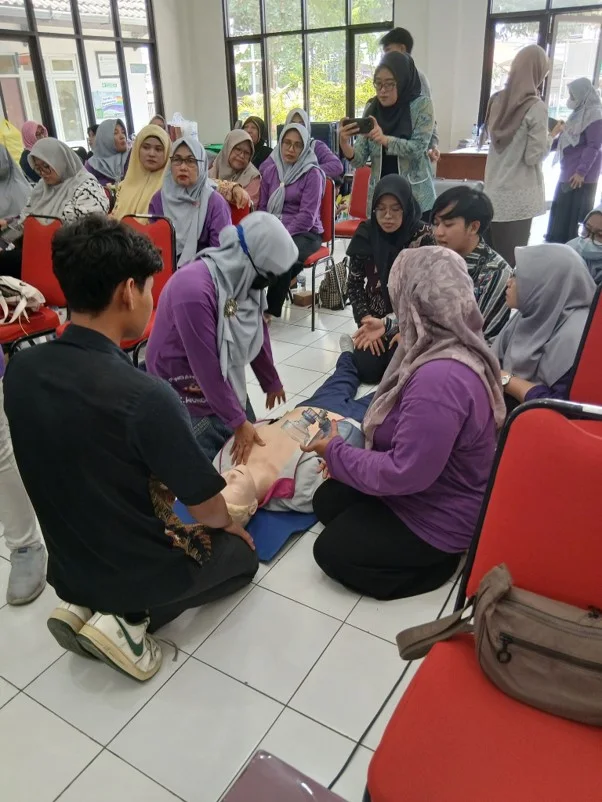
Participants also had the opportunity to participate in simulations and hands-on practice of Cardiopulmonary Resuscitation (CPR) using mannequins.
During the practice session, participants were introduced to the stages of assistance, starting from recognizing the victim's condition, ensuring responsiveness, requesting help, and performing chest compressions according to procedures provided by the instructor.
Before participants practiced, the implementation team provided a demonstration. Subsequently, participants attempted each stage on the mannequins under the guidance of instructors.
This hands-on approach allowed participants to not only understand the material theoretically but also experience how the rescue stages are performed in a simulated situation.
During the practice, instructors provided guidance and corrections on the participants' techniques to ensure that the actions taken remained in accordance with the basic principles of CPR.
Speed of Response Must Be Accompanied by Correct Action
In an emergency, panic is one of the challenges that often arises. Therefore, BLS training also emphasizes the importance of the ability to remain aware of the situation and take directed steps.
The first thing to do is not to act in a rush, but to ensure the safety of the location, recognize the victim's condition, check for responsiveness, and immediately call for help if a condition requiring urgent assistance is found.
This understanding is important because not all emergency conditions can be handled with the same actions.
Cadres and the public also need to know the limits of their competence. Initial rescue actions are provided to help the victim while waiting for professionals, not to replace medical examination and treatment.
Forming Emergency Response Cadres
In addition to BLS training, the activity was aimed at forming emergency response cadres within the community.
Cadres are expected to be drivers of preparedness in their respective areas while helping to disseminate knowledge regarding initial responses to emergencies.
The formation of cadres is also part of an effort to maintain the sustainability of education.
Emergency training is insufficient if done only once without refreshing skills. Knowledge and practical abilities need to be maintained through periodic education and practice.
With cadres who have gained a basic understanding of emergencies, it is hoped that this information can reach families and the wider community.
The activity was interactive. Participants not only received material but also engaged in discussions, followed demonstrations, and practiced several basic principles of rescue.
This approach is expected to help participants understand that preparedness is not just about knowing theory, but also knowing what to do when facing a real situation.
Preparedness is a Shared Responsibility
Through this activity, Dr. Dayu Satriya Wibawa, Sp.B, FINACS, and the team hope that the people of Wonocolo will increasingly understand that handling emergencies is a shared responsibility.
Medical personnel still have the primary role in medical treatment. However, the community's response in the initial minutes before professional help is available is also a critical part of the rescue system.
Moving forward, the existence of emergency response cadres is expected to be strengthened through periodic education and training so that the skills acquired are not lost after the training ends.
This effort is also in line with Sustainable Development Goals (SDGs) Goal 3: Good Health and Well-being.
BLS training and strengthening emergency response capabilities at the community level can support public preparedness and strengthen the initial part of the chain of survival , especially when facing cases such as cardiac arrest or other emergencies.
Ultimately, emergencies do not always happen in hospitals and are not always witnessed first by medical personnel.
Therefore, members of the public who are able to recognize emergency conditions, immediately request help, and provide initial assistance according to their capabilities can be a vital part of efforts to save lives.
The more prepared the community is in facing emergencies, the better the chances for victims to receive fast and directed assistance.







Comments 0
Write a Comment Share your response