

JurnalPost.com - Anxiety is a natural human response when facing pressure, uncertainty, or situations perceived as threatening. However, when anxiety becomes excessive, difficult to control, and begins to interfere with daily activities, the condition requires more serious attention.
Anxiety can affect a person's concentration, sleep patterns, social relationships, and overall quality of life. The World Health Organization (WHO, 2026) explains that anxiety disorders are characterized by excessive fear and worry, which can impact social life, education, and work.
Therefore, managing anxiety is essential to minimize its impact on daily life.
So far, medication has often been one of the approaches known to the public for addressing mental health issues. In fact, anxiety management can also involve non-pharmacological approaches that help individuals recognize, face, and manage their anxiety responses.
The WHO (2023), through its Mental Health Gap Action Programme (mhGAP) guidelines, recommends psychological interventions based on Cognitive Behavioral Therapy (Cognitive Behavioral Therapy or CBT) for adults with generalized anxiety disorder and/or panic disorder.
The WHO also recommends that stress management techniques be considered as part of treatment. This indicates that anxiety management is not solely related to medication but can also include psychological and behavioral strategies tailored to individual needs.
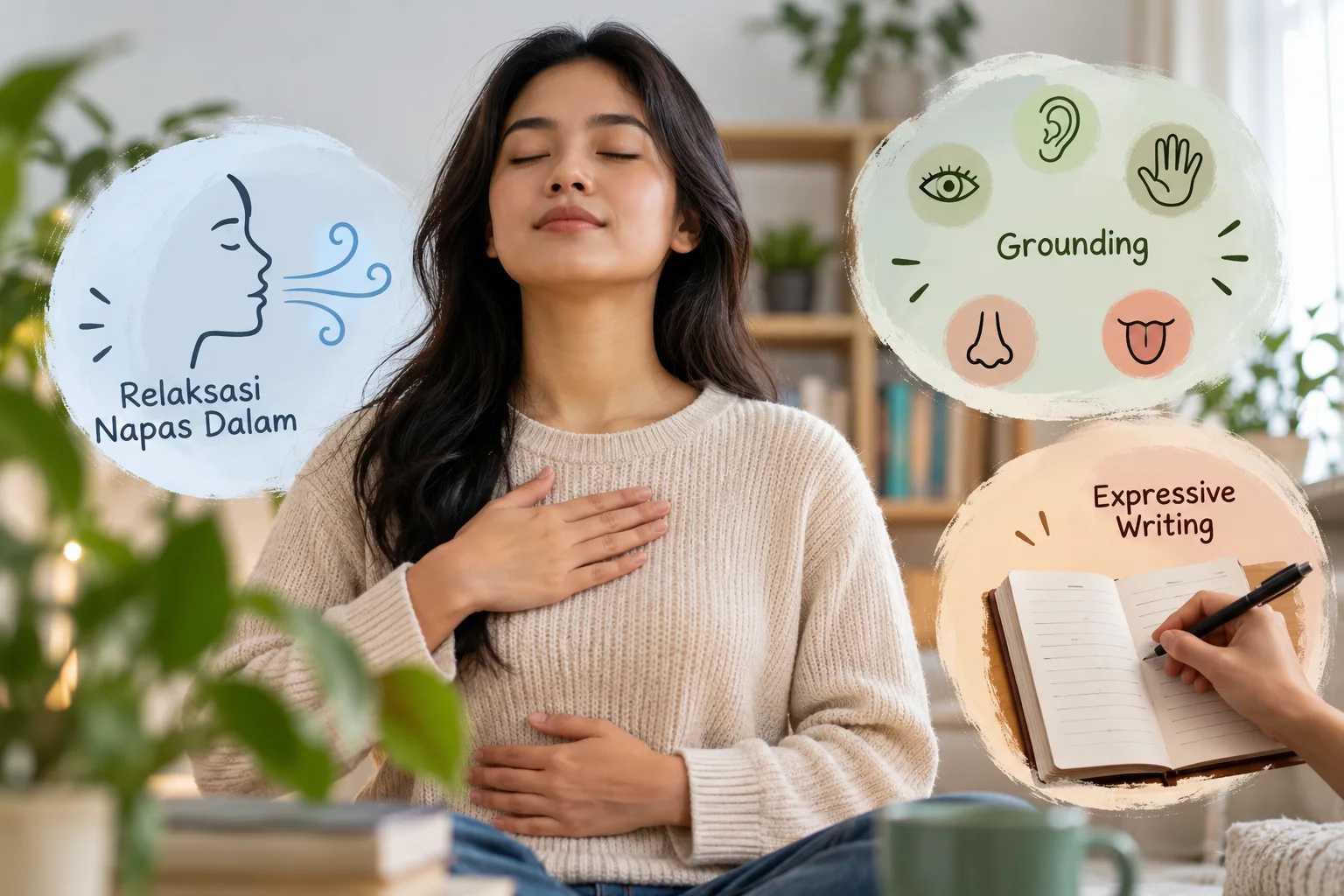
Some simple techniques that can be explored to help manage anxiety include breathing exercises, grounding, and expressive writing.
Breathing exercises help a person focus on their breath and calm down. Meanwhile, grounding redirects attention back to the present moment through the five senses, while expressive writing provides a space to pour out thoughts and feelings through writing.
Although these three techniques have different mechanisms and levels of research support, they are all worth discussing as complementary approaches in anxiety management.
Anxiety Does Not Always Have to Be Treated with Medication
One thing that needs to be clarified in understanding anxiety treatment is the assumption that medication is the only way to reduce anxiety.
In reality, the treatment of anxiety disorders can be carried out through several approaches tailored to an individual's condition and needs.
Medication still plays an important role for those who need it, but psychological and non-pharmacological approaches also need to receive balanced attention.
Managing anxiety does not always have to start with medication. Sometimes, simple steps to calm down and understand emotions can also be part of the process.
Deep breathing relaxation, grounding, and expressive writing are three alternative techniques that can be tried to help cope with anxiety.
1. Deep Breathing Relaxation
One simple way that can be tried to help manage anxiety is deep breathing relaxation (deep breathing).
This technique is performed by regulating breathing slowly and regularly to help the body relieve tension when the mind is filled with worry.
Doing it is quite easy. Sit in a comfortable position, relax your shoulders, then inhale slowly through your nose and exhale gently.
Repeat for several cycles without forcing the breath or holding it for too long. By slowing down breathing, a person can practice calming the physical responses that often accompany anxiety, such as rapid breathing and body tension.
The potential benefits of this relaxation approach are seen in the research by Atensi and Rifameutia (2023) titled The Effectiveness of a Combination of Relaxation and Cognitive Restructuring Techniques in Managing Anxiety in College Students.
The study found a decrease in a student's anxiety score from 18 to 8 after an intervention that combined relaxation and cognitive restructuring.
These findings show the potential of a relaxation approach in helping to manage anxiety. However, these results do not prove that deep breathing alone causes a reduction in anxiety because the study only involved one participant and used a combination of techniques.
2. Grounding Technique
When anxiety makes a person dwell on things that may not happen, the grounding technique can help redirect attention back to the present.
Grounding is an exercise that uses the five senses to make a person more aware of their surroundings.
One easy way to try is the 5-4-3-2-1 method. First, name five things you can see. Second, notice four things you can feel through touch, such as your feet touching the floor or the texture of your clothes.
Third, identify three sounds you can hear. Fourth, identify two scents you can smell. Finally, be aware of one taste you can recognize, for example, the taste of water in your mouth.
This exercise can be done slowly while focusing on each sensory experience without needing to rush.
By shifting attention from a whirlwind of worries to real things around you, a person can practice facing moments that feel stressful.
Research by Lesmana and Akrim (2024) titled Stress Management Training Through Sensory-Based Grounding Techniques reported a decrease in stress and an improvement in emotional regulation in 20 adolescents after training that included grounding, breathing relaxation, and other techniques.
These results support the potential of such exercises to help manage emotional pressure. However, the study did not specifically prove the effectiveness of grounding for anxiety disorders because what was measured was stress and the intervention combined several techniques.
3. Expressive Writing
In addition to breathing and sensory exercises, anxiety can also be faced by giving yourself space to understand emotions through writing.
Expressive writing is a technique of pouring thoughts and feelings related to emotional experiences into writing, rather than just recording daily activities.
To try it, a person can take about 10–15 minutes in a quiet place, then write honestly about what they are feeling, what triggers their worries, and the thoughts that keep repeating.
There is no need to think about grammar, sentence structure, or whether the writing is good. Focus on the effort to express what is being felt.
Once finished, the writing can be read again if it feels comfortable to help recognize patterns of thought and emotion.
However, one does not need to force themselves to write about experiences that are too painful if it actually makes them feel more distressed.
The potential benefits of this technique were studied by Anggoro (2025) in the article The Effectiveness of Expressive Writing in Reducing Anxiety in Bipolar Disorder Patients.
The study of six adults with bipolar disorder reported a decrease in anxiety levels after the expressive writingintervention.
Participants were also reported to feel calm and relieved and gained self-understanding.
However, the small number of participants and the lack of a control group mean that these results should be interpreted with caution.
Therefore, expressive writing can be considered as a way to recognize and express emotions, not as a substitute for professional help.
Not Just Trying Techniques, but Understanding Personal Needs
These three techniques show that managing anxiety can start from simple steps that are close to daily life.
Deep breathing relaxation can be tried when the body feels tense, grounding can help redirect attention back to the present, while expressive writing can be a space to recognize feelings that are difficult to express.
Although they have different mechanisms, all three give a person the opportunity to pay more attention to their physical and emotional condition.
In my opinion, what needs to be emphasized is not that one technique is definitely better than another, but that everyone may have different needs and experiences in dealing with anxiety.
What Should Readers Do?
So, how can someone start applying these approaches?
The first step is to recognize the situation being faced and choose a technique that feels comfortable.
A person can try to regulate their breathing slowly when feeling tense, use the 5-4-3-2-1 method when their mind is filled with worry, or write down their feelings to help understand what they are experiencing.
These exercises do not have to be done perfectly. What is more important is to pay attention to your own response and not force a technique that actually adds to the discomfort.
If anxiety continues to recur, becomes more severe, or begins to interfere with daily activities, consulting a psychologist, psychiatrist, or appropriate health professional is an important step.
On the other hand, discussions about alternative techniques need to be accompanied by an understanding that everyone's needs are different.
Some people feel helped by independent practice, while others may need psychotherapy, medication, or a combination of several forms of treatment.
Therefore, reducing the stigma against professional help is just as important as introducing simple ways to manage anxiety.
A person does not need to feel like a failure just because independent techniques have not yielded the expected results. Seeking help is not a sign of weakness, but a form of self-care.
A Message for Us All
Ultimately, dealing with anxiety is not about choosing between medication or alternative techniques absolutely, but about understanding personal needs and finding the right support.
Deep breathing relaxation, grounding, and expressive writing can be an initial step to recognize and manage emotional responses, although scientific evidence regarding their effectiveness still has limitations.
None of them promise that anxiety will disappear instantly, but they can open an opportunity for a person to pause, pay attention to themselves, and respond to worries more consciously.
Because taking care of mental health does not always start with big steps. Sometimes, small steps are worth trying.
Most importantly, do not let the effort to calm yourself make you ignore the need to obtain help when it is truly needed.
References
Anggoro, L. S. (2025). The effectiveness of expressive writing in reducing anxiety in bipolar disorder patients. Jurnal Integrasi Riset Psikologi, 3(1), 12–20.
Atensi, M., & Rifameutia, T. (2023). The effectiveness of a combination of relaxation and cognitive restructuring techniques in managing anxiety in college students. Jurnal Ilmiah Psikologi, 11(1), 559–568.
Lesmana, G., & Akrim, A. (2024). Stress management training through sensory-based grounding techniques. Jurnal PRODIKMAS Hasil Pengabdian kepada Masyarakat, 9(2), 42–48.
World Health Organization. (2023). Mental health gap action programme (mhGAP) guideline for mental, neurological and substance use disorders (3rd ed.).
World Health Organization. (2026, September 15). Anxiety disorders.




Comments 0
Write a Comment Share your response