

SURABAYA, JurnalPost.com – Plastic waste remains a persistent issue in residential areas. The volume of used plastic bottles continues to grow, while available storage space becomes increasingly limited. However, behind this problem, plastic waste actually holds economic potential if managed properly.
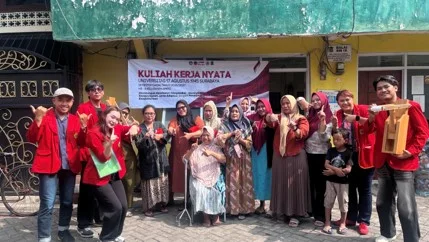
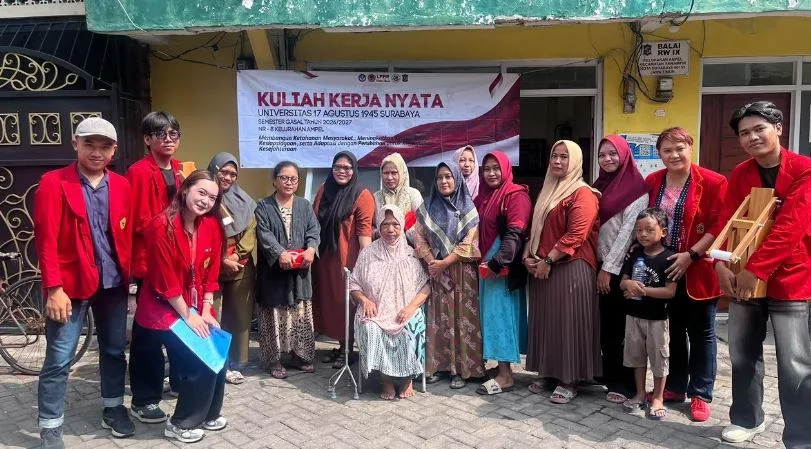
This is what I discovered while participating in the Community Service Program (KKN) of Universitas 17 August 1945 (UNTAG) Surabaya in RW 09, Ampel Village, Semampir District, Surabaya City.
One of the challenges faced by waste bank managers is the lack of a specialized tool to compress plastic bottles, making storage and transportation inefficient.
Simple Technology to Address Community Needs
As an architecture student, I view design as more than just buildings. In a broader sense, design is an effort to provide solutions that align with human and environmental needs.
In my opinion, useful technology does not have to be expensive or sophisticated; it must be easy to use and capable of addressing real-world problems.
Based on this perspective, my KKN colleagues and I designed and implemented a manual wooden plastic bottle press using a lever mechanism. This tool operates without electricity and functions to flatten plastic bottles, making them more compact for storage and transport.
Through testing on 100 plastic bottles, consisting of 53 bottles with a capacity of 600 milliliters and 47 bottles with a capacity of 1,500 milliliters, we achieved compression results with a final thickness of approximately 5–10 centimeters.
These results demonstrate that simple technology can help improve the efficiency of waste management.
Turning Plastic Waste into Economic Opportunities
Beyond environmental impact, managing plastic bottles also presents economic opportunities.
Based on local market prices, plastic bottles were previously valued at around Rp2,000–Rp3,000 per kilogram. Once the caps and labels are separated, the selling price can reach Rp5,000 per kilogram, depending on the collector's requirements.
It should be understood that this price increase is not solely due to the pressing process. The press helps save storage space, while the sorting of caps and labels improves the quality of the material being sold.
Both are simple steps that complement each other in creating more valuable waste management.
Encouraging Community Independence in Waste Management
On 21 November 2026, we conducted socialization, demonstrations, practical training, and the handover of the tool to the managers of the RW 09 Ampel Waste Bank.
This activity involved 10 participants and local residents who had the opportunity to understand and try using the tool firsthand.
From this activity, I realized that the success of a KKN program is not measured solely by the tool that was successfully built or handed over.
More importantly, it is about how the community can utilize and maintain the tool in a sustainable manner.
Innovation Stemming from Community Needs
For me, this experience is proof that environmental issues can be opportunities to create innovation while supporting the community's economy.
Through appropriate technology and the habit of sorting waste, plastic bottles that were previously considered worthless can become a source of benefit.
Ultimately, the best innovation is not always the most sophisticated, but the one that is closest to the community's needs and capable of providing long-term benefits.





Comments 0
Write a Comment Share your response