

SURABAYA, JurnalPost.com – Waste management remains a significant environmental challenge that requires serious attention, particularly in densely populated residential areas.
The ever-increasing volume of waste not only impacts environmental cleanliness but also poses potential risks to public health and community comfort. Therefore, concrete and innovative steps in waste management are necessary, starting from the smallest community level, namely the neighborhood association (RW) level.
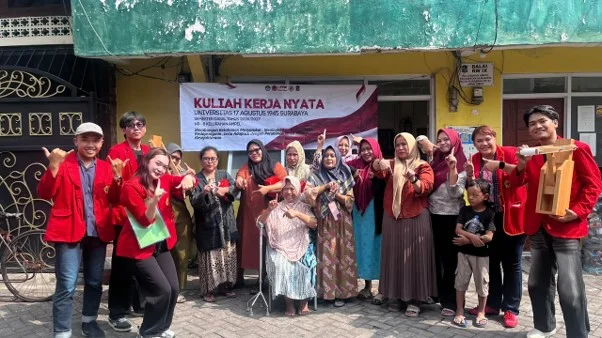
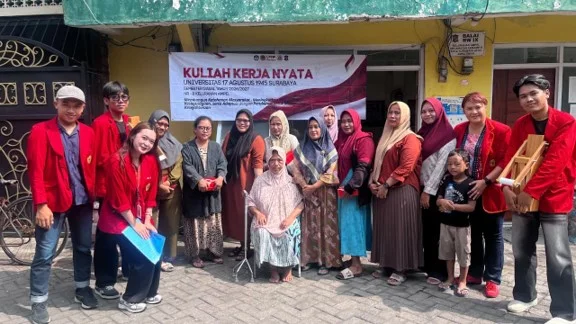
As a form of concern for this issue, students from Universitas 17 Agustus 1945 (UNTAG) Surabaya have introduced an innovation in the form of a waste-pressing device installed at the RW 09 community hall in Ampel Village, Semampir District, Surabaya.
Innovation Born from Community Needs
However, the presence of this device is not just about introducing technology to the community. More importantly, the waste press serves as a symbol that environmental change can begin with simple initiatives that involve collective participation.
As students, we recognize that in dense settlements like Ampel, space for storing waste is also space needed by residents for their daily activities.
Empty plastic bottles are light, but their shape causes a sack to fill up quickly. For residents who must store sorted plastic until collection time, this issue is a tangible problem.
The presence of this waste-pressing device is an effort to encourage more effective and targeted waste management within the community.
Through the pressing process, certain types of waste, particularly inorganic waste such as plastic bottles and compatible plastic packaging, can be compacted to reduce their volume.
Consequently, the need for storage space can be reduced, and the processes of waste collection and transportation have the potential to become more efficient.
The Role of Universities in Community Service
This is where universities can play a role. Students bring the ability to design tools, while residents understand how their environment functions on a daily basis.
Who usually handles waste collection? When do residents have time to drop off plastic bottles? Where can the pressed materials be stored without disrupting activities at the community hall?
The answers to these questions determine whether a design is suitable for the residents' lives. In community service, the ability to listen is just as important as the ability to design.
Building Sustainable Waste Management
For the university, the measure of success in community service can be seen several months after the device is installed. Is the device still being used? Can the residents manage it independently? Does the collected plastic have a routine distribution channel?
From RW 09 in Ampel, we can learn that environmental innovation is more useful when it stems from problems identified by the residents and can be managed with the resources they possess.
For students, that lesson is just as valuable as the success of creating a functional device.




Comments 0
Write a Comment Share your response