


JurnalPost.com – The Bajau are a maritime ethnic group widely known as sea nomads across the waters of Indonesia, Malaysia, the Philippines, and Brunei Darussalam. For the Bajau people, the sea is not merely a place to earn a living, but an integral part of their biological and cosmological identity.
They possess the ability to free-dive to depths of dozens of meters on a single long breath. Genetic and physiological studies by Melissa A. Ilardo and her team in the journal Cell (2018) found that the Bajau have undergone evolutionary adaptations, including a spleen size approximately 50 percent larger than that of comparative populations, which functions as a reservoir for oxygen-rich red blood cells during dives.
However, this evolutionary heritage and the once-pristine coastal ecosystems are now threatened by mining expansion. Although the national legal framework, through Law Number 1 of 2014 concerning the Management of Coastal Areas and Small Islands, restricts mining activities that could potentially damage small island ecosystems, a number of nickel mining business licenses (IUP) remain active on Kabaena Island, Southeast Sulawesi.
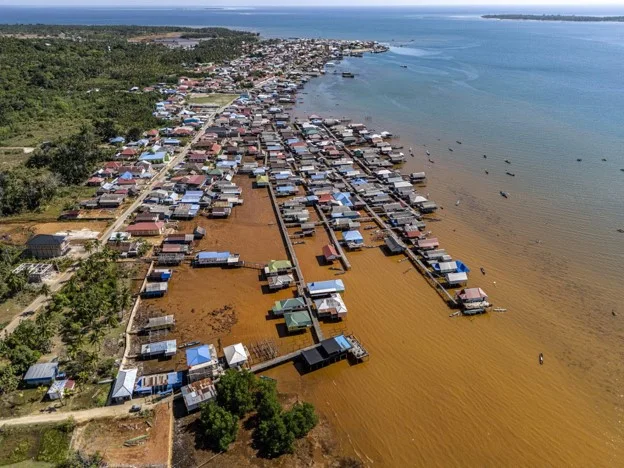
Investigations by the research institute Satya Bumi (2024) and spatial mapping by Auriga Nusantara in collaboration with Betahita (2024) note that mining concessions cover approximately 73 percent, or 650 square kilometers, of Kabaena Island's total area of 891 square kilometers.
The clearing of forest areas and open-pit mining activities trigger erosion that carries silt and potentially heavy metal pollutants into rivers and the sea. The seawater around the Bajau people's stilt houses has turned murky brown, burying coral reefs, disrupting seaweed farming cycles, and driving fish, octopuses, and shellfish away from the coast.
Field monitoring by Jaring Nusa KTI (2025), as referenced in this article, highlights issues of environmental pollution and reports of skin diseases among fishermen and Bajau children. Meanwhile, mining dust also raises concerns regarding the respiratory health of residents.
Green Energy Geopolitics and Ecological Colonialism
From a contemporary geopolitical perspective, the ecological tragedy befalling the Bajau people on Kabaena is not an isolated local issue, but part of a global struggle for strategic resources.
Global economic powers such as the United States, the European Union, and China are racing to secure supply chains forcritical mineralsto support the green energy transition and the electric vehicle battery industry.
As the owner of the world's largest nickel reserves, Indonesia is leveraging this geopolitical momentum through mineral downstreaming policies to strengthen its bargaining position in the global market.
However, behind the narrative of decarbonization and the green economy, practices are emerging that, in political ecology studies, are referred to asgreen colonialism.
Electric vehicles may reduce emissions on the streets of major cities in developed nations, but the ecological and social costs of producing their raw materials are being offloaded onto peripheral regions like Kabaena Island.
For the Bajau people, the electric vehicle batteries touted as environmentally friendly on the international diplomatic stage are directly linked to the threat of pollution in the waters upon which they depend for their survival.
Structural Exploitation by Extractive Elites
The suffering of the Bajau community is becoming increasingly structural due to domestic power relations that relegate coastal residents to a marginalized group.
From a political ecology perspective, the alliance of interests between mining corporations, global financiers, and political elites has the potential to create mechanisms of structural exploitation through three main patterns.
First, the legal privatization of living space. Through the issuance of concession permits that ignore the carrying capacity of small islands, power elites are transferring control of public space to corporations.
The construction of industrial jetties (jetty) narrows the fishing grounds of Bajau fishers who have historically relied on the sea without formal ownership certificates for those spaces.
Second, impoverishment and economic dependency. The destruction of coastal ecosystems is collapsing the traditional economic independence of the Bajau people.
As marine yields shrink and the costs of fishing rise, residents find themselves in a weak bargaining position, potentially forcing them to accept low-value cash compensation or become wage laborers in the very industry destroying their living space.
Corporate elites profit from the nickel supply chain, while local residents face the risks of long-term environmental damage.
Third, asymmetry in legal protection. State policy instruments are often perceived as being more responsive to securing the smooth operation of strategic investments than to protecting citizens' rights to a healthy environment.
Protests by coastal residents against water pollution and the narrowing of fishing grounds also risk facing administrative pressure or legal intimidation.
Demanding Geopolitical Justice
The reality experienced by the Bajau people on Kabaena Island demands a fundamental evaluation of the direction of Indonesia's natural resource geopolitics.
A nation's success in the global industrial supply chain should not be measured solely by the export volume of mineral commodities, but by its ability to safeguard the sovereignty of living spaces and the dignity of its own citizens.
Without the political courage to evaluate mining permits on small islands and restore coastal ecosystems, nickel downstreaming will only reproduce structural inequality—where the red blood and long breath of the Bajau people are sacrificed to power the world's energy transition engines.
References
Auriga Nusantara & Betahita. (2024). Kabaena: Small Island, Big Enemy — Spatial Analysis of Mining Business Permit Control on Kabaena Island.
Ilardo, M. A., et al. (2018). Physiological and Genetic Adaptations to Diving in Sea Nomads. Cell, 173(3), 569–580.
Jaring Nusa KTI. (2025). Nickel on the Small Island of Kabaena: Damaging Ecosystems, Lowering Community Quality of Life.
Satya Bumi. (2024). Nickel Fever on Kabaena Island: Sacrificing the Bajau People's Living Space.
Law of the Republic of Indonesia Number 1 of 2014 concerning Amendments to Law Number 27 of 2007 concerning the Management of Coastal Areas and Small Islands.






Comments 0
Write a Comment Share your response