

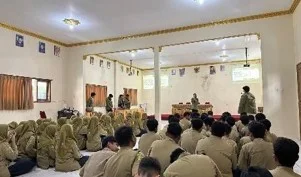
SURABAYA, JurnalPost.com — Efforts to foster environmental awareness from a young age are being continuously encouraged through educational activities and hands-on practice. Faculty members and students from the Universitas Pembangunan Nasional (UPN) “Veteran” East Java recently held a socialization event titled Building a Greener and More Beneficial School Environment at SMA Muhammadiyah 4 Surabaya on 28 October 2026.
The event, which took place from 09.00 to 12.00 WIB, involved 100 tenth-grade students. Beyond gaining an understanding of the importance of environmental conservation, participants were invited to practice planting herbal crops that can be utilized in daily life.
This socialization serves as a form of university engagement in building environmental awareness among the younger generation. Through an educational approach and field practice, students are expected to not only understand environmental issues in theory but also apply positive habits in their daily activities.
Fostering Environmental Awareness from an Early Age
The younger generation plays a vital role as agents of change agent of change in creating a better society. This role is not only related to technological and educational development but also encompasses concern for social and environmental issues.
Amidst the increasing digital activity of the younger generation, the experience of interacting directly with the surrounding environment is becoming increasingly important. Social activities involving students can serve as a means to strengthen sensitivity, build teamwork, and foster a sense of shared responsibility.
Schools are strategic places to shape environmentally conscious character. A clean, green, and well-organized school environment not only provides comfort for learning activities but also serves as a medium for learning about the importance of maintaining ecological balance.
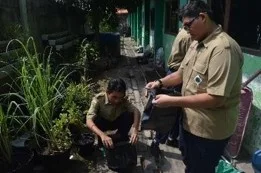
Through this socialization, students of SMA Muhammadiyah 4 Surabaya were encouraged to understand that environmental protection can begin with simple actions, such as caring for plants, utilizing available land, and maintaining the cleanliness of the school area.
Herbal Planting Practice
One of the main activities in this socialization was the hands-on practice of planting herbal crops.
Students received explanations regarding the importance of plants for the environment while being introduced to the benefits of herbal plants that can be cultivated around their homes or schools.
The planting practice was conducted to provide a more concrete learning experience. By being directly involved, students are expected to understand the basic stages of planting and the importance of plant care to ensure healthy growth.
This activity also served as an opportunity for students to learn about natural resources that have practical value in daily life.
Herbal plants were chosen as learning material due to their wide potential for utilization. In addition to supporting greening efforts, various types of herbal plants can be used for household needs or developed into products with economic value.
This approach is expected to encourage students to view gardening not just as a greening activity, but also as a skill beneficial for their future.
Introducing Business Opportunities from Herbal Plants
In addition to discussing environmental conservation, faculty and students from UPN Veteran East Java provided insights into business opportunities that can be developed through herbal plant cultivation.
The material aimed to broaden students' perspectives on the relationship between natural resource utilization, practical skills, and entrepreneurial activities.
Tenth-grade students were selected as participants because they still have ample time to identify their interests, develop skills, and consider their educational and career choices after completing secondary school.
By introducing business opportunities early on, this activity is expected to foster creativity and the students' ability to identify economic potential in their surroundings.
Productive use of herbal plants can also serve as an example of how activities that support environmental sustainability can go hand-in-hand with entrepreneurial skill development.
School as a Place for Character Building
Environmental awareness cannot be built solely through classroom lectures. Habituation and direct involvement are necessary for these values to become part of daily behavior.
Schools play a crucial role in shaping student character so they can manage and protect the environment responsibly.
A perspective that views humans as free to exploit nature without regard for sustainability can lead to environmental degradation. Therefore, understanding the relationship between humans and nature needs to be introduced from school age.
Through planting activities, students are invited to realize that the environment is an essential part of human life that must be protected together.
This activity also encourages the creation of a school environment that is more comfortable, beautiful, and supportive of the learning process.
Faculty and students from UPN Veteran East Java hope that the knowledge and experience gained by students will not end once the socialization event concludes.
The habit of planting and caring for plants is expected to be continuously applied, both in the school environment and at their respective homes.
Thus, the activity Building a Greener and More Beneficial School Environment not only serves as a means of environmental education but also as a step toward shaping a younger generation that possesses social concern, ecological responsibility, and the ability to utilize natural potential wisely.
Author: Herlina Suksmawati — Lecturer in Communication Science, UPN “Veteran” East Java





Comments 0
Write a Comment Share your response