

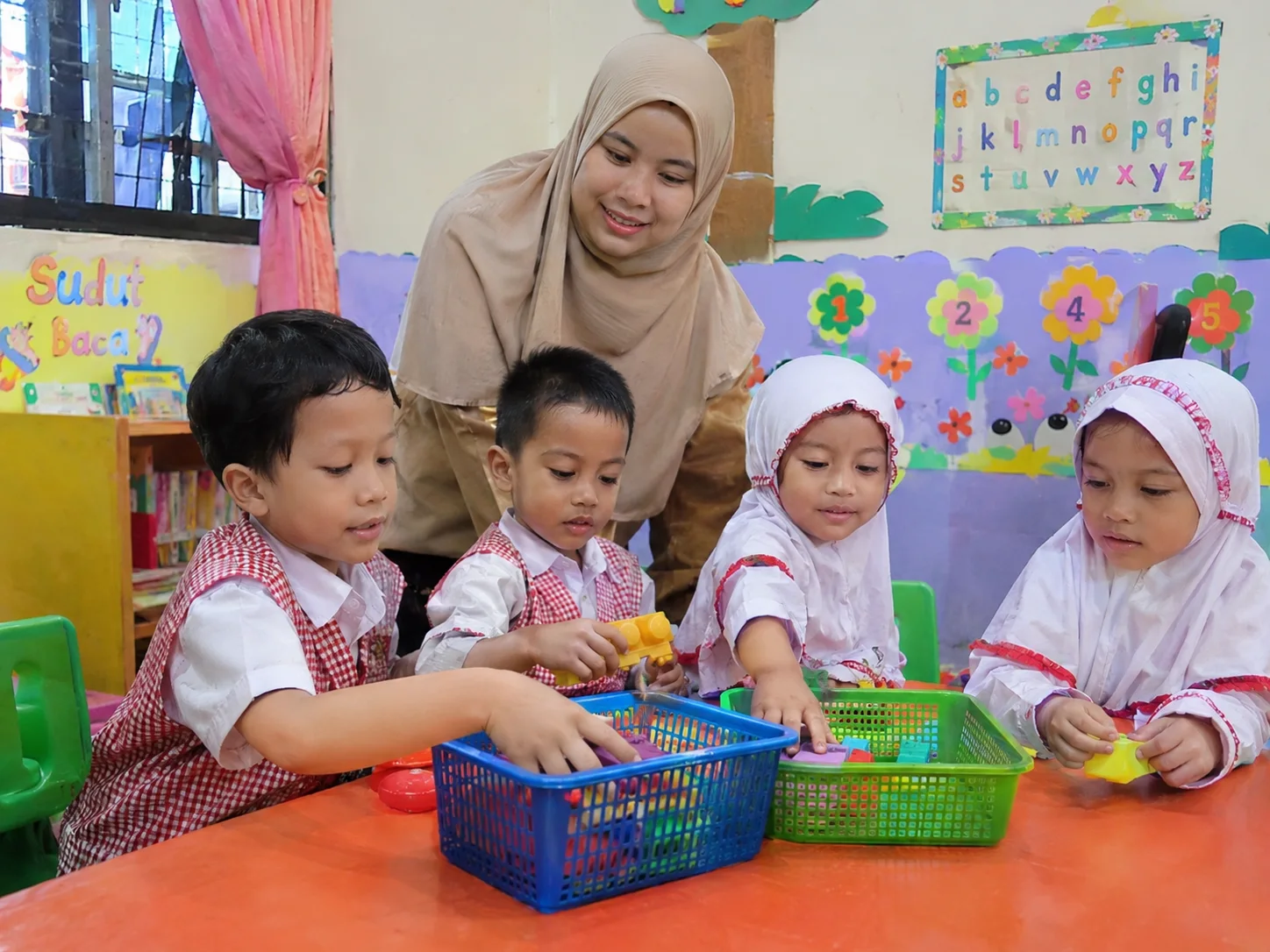
JurnalPost.com – Independence is a vital skill that needs to be instilled in children from an early age. This ability is not just about a child's courage to do things without help, but also encompasses responsibility, self-confidence, and the habit of completing daily tasks according to their developmental stage.
In a kindergarten environment, teachers play a crucial role in helping children build these habits. Through simple activities, such as tidying up toys, clearing away dining utensils, and completing tasks independently, children can learn to become more self-reliant individuals.
However, the development of independence varies from child to child. Some children are capable of performing activities without much assistance, while others still require guidance and support.
This condition was observed at TK Nurul Hidayah on 26 October 2026. Observations of 18 children in Group B, aged 5–6 years, showed that most children still required teacher guidance when performing daily classroom activities.
Results of Independence Observations in Children at TK Nurul Hidayah
The observation was conducted using a descriptive approach by monitoring children's behavior during classroom learning activities.
Three main activities were the focus: tidying up toys after use, clearing away dining areas after meals, and completing tasks independently.
Based on observation records, 8 children, or 44.4 percent, were already capable of performing activities on their own. Meanwhile, 10 children, or 55.6 percent, still required teacher guidance.
These results show that the level of independence among the observed group remains diverse. Some children are accustomed to performing activities without constant reminders, while others still need prompts to complete their tasks.
Nevertheless, these observation results cannot be used to assess all aspects of a child's independence development. The available data provides a general overview and does not yet separate results based on each specific activity observed.
These findings highlight the importance of providing support tailored to each child's needs. Teachers must provide opportunities for children to learn independence without forcing skills that are not yet appropriate for their developmental stage.
Teachers as Role Models in Building Independence
One way to develop a child's independence is through modeling. At an early age, children learn significantly by observing and imitating the behavior of adults around them, including their teachers.
During learning activities, teachers can demonstrate how to store toys, organize learning materials, or clear away dining equipment after use.
After providing an example, teachers need to give children the opportunity to try doing it themselves.
This approach helps children understand that every activity carries a responsibility that needs to be fulfilled.
Teachers should also avoid the habit of taking over tasks too quickly. When a child encounters difficulty, assistance should be provided gradually so they still have the opportunity to try.
Cultivating Independence Through Daily Activities
Independence is not formed overnight. Children require consistent practice for independent behavior to develop into a habit.
In kindergarten, habituation can be applied through simple activities relevant to the child's daily life.
For example, after playing, children are encouraged to return toys to their storage area. When finished eating, they are guided to tidy up the equipment used. Similarly, when working on tasks, children are encouraged to try completing them according to their abilities.
These seemingly simple activities are beneficial in building a sense of responsibility and the ability to care for oneself.
Habituation should also be carried out in a fun atmosphere. Children should not feel pressured when they are not yet able to complete an activity.
Instead, teachers can provide easy-to-understand guidance and appreciate every effort the child makes.
The Importance of Teacher Motivation and Support
Beyond being role models, teachers act as motivators, encouraging children to have the courage to try.
At the age of 5–6 years, children are still in the process of developing social, emotional, and daily living skills. Therefore, they require positive support when facing difficulties.
Praise for a child's effort can serve as a form of motivation. Recognition does not have to be given only when a child successfully completes an entire task, but also when they show the willingness to try.
For instance, when a child attempts to tidy up toys on their own, the teacher can express appreciation for their effort.
Through this approach, children are expected to become more confident in their abilities and less likely to give up when facing activities they perceive as difficult.
Support must also be tailored to each child's condition. Teachers should avoid comparing one child's abilities with their peers, as every child has a different developmental process.
Collaboration Between Teachers and Parents is Essential
Developing a child's independence cannot be done at school alone. The role of parents is also a vital part of building sustainable habits.
The independent habits applied by teachers in the classroom need to be supported through daily activities at home.
Parents can provide opportunities for children to store toys, clear away dining equipment, prepare personal items, or perform other simple activities according to their abilities.
In this process, parents need to trust the child to try before offering assistance.
If a child experiences difficulty, support remains necessary. However, assistance should not immediately replace the child's entire effort.
Communication between teachers and parents is also important so that the habits applied at school can be continued in the family environment.
With consistent support, children have more opportunities to develop self-confidence and responsibility.
Building Children's Independence Gradually
Observations at TK Nurul Hidayah show that developing independence remains a key part of early childhood education activities.
Of the 18 children observed, 55.6 percent still required teacher guidance. These findings provide an overview of the support needs within the observed group, rather than a conclusion regarding the abilities of all young children.
Therefore, teachers need to continue providing learning activities that offer space for children to try, take initiative, and complete simple responsibilities.
Schools can also support this process by providing a child-friendly environment, including toy storage and learning equipment that is easily accessible.
Ultimately, building independence does not mean letting children do everything without help. Independence actually develops when children receive appropriate guidance, opportunities to learn from experience, and support from their surrounding environment.
Through teacher modeling, consistent habituation, positive motivation, and cooperation with parents, children are expected to become increasingly capable of performing daily activities independently according to their developmental stage.







Comments 0
Write a Comment Share your response