

Introduction
Student organizations provide opportunities for students to learn leadership, collaboration, and accountability for collective decisions. One of the primary tests of their governance occurs when committees recruit new members. If proximity to the committee can alter how a candidate is evaluated, participants no longer receive equal opportunities.
Findings from the Corruption Eradication Commission (KPK) provide context regarding these risks within the education sector. The Education Integrity Assessment Survey (SPI) 2023, released on 2024, identified cases of students being 'placed' by officials in 38.77 percent of schools and 64.02 percent of higher education institutions surveyed. The KPK also noted the ease with which teachers or lecturers close to leadership could influence outcomes in 52.52 percent of schools and 74.07 percent of campuses surveyed (KPK, 2024). Permana and Setiawan (2024) discussed these findings in a study on corruption in the education sector.
These figures illustrate general educational governance. The extent of 'insider' practices in student organization recruitment falls outside the scope of these specific figures. This article examines how similar patterns can emerge in member selection, the factors driving them, and their impact on the organization's objectivity and integrity.
Understanding 'Insider' Practices
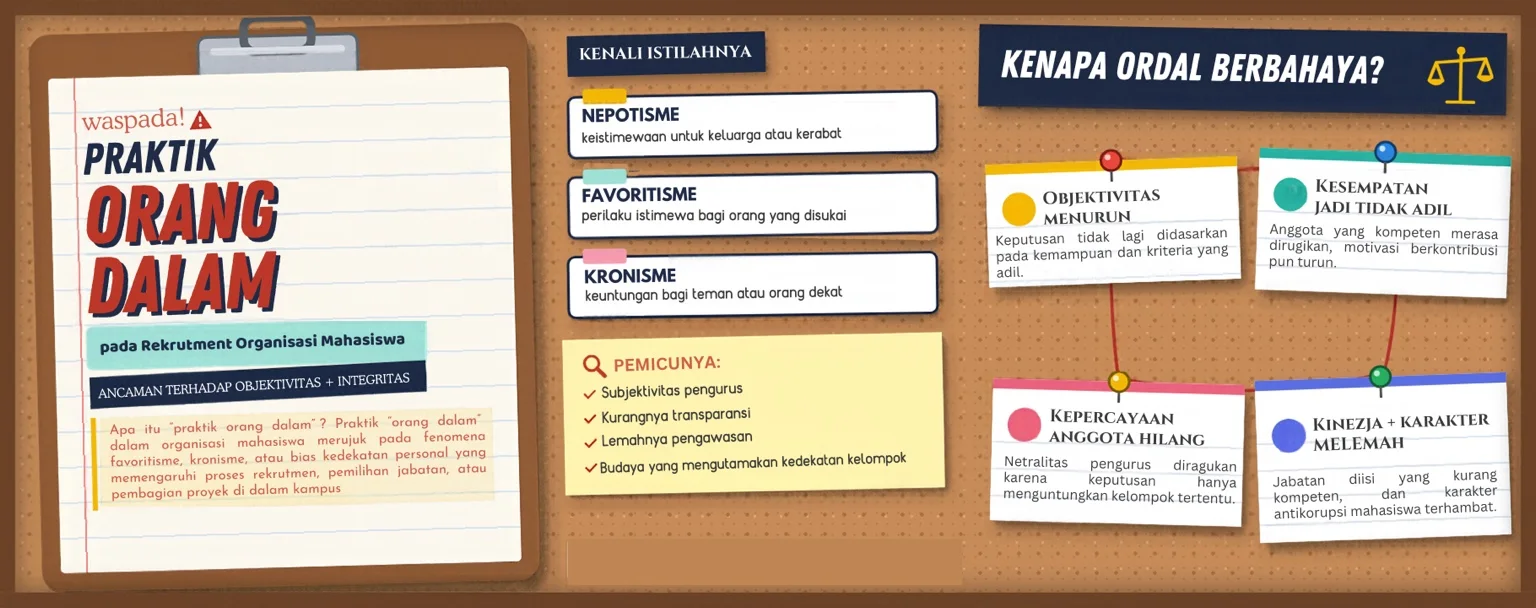
The term 'insider' (often referred to as 'ordal' in Indonesian) is used here to describe the granting of privileges based on proximity to those in positions of authority. In student organization recruitment, this proximity may stem from family ties, friendships, or existing relationships with committee members.
Several terms help define these forms. In the context of this article, nepotism relates to prioritizing family or relatives. Favoritism involves giving preferential treatment to those one likes. Cronyism refers to siding with close friends during selection or recruitment while disregarding qualifications (Language Development and Cultivation Agency, n.d.).
A committee member may already know a candidate. A conflict of interest arises when that relationship influences the evaluation, grants the candidate special access, or leads the committee to relax rules that apply to other participants.
Forms of 'Insider' Practices in Selection
Insider practices can emerge before interviews even begin. Candidates close to committee members, for example, might receive information about schedules, requirements, or selection stages earlier than others. This disparity in access gives some candidates more preparation time.
During the selection process, privileges may take the form of leaked interview questions or guidance provided only to specific candidates. Information and opportunities to ask questions should be provided through the same channels so that every participant can prepare with equal resources.
At the final decision stage, proximity can influence outcomes when the committee prioritizes known candidates, relaxes requirements without clear justification, or ignores evaluation scores. If this pattern continues after admission, the distribution of tasks and the appointment of officers also risk being determined more by relationships with decision-makers than by merit.
Factors Creating Opportunities
Proximity to a candidate may make committee members reluctant to give low scores or feel compelled to prioritize members of their own circle. The study by Permana and Setiawan (2024) on the education sector identifies personal motivation, environmental culture, weak oversight, and institutional governance as factors that facilitate corrupt behavior. This framework helps explain why bias in selection must be addressed through enforceable and monitored regulations.
Risks increase when criteria, scoring weights, and the basis for admission are known only to a select few. Candidates struggle to determine if they are undergoing a fair process. Committees also find it difficult to trace decisions if evaluation results are not documented. If decisions that deviate from procedures are tolerated, preferential treatment may be normalized and passed down to subsequent administrations.
Surya Timur and Sudiarta (2024) emphasize the importance of transparency, accountability, and participation in preventing the abuse of power in student organizations. Sulastri and Utami (2020) also found that the implementation of these three principles in the student organizations they studied still faces significant obstacles.
Impact on Objectivity and Trust
Selection loses its objectivity when the focus shifts from competence, interest, and commitment to proximity to the committee. Qualified candidates may lose their opportunity. In the long term, students may become reluctant to register or participate because they doubt the value of following established procedures.
Member trust can also diminish if the committee cannot explain decisions based on previously announced criteria. If the placement of members and officers ignores the alignment of skills with tasks, the coordination and execution of work programs are also at risk. The impact affects both prospective members and the organization, which relies on their contributions.
Integrity and Prevention in Recruitment
Anti-corruption education provides students with a framework to evaluate how authority is exercised. In a study by Zulqarnain et al. (2022), all 23 new student participants viewed civic and anti-corruption education as important. Basri et al. (2022) also reported that anti-corruption education explained 13.69 percent of the variation in student integrity in their research. These figures represent the results within the context of those specific studies.
Student organizations can apply these principles by announcing requirements, stages, and selection criteria before registration. During interviews, committees can use core questions and standardized scoring rubrics. If an evaluator has a close relationship with a candidate, they should disclose the potential conflict of interest and defer the evaluation of that candidate to other committee members.
Committees should also maintain evaluation records and provide a mechanism for lodging complaints regarding suspected procedural irregularities. Candidates can receive explanations regarding the stages and general basis for decisions, while individual participant scores remain protected. Post-recruitment evaluations provide the next administration with a foundation for improving the process.
Conclusion
Insider practices can influence selection from the initial dissemination of information to the final announcement of results. The impacts include the loss of opportunities for qualified candidates, a decline in trust toward the committee, and the placement of members who may not be well-suited to the organization's needs. Announcing criteria in advance, maintaining consistent evaluation, and establishing mechanisms to review decisions help student organizations ensure accountability in their recruitment processes.
References
- Language Development and Cultivation Agency. (n.d.). Favoritisme. In Online Great Dictionary of the Indonesian Language (KBBI). Favoritism entry.
- Language Development and Cultivation Agency. (n.d.). Kronisme. In Online Great Dictionary of the Indonesian Language (KBBI). Cronyism entry.
- Language Development and Cultivation Agency. (n.d.). Nepotisme. In Online Great Dictionary of the Indonesian Language (KBBI). Nepotism entry.
- Basri, J., Sulaiman, H., & Indriyani, I. (2022). Anti-corruption education and its influence on student integrity. Almarhalah: Journal of Islamic Education, 6(1), 10–18. DOI.
- Corruption Eradication Commission. (2024, 3 May). Nepotism practices and BOS fund irregularities in the academic sector.
- Permana, S., & Setiawan, M. (2024). Corruption in the education sector in Indonesia: Reality, causes, and solutions. Integritas: Anti-Corruption Journal, 10(2), 249–268. DOI.
- Sulastri, S., & Utami, I. S. (2020). Implementation of good governance in student organizations. Journal of Civic Education, 7(2), 87–96. Journal website.
- Surya Timur, M. A., & Sudiarta, I. K. (2024). Application of good governance principles as a preventive instrument against abuse of power in student organizations. Kertha Wicara: Journal of Legal Science, 13(8), 405–420. Journal website.
- Zulqarnain, Z., Ikhlas, M., & Ilhami, R. (2022). Perception of college students on civic and anti-corruption education: Importance and relevance. Integritas: Anti-Corruption Journal, 8(1), 123–134. DOI.
Comments 0
Write a Comment Share your response