

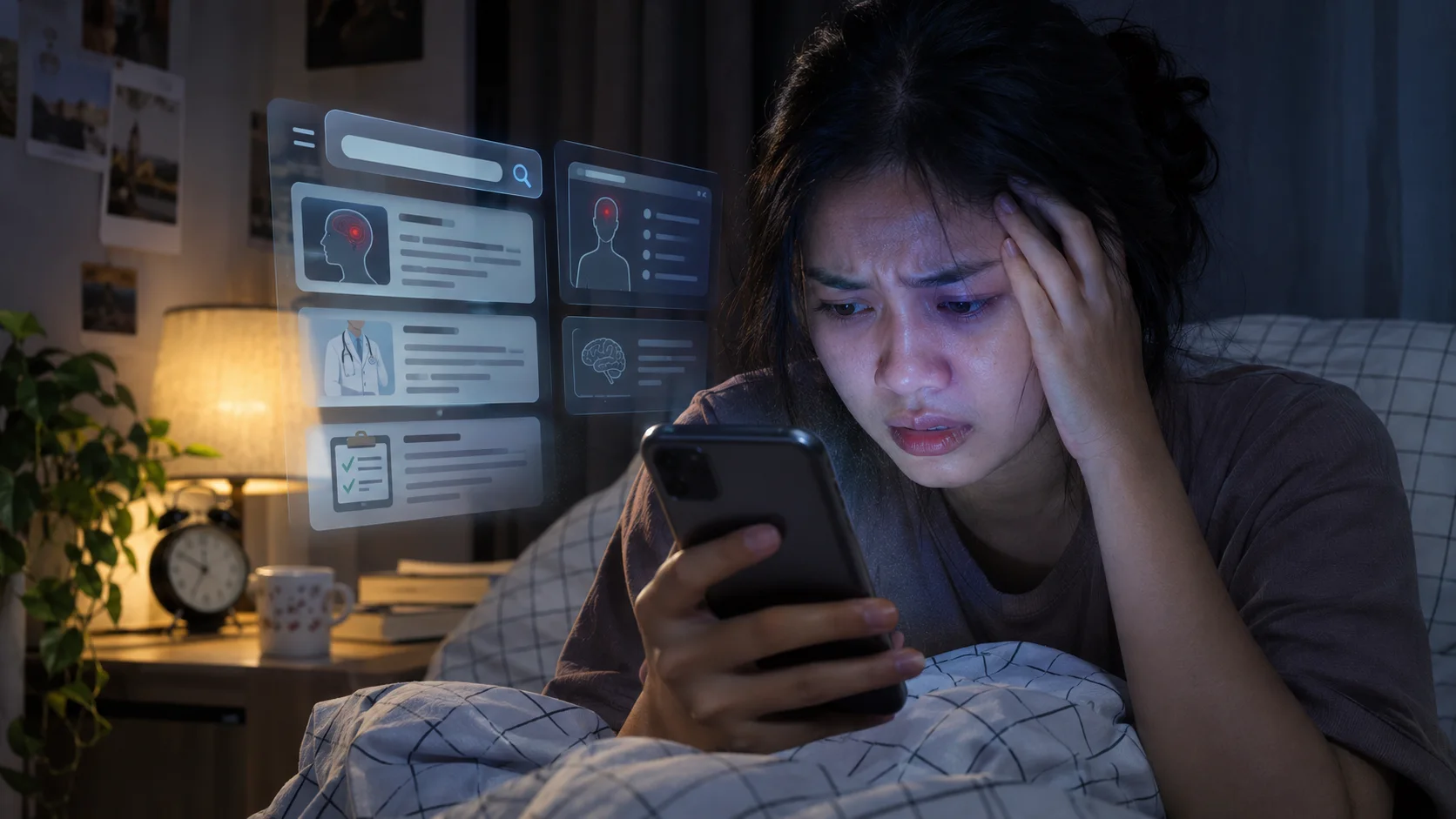
JurnalPost.com - Have you ever experienced a migraine and tried to find the cause on Google? You might have initially just wanted to confirm if the discomfort was due to lack of sleep, fatigue, or stress. However, after reading through search results, various possibilities of serious illnesses appeared, leaving you feeling even more unsettled.
Imagine the scene: it is two in the morning, your head is throbbing, you cannot sleep, and your hands start typing your symptoms into a search engine. Within seconds, the screen displays a range of health information, from common causes to terrifying, rare diseases.
The initial intention was to find peace of mind, but panic ensued instead. The more information you read, the greater your anxiety became. Consequently, sleep became even more elusive, and your mind was filled with the worst-case scenarios.
This phenomenon is known as cyberchondria, a condition where excessive searching for health information on the internet actually increases a person's anxiety regarding the possibility of having a disease.
However, an interesting question arises: is this habit solely because people use the internet too often? Or are there other issues that lead someone to prefer asking Google over consulting a healthcare professional directly?
When Google Becomes the Go-To for Health Advice
The internet has changed how society obtains health information. While people once had to read medical books or ask a doctor directly, various explanations for symptoms can now be found with just a few taps on a phone screen.
This convenience certainly has benefits. People can learn basic health information, understand the importance of disease prevention, and know when to seek medical help.
Unfortunately, easily accessible information is not always accompanied by proper understanding.
Search engines do not know a person's overall condition. Google does not know if the headache you are feeling appeared after staying up for three nights, skipping a meal, experiencing work pressure, or if you have a specific medical history.
Search engines only display information based on keywords. Meanwhile, determining a diagnosis requires much more complex medical examination and consideration.
The problem arises when someone assumes that all the potential diseases found on the internet are things they might be experiencing.
Symptoms that actually have many possible causes can be linked to the most serious diseases. As a result, a search that should have helped clarify a health condition instead amplifies fear.
In such a state, a person can get trapped in a cycle of anxiety. When they feel worried, they search for information. After reading the information, their worry increases. To eliminate that fear, they search again.
This cycle can continue repeatedly without ever producing certainty.
Cyberchondria Is More Than Just a Phone Addiction
The phenomenon of cyberchondria is also found in various studies in Indonesia.
Research by Diah Yusra and her colleagues published in the Journal of Counseling and Education in 2025 involved 350 students to analyze the tendency toward cyberchondria based on age and social media usage intensity.
The results showed that the level of cyberchondria among respondents was generally in the moderate category. The highest tendency was found in the age group of 21–24 years old with a social media usage duration of about four to six hours a day.
These findings suggest that digital technology usage is related to how some students respond to health information. However, this study does not necessarily prove that the longer someone uses social media, the more certain they are to experience cyberchondria.
Another study conducted by Gita Trisyaramita Salim and her colleagues on 337 migrant students in Bandung in 2024 found a strong positive correlation between rumination and cyberchondria.
Rumination is the tendency to think about an issue repeatedly, especially things that cause worry.
Someone who keeps thinking about a potential illness may be driven to search for information repeatedly. Instead of getting a reassuring answer, they find new information that raises further questions.
For students, this habit can disrupt study concentration, rest time, and daily activities if the anxiety becomes difficult to control.
Why Do People Prefer Asking Google?
From a sociological perspective, cyberchondria cannot be understood solely as an individual behavioral issue.
We also need to consider the social conditions that influence how people seek health assistance.
For some, visiting a health facility is not a simple matter. Some must travel long distances to reach a community health center or hospital. Others have to sacrifice working hours to wait in line for an examination.
For daily wage earners, losing a day of work can mean a reduction in family income.
On the other hand, consultation costs, limited health facilities, and a lack of understanding regarding health insurance procedures can also be barriers.
Meanwhile, Google is available 24 hours a day, is easy to access, and does not require direct consultation fees.
This situation helps explain why someone might choose to search for health information independently before seeing a medical professional.
This means that the habit of searching for symptoms online does not always arise because people are unwise in using technology. In some circumstances, the behavior may be related to the limited options available.
However, not everyone who experiences cyberchondria faces healthcare access barriers. Psychological factors, previous illness experiences, and the need for certainty also play a role.
This issue shows that health is not only related to the body's condition but also to the social environment, economy, and access to public services.
Similar Phenomena Occur in Other Countries
Cyberchondria is not just an issue for Indonesian society.
Research published in February 2026 regarding the experiences of millennials in the Philippines working from home showed a pattern of repetitive health information searching that can reinforce anxiety.
In that study, respondents described how information seeking, which initially aimed to gain certainty, could develop into worry, emotional pressure, and activity disruption.
The condition of working from home, which blurs the lines between work and personal life, is an important context in understanding the respondents' experiences.
These findings show that the ease of accessing information does not always result in a sense of security.
Health information can indeed help someone recognize symptoms. However, when used excessively without adequate understanding, that information also has the potential to amplify anxiety.
This is where digital health literacy becomes increasingly important.
It is not enough for people to simply have the ability to use a search engine. They also need to be able to distinguish trustworthy sources, understand the limitations of online information, and know when medical examination is necessary.
The Solution Is Not Just Stopping Google Searches
Some might argue that the simplest way to overcome cyberchondria is to stop searching for disease symptoms on the internet.
That advice can indeed help reduce excessive searching. However, the problem is not as simple as asking people to stay away from search engines.
What if someone needs health information but does not know who to ask? What if health facilities are far from their home or difficult to reach due to time and cost constraints?
Therefore, solving this issue requires a two-pronged approach.
From the individual side, people need to build the habit of seeking health information more wisely. Information should be obtained from official sources, such as the Ministry of Health, professional health organizations, or credible health service facilities.
It is also important to understand that internet search results are not a diagnosis. Symptoms that look similar do not necessarily have the same cause.
If complaints persist, worsen, or cause prolonged anxiety, consulting a health professional is a more appropriate step than continuously opening new search pages. For emergency symptoms, such as a sudden and severe headache or one accompanied by neurological disturbances, medical help must be sought immediately.
Meanwhile, from the government and healthcare system side, efforts are needed to expand access to services that are affordable, easy to use, and trustworthy.
Strengthening primary health facilities, ensuring an even distribution of medical personnel, and developing remote health consultation services can be part of the solution.
The government, health professionals, educational institutions, and digital platforms also need to improve health literacy so that the public is not easily trapped by misleading information.
When You Seek Peace but Find Fear Instead
Ultimately, cyberchondria reveals another side of digital life. Technology created to facilitate access to information can also become a source of anxiety when that information is not understood correctly.
This phenomenon reminds us that health issues cannot be separated from the social conditions of society.
It is true that every individual has a responsibility to use the internet wisely. However, that responsibility also needs to be supported by a healthcare system that is easy to reach and capable of answering the public's needs.
We cannot simply blame someone for searching for symptoms on Google without understanding the reasons why they prefer asking a screen over seeing a doctor.
It could be that what they actually need is not information about dozens of potential diseases, but a simple explanation from a trusted health professional.
So, is cyberchondria entirely the fault of internet users?
In our view, the answer is not that simple.
As long as there are people who struggle to access healthcare, as long as reliable medical information is not easily understood, and as long as anxiety finds answers faster from a search engine than from a health professional, this issue will remain a challenge.
Because when someone searches for answers about their health at two in the morning, what they are actually hoping for is not a list of scary diseases, but certainty, help, and a little peace of mind.



Comments 0
Write a Comment Share your response