

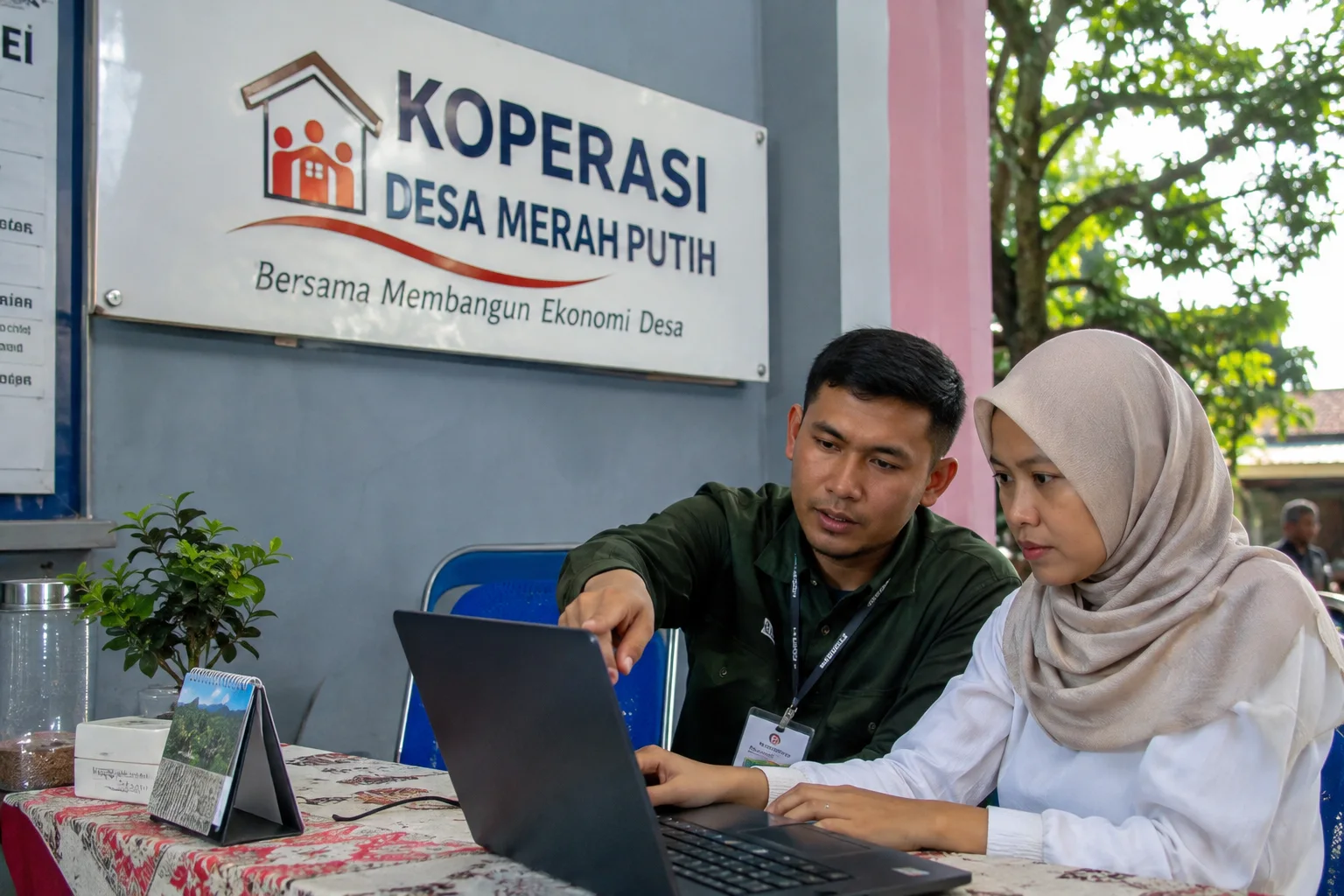
JurnalPost.com - Digitalization is a crucial step in efforts to improve the competitiveness of cooperatives in Indonesia. Technological advancements provide opportunities for cooperatives to improve services, increase operational efficiency, and present more transparent and accountable financial management.
However, the implementation of digital technology does not always run smoothly. Limited human resources, low digital literacy, infrastructure issues, and data security remain challenges faced by various cooperatives.
Amid these developments, the government continues to encourage cooperative transformation, one of which is through the Merah Putih Village/Sub-district Cooperative program and the development of a digital-based cooperative monitoring system.
Based on data from the Ministry of Cooperatives reported in July 2026, the number of cooperatives in Indonesia reached 224,256 units with 34,263,830 members as of 7 July 2026. Although the number is large, the contribution of cooperatives to the national economy is still considered suboptimal.
This condition indicates that the increase in the number of cooperatives needs to be followed by strengthening management quality, organizational professionalism, and the use of technology that suits the needs of members.
Cooperative Digitalization Is More Than Just Using Applications
Cooperative digitalization is often understood as the process of replacing manual recording with computer systems or digital applications. In fact, digital transformation has a much broader scope.
Digitalization is also related to changes in work patterns, organizational governance, service quality, and the ability of administrators and members to utilize technology.
Albarkati and his colleagues (2026) explain that cooperative digital transformation involves adjusting strategies, processes, structures, and organizational culture.
A similar view was expressed by Wahyuningsih and Sobariah (2026), who placed the application of financial technology or financial technology (fintech) as a process involving the relationship between technology, humans, and governance.
Thus, the success of digitalization is not sufficiently measured by the existence of applications or electronic systems. The more important thing is the extent to which technology provides benefits to the cooperative and all its members.
This is also related to the Technology Acceptance Model developed by Davis (1989). The model explains that technology acceptance is influenced by user perceptions regarding its benefits and ease of use.
Meanwhile, Rogers' diffusion of innovation theory (2003) shows that technology adoption occurs gradually through a process of communication and adjustment within the social environment.
Both approaches are relevant to the condition of cooperatives, which have members from various age groups, education levels, and technology usage capabilities.
Benefits of Digitalization for Cooperative Performance
A number of studies show that the application of digital technology is related to increased service efficiency, administrative accuracy, and transparency of cooperative management.
A literature review of eight studies published throughout 2023–2026 shows several main benefits of digitalization.
Increasing Operational Efficiency
One of the most tangible benefits is the acceleration of service and administrative processes.
Sasmito and Syihabuddin's research (2025) on digitalization at Kospin Jasa Surakarta shows that the use of technology helps accelerate transactions, reduce administrative errors, and increase financial data transparency.
Digital systems allow various activities that were previously performed manually to become more structured.
Transaction recording, savings and loan management, report preparation, and monitoring of cooperative activities can be done more practically.
Albarkati and his colleagues (2026) also found that data integration in one platform makes it easier for administrators and supervisors to monitor cooperative activities without having to wait for manual report preparation.
Strengthening Financial Transparency
Digitalization opens opportunities for members to obtain financial information more easily.
Through an integrated system, members can access balance information, transaction history, and other cooperative services according to the available facilities.
Research by Wahyuningsih and Sobariah (2026) at the savings and loan unit of Primkoppol Satbrimob Polda West Java shows that the ease of accessing services obtained a score of 43 out of 50.
Meanwhile, access to financial information obtained a score of 41 and transaction speed received a score of 40.
These findings show that technology can help increase information openness and build member trust in cooperative management.
However, digital transparency still requires adequate supervision and accountability mechanisms.
Supporting Management Performance
The benefits of digitalization are also seen in the increased productivity of cooperative managers.
Supriyadi and Purnomo (2024), through research on 94 employees from six credit cooperatives or credit unions members of Puskhat, found a positive and significant relationship between digitalization and employee performance.
In that study, digitalization explained about 42.1 percent of the variation in employee performance.
Meanwhile, about 57.9 percent of other variations are related to factors outside the research model, such as motivation, leadership, and other organizational aspects.
These results indicate that the use of technology can support performance, but it is not the only determining factor for the success of cooperative management.
Challenges of Cooperative Digitalization in Indonesia
Although it provides various benefits, the implementation of digitalization still faces a number of obstacles.
Based on the results of the research synthesis, the biggest challenges are not only related to the availability of technology, but also the readiness of human resources and organizational governance.
Low Digital Literacy
The ability of administrators and members to use technology is one of the important factors in the digital transformation process.
Pelix and his colleagues (2025) identified low digital literacy as one of the main obstacles, especially in cooperatives located in rural areas.
A similar condition was found in the research of Albarkati and his colleagues (2026), which showed that younger members tend to be more active in using digital services, while some other members still rely on conventional services.
At the Merah Putih Cooperative in Ketabang Sub-district, Surabaya, Bahri and his colleagues (2026) found limited ability among some administrators to use applications and websites.
This problem causes the use of technology in several activities to still require assistance from other parties.
Infrastructure and Cost Limitations
Not all cooperatives have adequate technology facilities.
The availability of internet networks, computer equipment, application development costs, and system maintenance needs are important considerations in the implementation of digitalization.
Research by Supriyadi and Purnomo (2024) shows that infrastructure and internet speed received the lowest scores among 13 digitalization indicators studied, although they were still in the good category.
This shows that the quality of infrastructure still needs attention so that technology can be utilized optimally.
Cooperatives with limited budgets also need to consider systems that are appropriate for their scale of business, rather than just following technological developments.
Data Security and Oversight Systems
The use of digital technology brings new responsibilities in data protection and transaction security.
Member personal information, financial data, and transaction history need to be managed with adequate security systems.
In the research of Wahyuningsih and Sobariah (2026), the personal data security aspect obtained a score of 32 out of 50.
Meanwhile, the transaction audit and periodic system update indicators each received a score of 24 out of 50.
These findings show that the ease of using technology is not always followed by the readiness of security and oversight mechanisms.
Without adequate protection, digitalization has the potential to cause new problems, including data leaks, misuse of information, and declining member trust.
Resistance to Change
The change from a conventional system to a digital system can also cause rejection or hesitation.
Some administrators and members feel more comfortable using old procedures that have been applied for years.
Albarkati and his colleagues (2026) found that organizational culture is one of the factors that influence a cooperative's readiness to implement a digital system.
Therefore, digital transformation requires communication, training, and mentoring so that all members can understand the benefits of these changes.
Development of Merah Putih Cooperative Digitalization
Efforts to digitalize cooperatives are receiving increasing attention in line with the development of the Merah Putih Village/Sub-district Cooperative program.
On 21 July 2025, the government inaugurated 80,081 Merah Putih Village Cooperatives as part of a community economic strengthening program.
Then, in January 2026, the Minister of Cooperatives stated that more than 83 thousand Merah Putih Cooperatives had been incorporated, with about 1.65 million members and 690 thousand administrators.
The government is also developing a digital-based monitoring system through a command center launched in December 2025.
The system is directed to help monitor the condition of cooperatives, including distinguishing between cooperatives considered healthy and those requiring further attention.
However, the success of the monitoring system still depends on the quality of reports submitted by each cooperative.
If administrators do not yet have adequate recording and reporting capabilities, the data entering the system may not accurately reflect the condition of the cooperative.
Therefore, technology development needs to go hand in hand with increasing the capacity of administrators and strengthening governance.
Critical Notes on Research Results
Although various studies show the benefits of digitalization, the results still need to be understood with caution.
This study uses a literature review method by examining eight national research articles published in 2023–2026. Seven articles were examined through full text, while one article was examined through its abstract.
The analysis was carried out by grouping the findings into three main themes: benefits, challenges, and strategies for cooperative digitalization.
Two quantitative studies discussing the relationship between digitalization and financial performance, namely Fadhilah and Darmawati (2023) and Perdhiansyah and Kusmana (2024), reported almost identical statistical results despite having different research objects and periods.
Both studies used indicators of Return on Assets (ROA), Return on Equity (ROE), and the ratio of operating expenses to operating income (BOPO).
The similarity of these statistical results requires further examination so that they cannot be directly treated as two completely independent empirical pieces of evidence.
In addition, there are differences in the mention of the research period in one of the articles as well as issues with the definition of the BOPO ratio that need to be considered in interpreting the results.
Therefore, findings regarding improved financial performance should be understood as initial indications that still require broader testing.
Most of the studies reviewed also used case study approaches with limited scope.
The results of research on one cooperative or a specific region cannot necessarily be generalized to all cooperatives in Indonesia.
Strategies to Strengthen Cooperative Digitalization
For digitalization to provide sustainable benefits, a strategy is needed that does not just focus on procuring devices or applications.
Some steps that can be taken include the following.
First, improve the digital literacy of administrators and members.
Training needs to be carried out gradually and continuously, especially for members who are not used to using digital services.
Training materials should be adjusted to the operational needs of the cooperative, ranging from transaction recording to the use of financial applications.
Second, choose technology that is easy to use.
Cooperatives need to consider system simplicity, ease of access, operational costs, and the capabilities of their users.
Applications that are too complicated can actually hinder work if not accompanied by mentoring.
Third, strengthen data security and transaction oversight.
The application of technology must be equipped with user access settings, personal information protection, transaction activity recording, and periodic system updates.
Fourth, build cooperation with technology providers.
Collaboration with digital financial service providers can be an alternative for cooperatives that have limited resources to develop their own systems.
However, such cooperation still requires consideration regarding costs, security, and service suitability.
Fifth, maintain the principles of openness and member participation.
Digitalization should not cause some members to lose the opportunity to obtain information or participate in cooperative activities.
Administrators need to ensure that digital services remain inclusively accessible, including by members who require assistance.
Digitalization Must Strengthen Cooperative Institutions
Digitalization has great potential to increase the efficiency, transparency, and quality of cooperative services in Indonesia.
Various studies show that the application of technology can accelerate transactions, reduce administrative errors, and facilitate financial information management.
However, this success is strongly influenced by the readiness of administrators, the ability of members, infrastructure support, data security, and organizational culture.
The development of the Merah Putih Village/Sub-district Cooperative shows the importance of human resource readiness in supporting large-scale digital transformation policies.
It is not enough for a cooperative to just have an electronic system. Technology must also be able to be used effectively, managed responsibly, and provide real benefits to members.
This study has limitations because it only uses eight studies with a narrative synthesis approach, not a systematic review. Therefore, further research with a broader scope is needed, including evaluations before and after digitalization and measurements of member participation.
Ultimately, cooperative digitalization needs to be understood as an institutional transformation, not just the procurement of applications or technology devices.
When technology is supported by competent human resources, transparent governance, and strong member participation, cooperatives have a greater opportunity to develop professionally and sustainably.
Bibliography
Albarkati, A. R. A., Fibrilian, Z., Alhidayatullah, Sobar, A., & Rianto, T. (2026). Digital-based cooperative organizational transformation: Adaptation, challenges, and opportunities towards sustainable cooperatives. Jurnal Inspirasi Ilmu Manajemen, 5(1).
Bahri, D. F. D., Arujie, I. R., Izzah, N., Irsyadhie, M. R., Nabila, N. K., & Sumiarsa, F. F. (2026). Empowering cooperatives through socialization and creation of financial report websites in Ketabang Sub-district. Abidumasy, 7(1), 1–9.
Davis, F. D. (1989). Perceived usefulness, perceived ease of use, and user acceptance of information technology. MIS Quarterly, 13(3), 319–340.
Fadhilah, N., & Darmawati. (2023). Digital transformation: Improving the financial performance of sharia cooperatives. Syarikat: Jurnal Rumpun Ekonomi Syariah, 6(2), 532–544.
Pelix, L., Pallangan, M. A., & Tongli, B. (2025). Sustainable growth strategy for savings and loan cooperatives in the digital era. Jurnal Riset Akuntansi Aksioma, 24(1), 70–79.
Perdhiansyah, & Kusmana, E. (2024). Digital transformation improves the financial performance of cooperatives in Pontianak City. Jurnal Eksos, 20(1), 50–54.
Rogers, E. M. (2003). Diffusion of Innovations (5th ed.). Free Press.
Sasmito, S. U., & Syihabuddin, M. (2025). Analysis of digitalization implementation in improving the performance of Koperasi Kospin Jasa Surakarta. RIGGS: Journal of Artificial Intelligence and Digital Business, 4(4), 6754–6760.
Supriyadi, D., & Purnomo, D. H. (2024). The influence of digitalization on cooperative employee performance. Coopetition: Jurnal Ilmiah Manajemen, 15(3), 527–540.
Wahyuningsih, E., & Sobariah, N. S. (2026). Evaluation of the application of financial technology (fintech) in efforts to improve cooperative financial management and its benefits for members. J-COOP, 2(1), 103–110.









Comments 0
Write a Comment Share your response