

JurnalPost.com – A news report that is easy for readers to understand depends on more than just comprehensive information or precise language usage. Behind the arrangement of sentences and paragraphs lie various linguistic elements that interconnect to form meaning and maintain the continuity of information.
The use of pronouns, conjunctions, term repetition, and the relationships between ideas play a crucial role in determining how an event is conveyed to the public. These elements are integral to the formation of cohesion and coherence within a discourse.
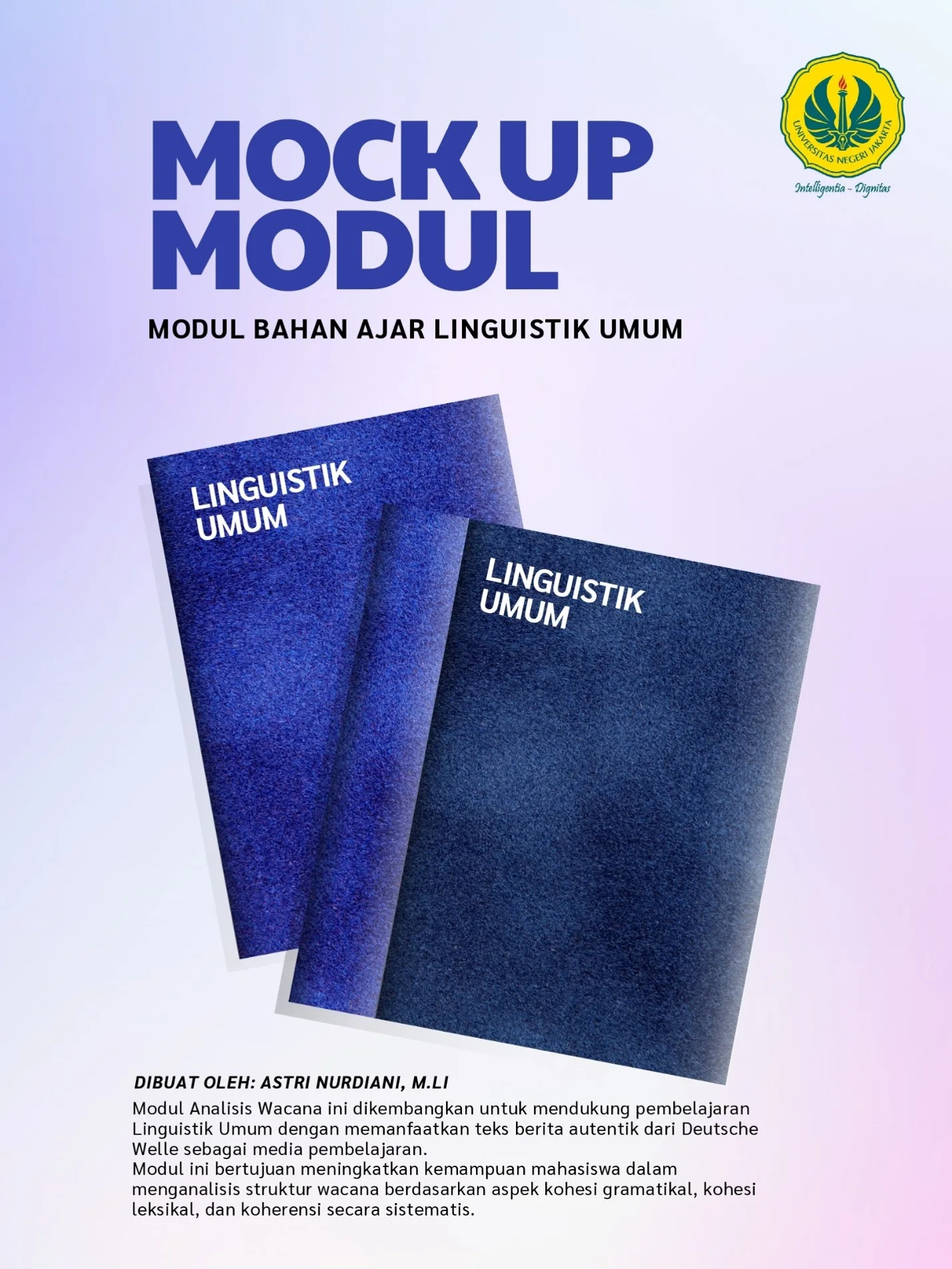
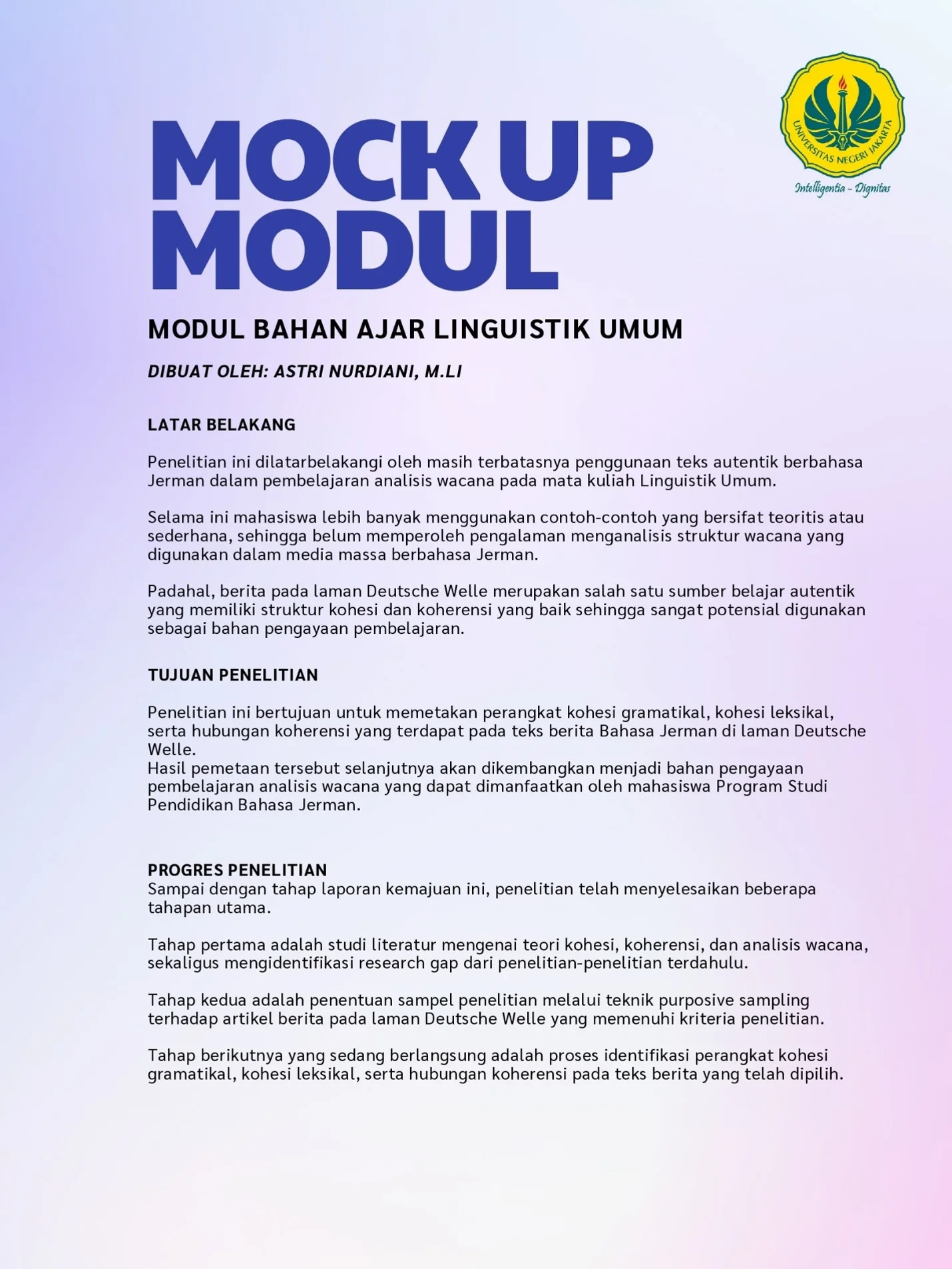
This issue is the focus of a study titled “Development of a General Linguistics Teaching Module through the Mapping of Cohesion and Coherence in German-Language Articles on the Deutsche Welle Website” conducted by Astri Nurdiani, M.Li., a lecturer in German Language Education at the Faculty of Languages and Arts, Universitas Negeri Jakarta (UNJ).
The research examines how language usage and semantic relationships between ideas build the integrity of German-language news texts. The analysis results serve as a foundation for developing General Linguistics learning materials, particularly in the study of discourse analysis.
One of the articles analyzed is titled “Drohnen-Alarm bei Leipzig: Welche Lehren werden gezogen?” or “Drone Alert in Leipzig: What Lessons Can Be Learned?” which was published on the Deutsche Welle (DW) website.
The article discusses drone security issues in the Leipzig/Halle Airport area, Germany, including government responses, expert perspectives, and potential threats to critical infrastructure.
Through this article, the research explores how an event is developed into a news report that possesses comprehensive informational and semantic relationships.
Language that Connects Information in News
The analysis results indicate that news integrity is built through two primary elements: grammatical cohesion and lexical cohesion.
Grammatical cohesion relates to the use of linguistic devices, such as pronouns and conjunctions, which function to connect information within the text. The use of these elements allows news writers to refer back to specific people, events, or issues without having to repeat the same terms continuously.
Meanwhile, lexical cohesion is formed through relationships between vocabulary, whether through word repetition or the use of terms with semantic proximity.
In the analyzed Deutsche Welle article, the use of terms such as Drohne (drone), Flughafen (airport), and Sicherheit (security) helps maintain the focus of the discussion.
These words do not merely appear as information; they act as binders that connect various parts of the report.
The use of varied vocabulary within the same semantic field allows the discussion to develop without losing its direction. Consequently, readers can follow the main issue even when the article presents a wealth of information and perspectives.
These findings demonstrate that word choice in news reporting serves a broader function than simply conveying facts. Language also plays a role in building relationships between pieces of information so that a text can be understood as a unified whole.
From Drone Incidents to Infrastructure Security Issues
Beyond linguistic elements, this research highlights how semantic relationships between ideas, or coherence, are constructed in news reporting.
The analyzed Deutsche Welle article does not just present information regarding the drone incident in the airport area. The discussion expands to include government responses, the readiness of anti-drone defense technology, expert opinions, potential motives, and issues regarding logistics infrastructure security.
This progression of information demonstrates a pattern of relationships between ideas that are arranged incrementally.
Several patterns identified include elaboration or information development, comparison, contrast, cause-and-effect relationships, and providing context for an event.
For example, the discussion regarding anti-drone defense systems provides additional explanation for the security issues that were the initial focus of the report.
Differing perspectives from various parties also broaden how readers understand the issue. Information is not delivered through a single perspective but is developed by presenting various considerations.
The article also links the drone security issue to the DHL container fire incident on 2024. This connection provides historical context regarding security challenges in logistics and transportation activities.
Through such structuring, a news report can move from a concrete event report to a broader discussion without losing its connection to the main topic.
Why are Cohesion and Coherence Important in News Reporting?
In linguistic studies, cohesion and coherence are two complementary aspects that build the integrity of a discourse.
Cohesion emphasizes the relationships between linguistic elements visible in the text structure, while coherence relates to the continuity of meaning and the logical relationships between ideas.
Both have different functions but are inseparable in the process of building reader comprehension.
An article may use many conjunctions, pronouns, or repeated terms. However, the use of these elements does not necessarily result in an easily understood text if the relationships between ideas are not clearly organized.
Conversely, ideas that have logical relationships also require the support of linguistic devices so that information can be conveyed coherently.
Through this research, news integrity is understood not merely as the result of correct grammar usage, but also as the writer's ability to develop information, connect perspectives, and organize the flow of discussion.
This is important because readers do not just receive information from a news report; they also build understanding based on how that information is presented.
Deutsche Welle News as a Resource for German Language Learning
The findings of this research not only contribute to linguistic studies but also open opportunities for utilizing authentic news texts as learning materials for German language studies in higher education.
News published by German-language media can serve as a learning resource that bridges linguistic concepts with real-world language usage.
Through General Linguistics studies, particularly in Discourse Analysis, students can learn how cohesion and coherence elements function within a text.
Students are not only asked to understand definitions or memorize concepts but can also practice identifying pronouns, conjunctions, vocabulary repetition, and semantic relationships between paragraphs.
In addition to improving language analysis skills, the use of news texts allows students to understand the social, political, and cultural contexts that underpin the use of the German language.
This approach can make linguistic learning more contextual because students are directly confronted with examples of authentic language usage.
The mapping of cohesion and coherence analysis results can subsequently be utilized as a basis for compiling teaching modules that help students understand discourse analysis concepts in a more structured manner.
Thus, research on the cohesion and coherence of German-language articles on the Deutsche Welle website demonstrates that language analysis has benefits that extend beyond the study of grammatical structures.
By reading the relationships between language and meaning, both readers and students can understand how a news report is constructed, how information is developed, and how an event is shaped into a complete and understandable discourse.








Comments 0
Write a Comment Share your response