


JurnalPost.com – Literature education serves not only as a means to introduce linguistic works to students but also plays a role in improving literacy skills while introducing Indonesia's cultural richness from an early age.
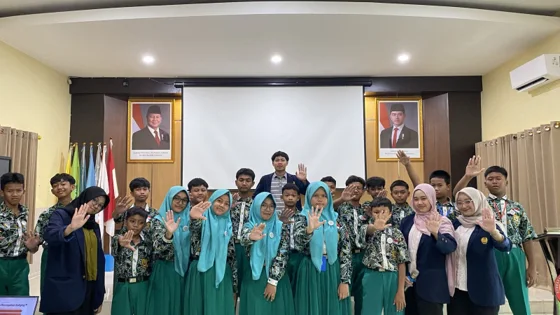
This approach was applied in Indonesian language classes for seventh-grade students at SMP Negeri 2 Banguntapan, Bantul, in September 2026. A total of 32 students participated in a traditional poetry lesson using the Problem Based Learning (PBL) model combined with a card-matching board or matching board.
The activity was conducted by Sheryl Faissa Titania, a student from the Indonesian Language and Literature Education (PBSI) study program at Yogyakarta State University (UNY), as part of her Educational Practice (PK).
The lesson was designed to help students understand the characteristics, elements, and structures of four types of traditional Nusantara poetry: pantun, gurindam, syair, and mantra. Beyond mastering the material, students were encouraged to develop critical thinking, comparative reading, teamwork, and communication skills.
The learning process began with oral trigger questions regarding rhyme schemes and the characteristics of classical poetry. This method was used to gauge students' prior knowledge before they moved into group activities.
Students were then divided into groups of four. Each group received a “Mystery Envelope” containing eight cards featuring shuffled excerpts of poetry stanzas.
Using these cards, students were asked to identify various poetic elements. They counted syllables, observed end-rhyme patterns, distinguished between the opening (sampiran) and content (isi) functions, and recognized the linguistic characteristics used in mantras.
The analysis results were then placed on a worksheet board titled “Traditional Poetry Detective Mission.” Students had to match each card to the poetry category they deemed appropriate based on the text characteristics identified.
Students Learn to Present Arguments
The learning atmosphere became increasingly interactive as each group began presenting their analysis results in front of the class.
Students were not only asked to state whether a text was a pantun, syair, gurindam, or mantra. They also had to explain the reasoning behind their choices based on rhyme patterns, line arrangements, word choices, and text structure.
Inter-group discussions turned the learning process into an activity of cross-checking and comparing findings. Students could ask questions or respond to other groups' opinions if they found discrepancies in the analysis results.
During the activity, the PK student acted as a facilitator. Conceptual reinforcement was provided, especially when students struggled to distinguish the characteristics of certain types of traditional poetry, such as syair and gurindam.
A scaffolding approach, or the provision of gradual learning assistance, was used so that students with different levels of understanding could still follow the learning process.
With this pattern, students who had already mastered the material could assist their group members, while the teacher or facilitator provided guidance when concepts were still not quite right.
Learning Literature Through Tactile Media
The use of a matching board ensured that learning did not just take place through theoretical explanations. Students could interact directly with the material through cards that had to be read, sorted, compared, and placed into specific categories.
This tactile medium also encouraged every group member to engage in the learning process. The process of determining the position of the cards required discussion and consensus before the group finalized their answers.
Through this activity, traditional poetry lessons were directed to be closer to the students' learning experiences while reducing the impression that literature material consists only of theory and rote memorization.
The activity was also linked to the Sustainable Development Goals (SDGs), specifically SDG 4 on Quality Education, through efforts to provide active, inclusive, and enjoyable learning.
Meanwhile, the introduction of pantun, gurindam, syair, and mantra became part of an effort to introduce and foster appreciation for literary traditions and Nusantara cultural heritage, in line with the spirit of cultural heritage preservation in SDG 11, target 11.4.
Learning with similar media can still be developed for other Indonesian language materials. Classification game models, text cards, and matching boards can be adapted to the competencies to be achieved in learning activities.
After understanding the elements and structures of various types of traditional poetry, subsequent learning can be directed toward the production stage. Students are expected to be able to utilize the understanding they have gained to compose pantun, gurindam, syair, or other forms of traditional poetry independently.
Thus, literature education does not stop at the ability to recognize text structures but develops into the ability to process language and produce works as part of the literacy process and appreciation for Indonesian culture.





Comments 0
Write a Comment Share your response