

BANDUNG, JurnalPost.com – Wastewater treatment education cannot rely solely on classroom theory. For vocational high school (SMK) students, hands-on experience with laboratory equipment is a vital element in bridging the gap between vocational education and the demands of the industrial sector.
This necessity motivated the Community Service (PkM) team from the Chemical Engineering Department at the Bandung State Polytechnic (Polban) to provide practical support tools, specifically Imhoff cones and a turbidimeter, to SMK Negeri 7 Bandung.
These devices were provided to strengthen learning, particularly regarding coagulation-flocculation and sedimentation, which are critical components in the wastewater treatment process.
During these stages, suspended particles in the water are encouraged to aggregate into flocs, which are then separated through a sedimentation process.
Through this community service initiative, the Polban team emphasized the importance of practical experience so that students can grasp wastewater treatment concepts by directly observing and measuring the changes occurring during the treatment process.
The Imhoff cone allows students to observe and measure the volume of settled solids following the coagulation-flocculation process, while the turbidimeter is used to quantitatively measure water turbidity levels.
Consequently, students do not just observe visual changes but also acquire data that can be used to assess the effectiveness of the treatment process.
From Theory to Practice: Understanding Wastewater Treatment in the Laboratory
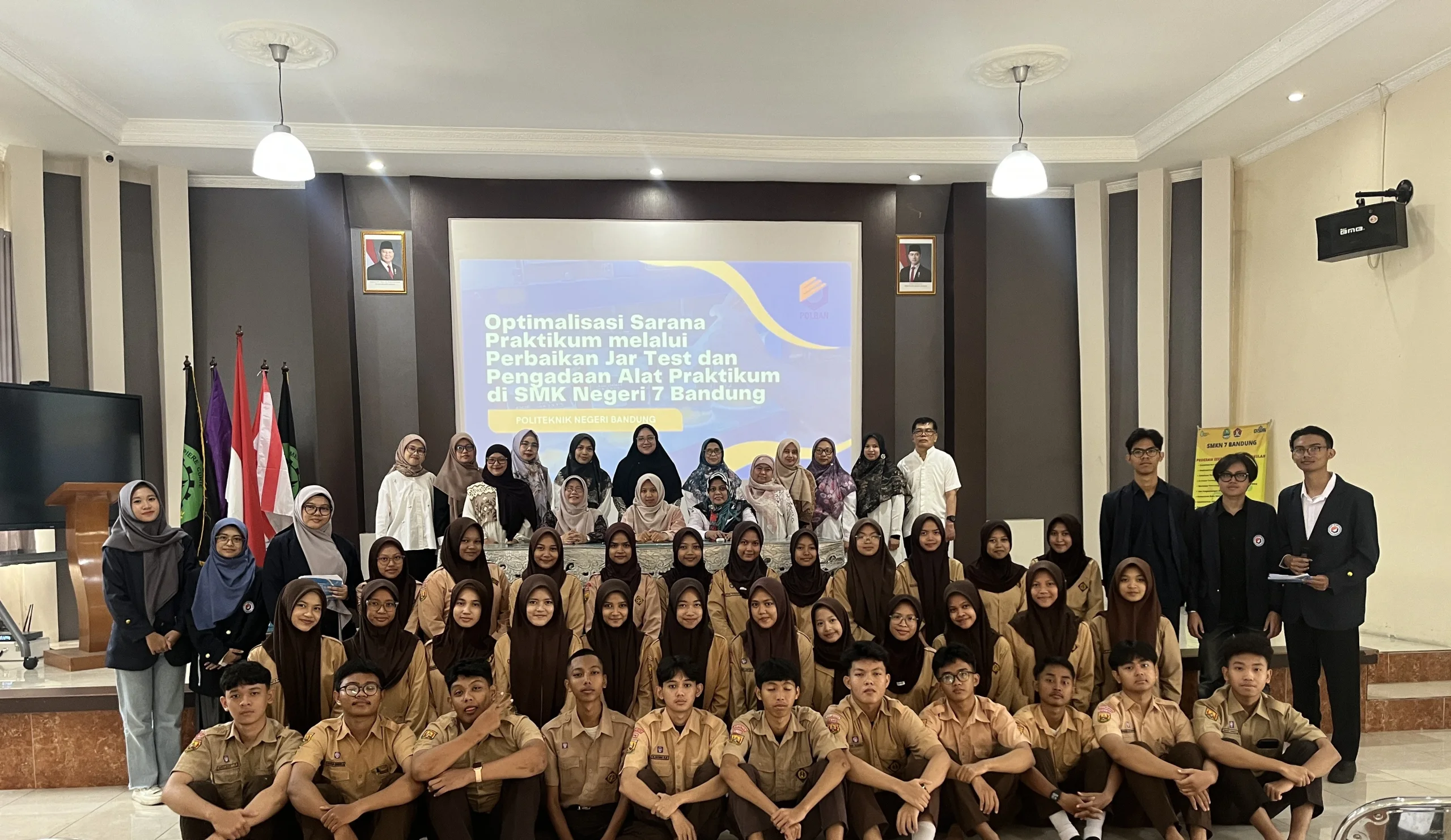
The activity was attended by 34 students as well as 17 teachers and laboratory staff. Through live demonstrations, participants were introduced to the coagulation and flocculation process using the jar testmethod.
During the practice, participants observed how the addition of coagulants and the stirring process facilitate floc formation. The results were then analyzed using the Imhoff cone to determine the volume of sediment produced.
Following the sedimentation process, water samples were measured using the turbidimeter to determine their turbidity levels.
Through these steps, participants were introduced to the relationship between treatment processes and water quality parameters. They learned that the success of treatment cannot be judged by visual inspection alone but must be supported by measurement data.
This experience provided students with an opportunity to become familiar with wastewater treatment practices commonly found in the industrial world.
Material previously studied in the classroom became easier to understand once students could witness the treatment process firsthand and familiarize themselves with the equipment used.
Evaluation results showed a highly positive response from participants regarding the implementation of the activity.
Based on the evaluation, the percentage of participants who provided the highest rating or "strongly agree" category ranged from 66.67–82.22 percent across various activity indicators.
Specifically, 82.22 percent of participants strongly agreed that this activity improved their understanding of the material presented.
Regarding school facilities, 81.82 percent of respondents strongly agreed that the equipment grant improved the quality and completeness of the laboratory facilities.
The same percentage also strongly agreed that the presence of this equipment supports the achievement of learning competencies in related subjects.
These results indicate that the activity not only provided direct learning experiences but also received positive feedback regarding the strengthening of practical facilities at the school.
Aligning Vocational Education with Industrial Needs
Wastewater treatment is a field closely related to the competencies of Chemical Engineering graduates.
In industrial operations, wastewater generated from production processes must be treated before being released into the environment, in accordance with applicable quality standards.
Processes such as coagulation, flocculation, sedimentation, and water quality testing are part of the knowledge and skills required in this field.
Therefore, introducing laboratory equipment at the vocational high school level is a crucial step in helping students understand the application of their studies within a professional context.
For universities, this activity represents a tangible contribution toward improving the quality of vocational education.
The collaboration between Polban and SMKN 7 Bandung also opens opportunities to share knowledge and experience while helping to identify learning needs that are more aligned with industrial practices.
The support provided through laboratory equipment is expected to offer sustainable benefits for student practical activities, particularly in understanding wastewater treatment processes.
Beyond strengthening learning facilities, this activity encourages the development of student competencies through an approach that combines theory, demonstration, observation, and direct measurement.
With improved facilities and human resource capacity, the school laboratory is expected to be better equipped to support practice-based learning.
Through this experience, students can build the understanding and skills necessary to serve as a foundation for further education or entry into the workforce.
Collaborations between universities and vocational schools like this are one way to narrow the gap between academic learning and the skill requirements of the industrial world.







Comments 0
Write a Comment Share your response