

Abstract
The evolution of digital technology has significantly altered student characteristics and classroom approaches. Generations Z and Alpha are increasingly accustomed to visual media, interactive technology, and digital learning resources. This shift necessitates innovation in Islamic Religious Education (PAI) to ensure religious material is delivered in a more engaging, contextual, and accessible manner. This article examines the use of Canva as an interactive multimedia learning tool, drawing on previous research. One development study on Fiqh (Islamic jurisprudence) showed a media validity rate of 98.3% based on subject matter expert reviews and 98.0% based on media expert reviews, with a student response rate of 93.1% categorized as highly engaging. These findings highlight Canva's potential in supporting PAI media development. Despite limitations regarding internet access and technological infrastructure, well-designed Canva materials can serve as a viable alternative for fostering creative, participatory, and relevant learning experiences.
Keywords: Canva, Islamic Religious Education, Interactive Learning Media, Educational Innovation, Digital Literacy.
Introduction
Advancements in information and communication technology have brought major changes to the world of education. Learning processes, which previously relied heavily on one-way communication, are now shifting toward approaches that emphasize active participation, creativity, and the use of digital media.
This transformation is inseparable from the characteristics of students who are increasingly tech-savvy. Generations Z and Alpha grow up in an environment saturated with digital information, ranging from images and videos to animations and interactive applications.
This reality presents both challenges and opportunities for educators, including Islamic Religious Education (PAI) teachers.
In practice, PAI instruction is still often dominated by the lecture method. While this approach remains useful for explaining religious concepts and providing moral guidance, a lack of variety in teaching methods can diminish student engagement.
Yet, PAI is not merely about mastering religious knowledge; it is also about character building, strengthening faith, understanding Islamic law, and developing the skills to practice worship in daily life.
Topics related to worship procedures, the history of Islamic civilization, and moral values require an approach that bridges theoretical knowledge with the students' lived experiences.
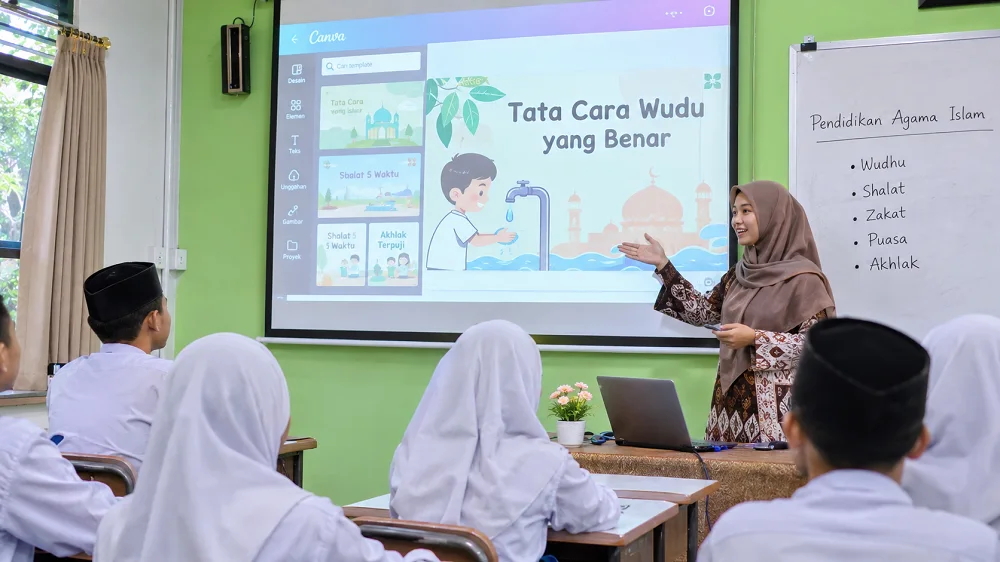
One viable alternative is the use of the Canva application as a digital learning medium.
Canva is a visual design platform that allows users to create presentations, posters, infographics, instructional videos, and various multimedia teaching materials. With its user-friendly features, teachers can develop creative learning materials without needing advanced graphic design skills.
The use of Canva in PAI is a compelling subject of study because it offers educators the opportunity to shift from verbal-dominated instruction to a more visual and interactive learning experience.
Transforming PAI Learning in the Digital Era
Islamic Religious Education plays a crucial role in shaping students who not only possess religious knowledge but are also capable of applying Islamic values in their daily lives.
Therefore, PAI instruction must be designed to develop critical thinking, conceptual understanding, and practical religious skills in a balanced manner.
Technological advancements provide educators with the opportunity to present more diverse learning experiences.
For example, procedures for wudu, prayer, or ritual bathing can be explained through a combination of text, illustrations, and demonstration videos. Meanwhile, Islamic history can be presented through chronological infographics or visual presentations that help students understand the relationships between events.
This approach aligns with Edgar Dale's Cone of Experience , which emphasizes the importance of varied experiences and representations in the learning process.
The use of visual and audiovisual media helps students grasp material through various presentation formats. However, the success of learning still depends on the alignment of the media with the objectives, student characteristics, and teaching strategies.
Riyana (2012) also emphasizes the importance of learning media in supporting more effective educational communication.
In this context, Canva can serve as a tool to expand interaction between teachers, students, and the learning material.
Teachers no longer just convey information through oral explanations but can develop activities that encourage students to observe, discuss, answer questions, and articulate their understanding.
Thus, technology does not replace the educator's role but acts as a supporting tool to enhance the quality of the learning experience.
Utilizing Canva as an Interactive Learning Medium
One of Canva's strengths is its ability to integrate various multimedia elements into a single teaching resource.
Teachers can utilize illustrations, animations, audio recordings, videos, and interactive links to deliver religious material in a more varied way.
For instance, a Fiqh lesson on ritual bathing procedures can be developed through a presentation that includes conceptual explanations, step-by-step sequences, supporting illustrations, and evaluation questions.
Students not only receive information through text but also have the opportunity to understand the steps of worship more systematically.
In Akidah Akhlak (Faith and Morals) lessons, Canva can be used to create infographics on virtuous behaviors, such as honesty, responsibility, tolerance, and social care.
These media can be paired with real-life scenarios so that students can connect religious values to their own experiences.
Canva can also be used for collaborative learning activities. Teachers can assign groups of students to create da'wah posters, Islamic history infographics, or presentations on religious values.
Such activities have the potential to develop creativity, communication skills, and teamwork.
However, the interactivity of learning is not determined solely by the presence of animations or visual elements. Teachers must still design activities that provide students with opportunities to think, ask questions, and evaluate their understanding.
Research Findings on Canva in PAI Learning
The potential of Canva as a learning medium has been discussed in numerous educational studies.
Research by Alfatih, Jannah, and Raharjo (2024) on the use of Canva as an interactive multimedia learning medium for fourth-grade Fiqh at MI NU 2 Kebonagung Kendal provides insight into the feasibility of such media.
The study, which used a development approach, showed expert assessment results of 98.3% for subject matter and 98.0% for media.
Meanwhile, student response to the developed media reached 93.1% in the highly engaging category.
These results demonstrate that the Canva-based media developed in the study had a high level of validity based on expert assessment and received positive responses from students.
However, the percentage of validity and student response cannot be directly interpreted as the magnitude of improvement in learning outcomes. Assessing the effectiveness of learning still requires measurements consistent with the research design.
Research by Pebrina and Annisa (2023) also discussed the development of poster media using Canva for PAI and Character Education at SMP Negeri 4 Payakumbuh.
This study reinforces the focus on using visual media as an alternative for presenting religious education material.
Furthermore, Mahyudin (2023) examined the development of Canva learning media for PAI and Character Education in Phase C of elementary school.
Melviana and her colleagues (2023) also discussed the use of Canva-based instructional videos for introducing Islamic Politics to fifth-grade elementary students.
Meanwhile, research by Nur Nasution, Halimah, and Mahrisa (2023) examined the influence of Canva learning media and learning motivation on PAI learning outcomes for students at SD Panca Budi Medan.
These various studies show that Canva has been used in diverse PAI learning contexts, whether as presentation media, posters, or educational videos.
Although the results and research methods differ, these studies provide a foundation for developing digital learning media tailored to student needs.
Advantages and Challenges of Using Canva
The use of Canva offers several practical advantages for educators.
First, the application provides a wide range of design options that can be adapted to learning materials. Teachers can create more structured teaching materials without having to start the entire design process from scratch.
Second, Canva has a relatively user-friendly interface. The drag and drop feature allows teachers to arrange text, images, and visual elements practically.
Third, Canva supports the development of various types of teaching materials, from posters and infographics to presentations and instructional videos.
Fourth, there are collaboration features that can be utilized to support group work or the joint development of teaching materials among teachers.
Additionally, Canva provides the Canva for Education program for eligible educational users, which helps expand access to learning features.
Nevertheless, the use of Canva also has several limitations.
Internet connectivity is a significant challenge, especially for schools in areas with limited digital infrastructure.
Limited access to devices such as computers, projectors, and smartphones can also affect the implementation of digital learning media.
Furthermore, excessive use of ready-made designs can lead to teaching materials that look uniform and fail to account for the specific characteristics of the students.
Another challenge to note is the tendency to prioritize visual appearance over the depth of the content.
Aesthetically pleasing media will not necessarily improve understanding if they are not designed based on clear learning objectives.
Therefore, the use of Canva must be accompanied by careful pedagogical planning.
Teachers can adapt media to student abilities, utilize downloaded materials for offline learning, and develop collaborative learning activities when available devices are limited.
The Importance of Digital Competence for PAI Teachers
The success of technology integration in learning is not determined solely by the sophistication of the application, but also by the educator's competence in using it.
PAI teachers need digital literacy skills that include the ability to select information sources, organize teaching materials, evaluate content quality, and use technology responsibly.
In the process of developing Canva-based media, educators must ensure that every illustration, video, and explanation used aligns with the substance of the religious material.
This is crucial because PAI instruction involves understanding values, faith, morals, and worship practices that require accurate information.
The use of artificial intelligence technology available on various digital platforms must also be accompanied by a verification process by the teacher.
Automatically generated material should not be used directly without ensuring its consistency with credible religious sources.
Thus, the digital competence of teachers must go hand-in-hand with subject matter mastery and pedagogical skills.
Canva should be viewed as a tool to strengthen the learning process, not as the primary goal of instruction.
Conclusion
The use of Canva as an interactive multimedia learning medium is a viable innovation alternative for Islamic Religious Education.
The platform's ability to combine visual, audio, video, and collaborative elements provides teachers with the opportunity to deliver religious material in a more engaging and contextual manner.
A number of previous studies indicate that Canva-based learning media have the potential for development and receive positive responses from students.
However, successful implementation still requires alignment between the media, teaching methods, student characteristics, and educational goals.
Limitations in infrastructure, internet access, and teacher digital competence must also be addressed to ensure that technology usage does not create learning gaps.
Therefore, strengthening the capacity of PAI teachers to develop digital media is a crucial step toward creating learning that is more adaptive to the changing times.
Ultimately, the transformation of Islamic Religious Education is not just about bringing technology into the classroom. The more fundamental aspect is how technology can be used to help students understand, internalize, and practice Islamic values in their daily lives.
With the right approach, PAI instruction can evolve into an educational process that is creative, interactive, and firmly grounded in the formation of student character and morals.
References
Alfatih, A. M., Jannah, H., & Raharjo, R. (2024). Pemanfaatan aplikasi Canva sebagai media pembelajaran multimedia interaktif di Madrasah Ibtidaiyah. SITTAH: Journal of Primary Education, 5(2), 128–141.
Mahyudin, A. (2023). Pengembangan media pembelajaran Canva mata pelajaran PAI & BP Fase C – Sekolah Dasar. JIDeR: Journal of Instructional and Development Researches, 3(4), 171.
Melviana, Oktaviani, A. A., Fadilah, H., & Aeni, A. N. (2023). Pemanfaatan video pembelajaran berbasis Canva dalam pengenalan Politik Islam pada siswa kelas 5 SD. Journal on Education, 6(1), 747.
Nur Nasution, W., Halimah, S., & Mahrisa, R. (2023). The influence of Canva application learning media and learning motivation on students’ Islamic religious education learning outcomes at Panca Budi Elementary School, Medan. International Journal of Research and Review, 10(2), 772–783.
Pebrina, R., & Annisa, R. (2023). Pengembangan media poster menggunakan aplikasi Canva pada mata pelajaran PAI dan Budi Pekerti di SMP Negeri 4 Payakumbuh. Tazkia: Jurnal Pendidikan Islam, 12(1), 65–66.
Rahmatullah, R., Inanna, I., & Ampa, A. T. (2020). Media pembelajaran audio visual berbasis aplikasi Canva. Jurnal Pendidikan Ekonomi Undiksha, 12(2), 317–327.
Riyana, C. (2012). Media Pembelajaran. Direktorat Jenderal Pendidikan Islam Kementerian Agama Republik Indonesia.
Syafrianti. (2022). Pemanfaatan aplikasi Canva sebagai media pembelajaran untuk meningkatkan hasil belajar Pendidikan Agama Islam. GUAU: Jurnal Pendidikan Profesi Guru Agama Islam, 2(2), 468.
Wulandari, T., & Mudinillah, A. (2022). Efektivitas penggunaan aplikasi Canva sebagai media pembelajaran IPA MI/SD. Jurnal Riset Madrasah Ibtidaiyah (JURMIA), 2(1), 102–118.
Yuliana, D., Baijuri, A., Suparto, A. A., Seituni, S., & Syukria, S. (2023). Pemanfaatan aplikasi Canva sebagai media video pembelajaran kreatif, inovatif, dan kolaboratif. JUKANTI: Jurnal Pendidikan Teknologi Informasi, 6(1), 1–11.
Author Profile
Vidya Nur Santi is a student of the Islamic Religious Education Study Program at the Madani College of Islamic Studies (STIT) in Yogyakarta. The author has a keen interest in Islamic education, learning innovation, and the use of digital technology to support the improvement of educational quality.
Comments 0
Write a Comment Share your response