


JurnalPost.com - Public speaking is a vital communication skill in daily life. In university settings, students are expected to express opinions, present material, and answer questions clearly. This ability is equally essential in the professional world, such as during job interviews, discussions, and when pitching ideas.
However, many still believe that public speaking is a gift reserved only for those who are naturally talented and confident. In reality, this assumption is not entirely accurate.
Public speaking is not merely an innate talent; it is a skill that can be learned and developed through practice and experience. Those who appear fluent were not necessarily born with that ability.
The habit of engaging in discussions, thorough preparation, and the experience of performing before others can help anyone become a better speaker. Therefore, it is inaccurate for someone to label themselves incapable of public speaking simply because they are not yet accustomed to it.
Overcoming Nervousness and the Fear of Making Mistakes
One of the main obstacles to public speaking is the nervousness and fear of making mistakes. When standing before an audience, one might worry about forgetting the material, misspeaking, or receiving negative judgment.
These feelings can erode self-confidence, leading some to avoid speaking opportunities altogether. Yet, nervousness is something that can be managed gradually.
One does not need to be perfect immediately; it is more important to have the courage to try and learn from every experience.
The Importance of Practice and Preparation in Public Speaking
To develop this skill, consistent practice is essential. Preparing the material helps the speaker understand the topic, while active practice helps in managing intonation, speaking pace, and body language.
Furthermore, feedback from others can help identify areas for improvement. With sufficient preparation and practice, one can better grasp the material and convey ideas more effectively.
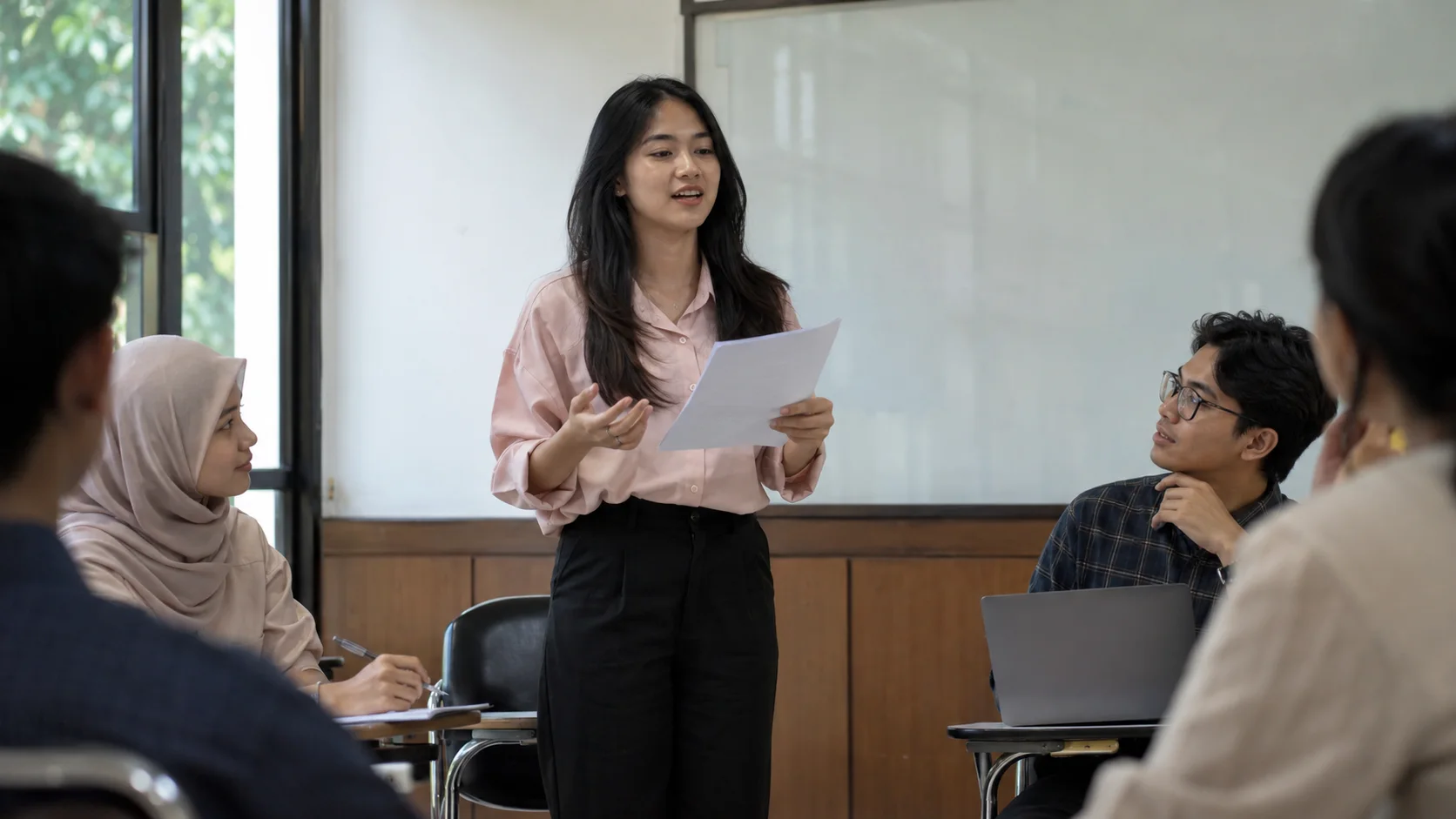
This demonstrates that the ability to public speak relies not just on courage, but also on effort and the willingness to keep learning.
The Role of Public Speaking in Student Life
For students, class presentations and discussions should not be viewed merely as obligations to earn a grade. These activities serve as a training ground for communication skills that will be useful in the future.
Students need to get used to expressing ideas in accessible language, providing logical reasoning, and answering questions in a focused manner.
If these opportunities are utilized well, students will be better prepared for situations requiring strong communication skills, both during their studies and when entering the workforce.
A Supportive Environment Builds Confidence
Beyond individual practice, a supportive environment plays a role in building confidence. Constructive criticism helps one identify weaknesses, whereas mocking mistakes only makes people more afraid to try.
Therefore, educational environments must provide students with opportunities to practice and express opinions without fear of being belittled.
Such support is crucial for encouraging students to grow while learning to respect others who are also in the process of learning.
Public Speaking Is More Than Just Speaking Fluently
Nevertheless, public speaking is not measured solely by fluency or the courage to appear before a crowd.
A speaker must also understand the material, convey information responsibly, and respect the audience's opinions. Speaking confidently without understanding the topic can actually diminish the quality of communication.
In this context, the goal of public speaking is not just to appear convincing, but to ensure that ideas are conveyed clearly and understood by others.
Ultimately, public speaking should not be considered a privilege reserved for a select few. While talent may provide an advantage for some, practice, preparation, and experience are the true drivers of skill development.
Nervousness is not a reason to stop trying, and mistakes are not proof of an inability to grow.
Therefore, every student should treat speaking opportunities as a learning process. There is no need to wait until one feels completely confident to start, as confidence grows through experience.
Public speaking is not about who has the natural talent, but about who is willing to learn, practice, and continuously improve to convey their ideas effectively.



Comments 0
Write a Comment Share your response