


Group work should be a space for students to learn how to collaborate, exchange ideas, and take responsibility for shared tasks. However, in practice, it does not always run ideally. It is not uncommon for some members to work harder to cover for the lack of contribution from others. Ironically, all members often receive the same recognition or grade.
This issue is not merely about task division; it also concerns academic integrity. When each member's contribution cannot be clearly identified, it creates opportunities for individuals to evade responsibility or claim work they did not actually complete. Donelan and Kear (2024) identified unequal participation, unclear task distribution, and interpersonal relationship issues as challenges in implementing group projects in higher education. This indicates that collaboration requires a more structured management mechanism.
Clear Task Division, Yet Opaque Contributions
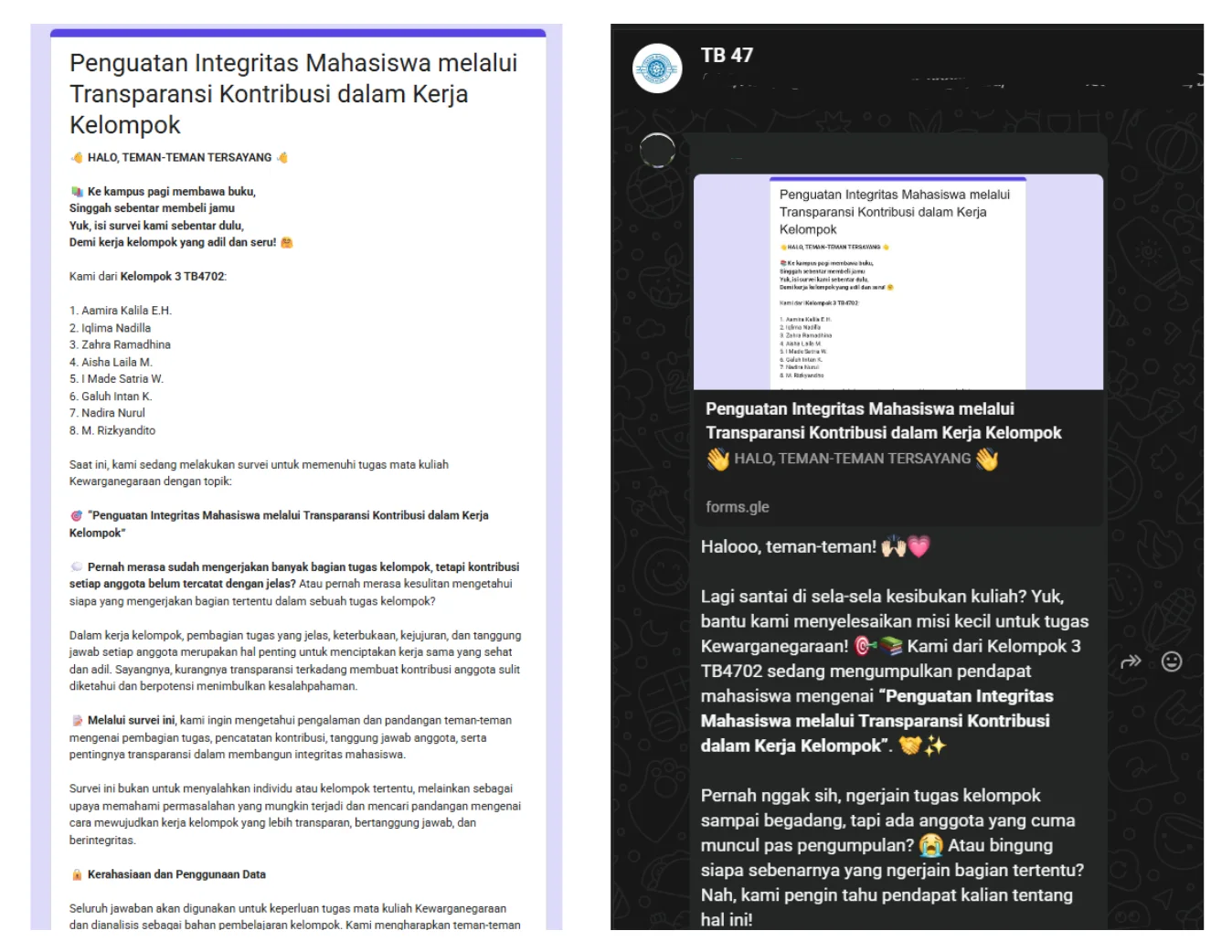
To understand this issue, an online survey was conducted among 39 respondents from various educational levels and fields of study between 25 October and 2 November 2026. The survey used 20 closed-ended questions with Yes and No options, covering four indicators: transparency of task division, contribution logging, integrity and responsibility, and group work problems. Data were collected using convenience sampling and analyzed descriptively and quantitatively. The survey results show that 94.9% of respondents stated their groups had clear task divisions communicated openly. However, only 79.5% had written records of task division, while only 59% had records of each member's actual contribution.
This gap shows that knowing who is responsible for a task does not necessarily mean knowing who actually performed it. As many as 66.7% of respondents have struggled to identify the work completed by other members, while 79.5% stated that the lack of contribution records made it difficult for them to gauge the level of effort put in by each member.
The issue becomes even more apparent when respondents were asked about unequal contributions. 97.4% have encountered members who contributed little but still received the same recognition. Furthermore, 84.6% have seen members claim to have done more than their actual contribution. In fact, 87.2% have felt disadvantaged because they had to complete the majority of the work. These findings demonstrate that the problem with group work lies not only in task division but also in the weak mechanisms for ensuring that responsibilities are truly fulfilled.
Integrity Cannot Be Built Through Moral Appeals Alone
Interestingly, all respondents (100%) stated that every member should be honest about their contributions and be willing to take responsibility for their respective tasks. However, this high level of awareness is not fully reflected in their experiences. 94.9% believe that receiving the same grade sometimes does not reflect individual contributions, while 97.4% believe that a lack of transparency can lead to conflict among members. This condition reveals a gap between integrity as a principle and integrity as a behavior. Students may understand the importance of honesty and responsibility, but without clear accountability mechanisms, it is difficult to evaluate each member's contribution objectively.
Dijkstra et al. (2016) emphasize the importance of considering individual contributions in group work assessment. In line with this, Ion, Díaz-Vicario, and Mercader (2024) explain that self-assessment and peer-assessment can help improve fairness in contribution assessment. Meanwhile, Rasoolia et al. (2025) show that the perception of fairness in group work is related to the assessment process and how members are treated.
In the context of civic education, this issue also relates to the application of Pancasila values. Honesty, responsibility, justice, and deliberation should not only be understood as concepts but applied in daily academic activities. Thus, group work can serve as a learning space to build integrity while respecting the rights and responsibilities of each individual.
CCTS: A Solution for Building Transparent Group Work
To address these issues, a mechanism is needed that does not rely solely on verbal agreements or communication via chat groups. One idea that can be implemented is the Collaborative Contribution Transparency System (CCTS), a contribution transparency system that integrates task division, work documentation, verification, and member evaluation. CCTS can be implemented in four stages.
First, Digital Task Agreement
Before work begins, all members agree on task division, persons in charge, targets, and deadlines. The agreement is recorded in a digital document accessible to everyone so that each member understands their responsibilities from the start.
Second, Contribution Log
Each member records work progress, completed results, revisions, and obstacles encountered. The logging is supplemented with evidence such as document links or revision history. This data is then displayed via a progress dashboard that shows the status of each member's work, allowing task progress to be monitored openly.
Third, Peer Verification
Each member has the opportunity to confirm the contributions of other members based on evidence of work. Verification can be done through peer evaluation forms, including anonymously to reduce social pressure. If there are differences in assessment, members can resolve them through deliberation before the assignment is submitted.
Fourth, Fair Contribution Review
At the end of the project, the group evaluates contributions based on task completion, quality of results, adherence to deadlines, and involvement in helping other members. The evaluation results can serve as a consideration for lecturers in assessing individual contributions.
The implementation of this system can begin by using Google Sheets to record contributions, Google Drive to store work evidence, and Google Forms for peer evaluation. Further development could integrate these three into a more practical contribution dashboard. However, assessment should not be based solely on the quantity of work or digital activity. Quality, difficulty level, and task complexity must also be taken into account. Furthermore, contribution data must be kept confidential so it does not become a tool for shaming or discriminating against certain members.
Building a Fairer Academic Culture
The survey results from 39 respondents show that clear task division does not necessarily guarantee transparent and fair contributions. The gap between agreement and execution remains a challenge that needs attention in building academic integrity. Although these survey results cannot be generalized to all students due to the use of convenience sampling, the findings provide an overview of issues that deserve attention.
Contribution transparency does not mean eliminating trust among students. On the contrary, transparency can be a means to build trust through accountable responsibility. Through the implementation of CCTS, students are encouraged to agree on responsibilities, record work, verify each other, and evaluate contributions based on evidence.
Ultimately, the success of a group should not be measured only by the completed assignment, but also by how each member takes part in completing that assignment. Because true group work is not about who gets the same grade, but about how everyone carries out their responsibilities honestly and fairly.
Comments 0
Write a Comment Share your response