

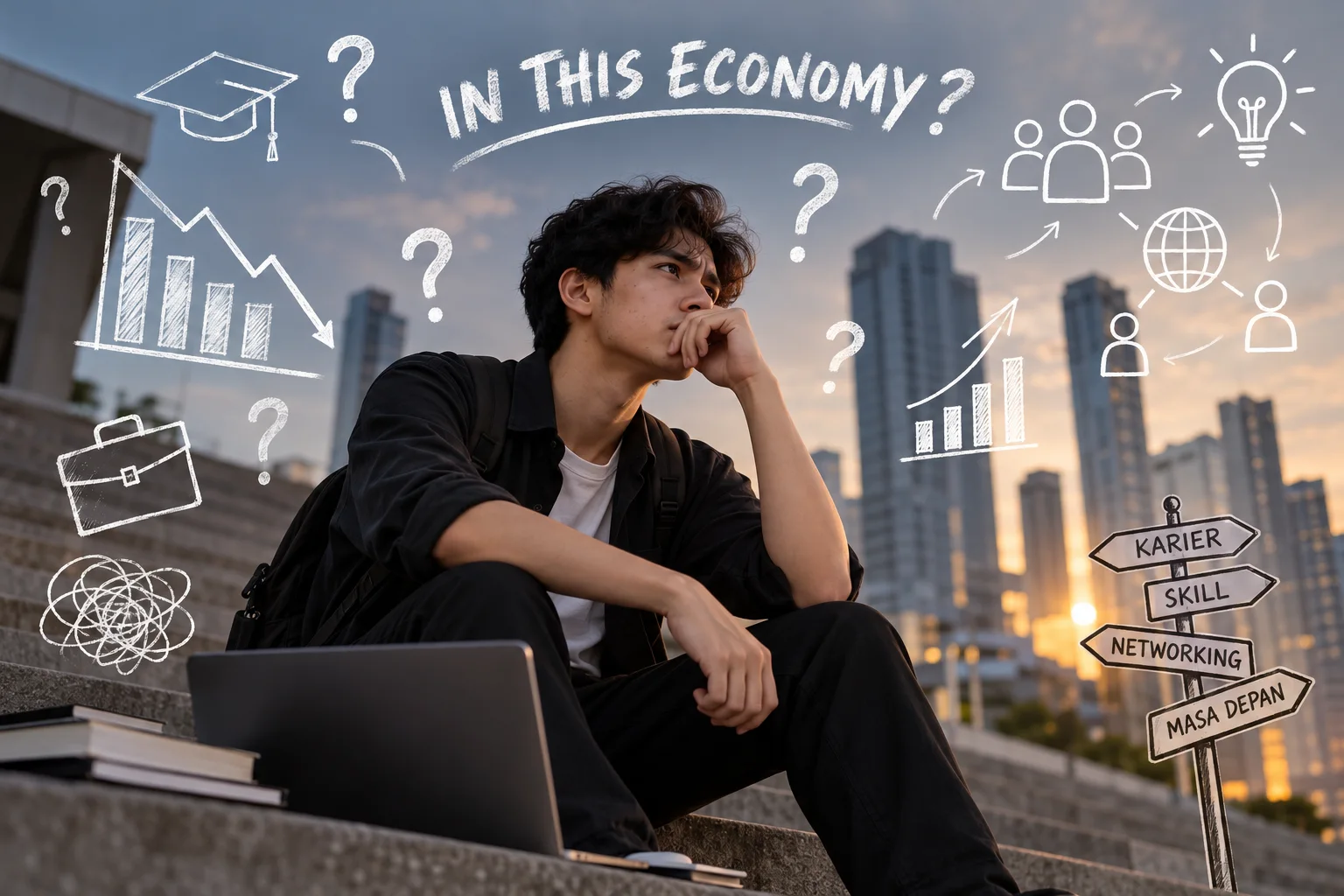
JurnalPost.com — Confusion is a word deeply intertwined with ignorance and a loss of direction. It is a feeling encountered throughout life, from youth to old age. However, when we narrow the age range specifically to 18 to 30, is this confusion merely a coincidence, or has it become a common phenomenon in developing nations like Indonesia?
Right now, you might be feeling it, aren't you? Confusion. Why does this opening paragraph seem unrelated to the title? Or perhaps, some readers may have simply glanced at the title and skipped straight to this section.
This demonstrates that the word confusion is, in itself, confusing. It seems to lead us into an endless paradox, as it can be found across various fields and life issues.
So, what is the actual connection between confusion, the phrase “In This Economy”, and the strategies Generation Z (Gen Z) uses to survive amidst uncertainty?
The “In This Economy” Phenomenon and the Reality of Gen Z
Recently, the phrase “In This Economy” has become quite popular on social media, even finding its way into daily conversation. Literally, it means "in an economic condition like this." However, when interpreted more deeply, the phrase serves as an affirmation that one must think realistically and logically when facing life's various challenges.
Essentially, the phrase “In This Economy” is often used to reinforce a statement, especially when someone is faced with a situation that demands adaptation.
For example:
“As students, we cannot remain perpetually confused about which field to pursue or stay fixated on only one skill. Because, in this economy, we are required to be adaptable, develop various skills, and seize opportunities to survive in the competitive job market.”
From that example, the relationship between confusion and the phrase “In This Economy” begins to emerge. Confusion describes the state of being faced with various choices, while the phrase emphasizes the importance of having conviction, mastering skills, and continuously developing one's mindset.
In other words, a challenging economic climate should not cause the younger generation to stop moving forward. Instead, it can serve as a catalyst to better understand one's own abilities and prepare for the future.
The Gen Z Dilemma in a Competitive Job Market
So, what about Gen Z's survival strategies? What is their connection to the confusion discussed earlier?
Looking at current conditions, many in Gen Z face various forms of uncertainty, particularly regarding their future and the world of work. Competition for jobs is intensifying, while demands for skills and experience continue to evolve.
Many job seekers must face the reality that landing a job that meets their expectations is no easy task. Even when they do secure employment, other issues arise, such as income that is perceived as disproportionate to the responsibilities, time, and energy given to the company or institution.
This situation then creates a new dilemma. Should one stay in a job that provides little satisfaction, or choose to quit in search of better opportunities?
On the other hand, the phenomenon of college graduates working outside their fields of study is a common reality. Some must adjust their career choices to the available opportunities just to meet their basic needs.
In such a situation, the phrase “In This Economy” feels increasingly relevant. One is required to keep trying, adapting, and making decisions even when things do not always go according to plan.
Another equally important issue is the psychological pressure caused by uncertainty about the future. Difficulty finding work, social pressure, and the demand to achieve success quickly can trigger feelings of anxiety, low self-esteem, and a loss of direction.
If left without adequate support, this pressure can have a serious impact on one's mental health. Therefore, the issues faced by the younger generation should not be taken lightly or dismissed as merely a result of a lack of individual effort.
Because, behind someone who has not yet found a job, there may be a long struggle, repeated rejections, and hopes that are continuously being pursued.
Collaboration and Networking as Survival Strategies
In this section, we may still be grappling with confusion regarding the most appropriate strategy to survive in an economically uncertain climate.
What if the challenges faced become increasingly complex? What if individual ability alone turns out to be insufficient to find a solution?
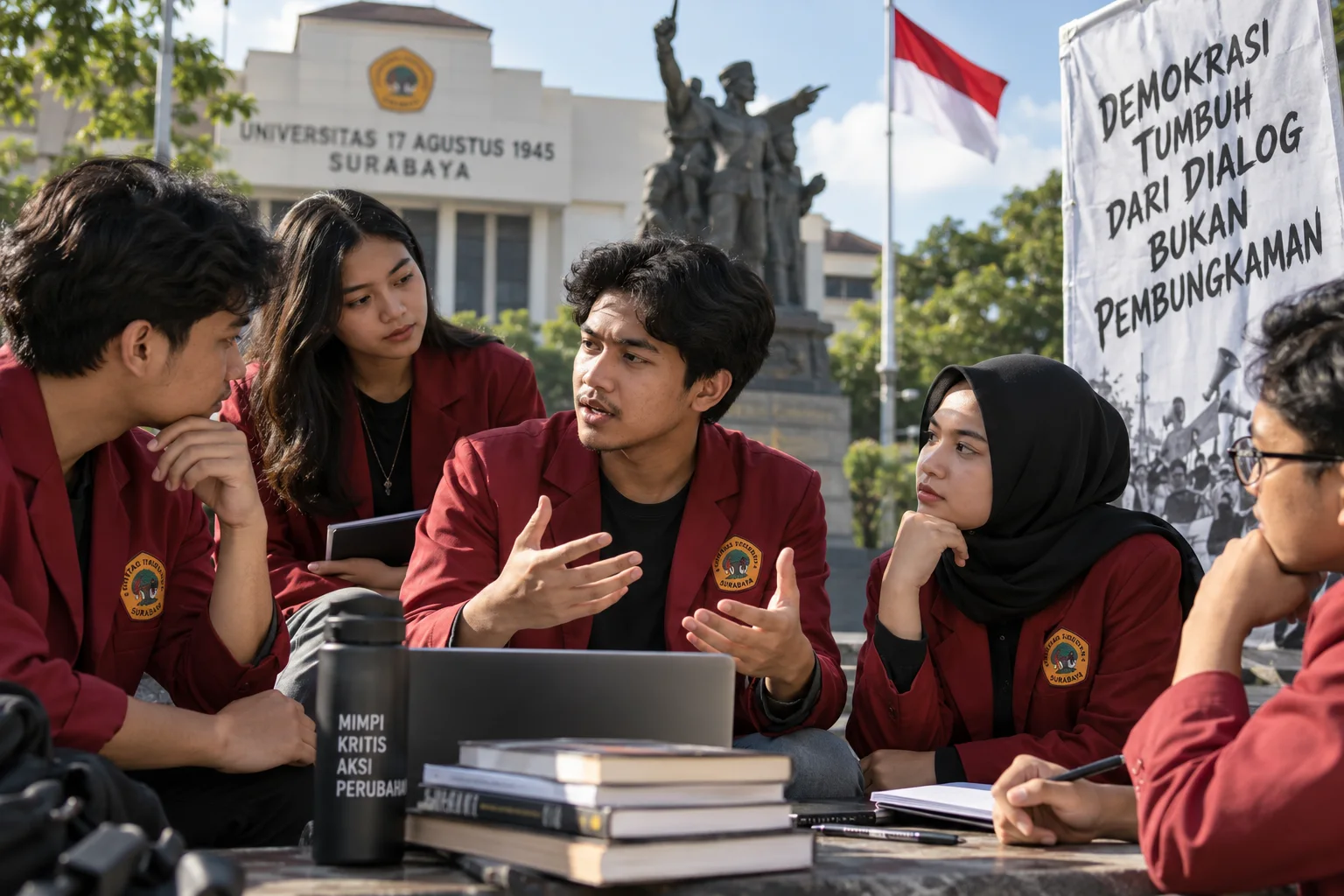
One answer lies in human interaction, specifically through collaboration and networking or collaboration and networking.
These two things are sometimes forgotten and receive insufficient attention. Some may assume that success is determined solely by personal ability, so social relationships and cooperation are not viewed as important.
Yet, as social beings, humans cannot fully live and thrive without the help of others.
Collaboration allows individuals to exchange knowledge, experience, and skills. Meanwhile, networking or connections can open access to information, opportunities, and environments that support personal development.
In simple terms, collaboration is the ability to work together to achieve a specific goal, while networking is the relationship built and maintained through social interaction.
Neither is a new concept. Since ancient times, humans have built relationships, expanded friendships, and worked together to meet various life needs.
Without realizing it, these activities have become an essential part of social life. In fact, in education and the workplace, the ability to build relationships often helps individuals discover opportunities that were previously invisible.
For Gen Z, building a network does not always have to start with major events or relationships with influential people. Simple steps, such as actively participating in discussions, joining organizations, engaging in joint projects, maintaining communication with college peers, and sharing information and experiences, can be a good start.
However, it must be understood that building connections is not just about seeking personal gain. Strong relationships are actually born from trust, mutual respect, and a willingness to provide value to others.
Thus, collaboration and networking not only help individuals gain opportunities but also shape the ability to communicate, adapt, and solve problems together.
Turning Confusion into an Opportunity for Growth
Returning to the three main points discussed—confusion, the phrase “In This Economy”, and Gen Z's survival strategies—all three are actually closely linked.
Confusion is a state anyone can experience when facing choices and uncertainty. Meanwhile, “In This Economy” describes a reality that demands one to be more flexible in facing change.
Collaboration and networking can serve as a strategy to address both of these issues.
Of course, building connections does not mean all economic difficulties and employment issues will resolve themselves. Skills, knowledge, perseverance, and the ability to make decisions remain factors that cannot be ignored.
However, through healthy social relationships and productive cooperation, one has a greater chance to learn, gain new perspectives, and find alternative solutions to problems.
Therefore, in facing the current economic climate, Gen Z needs to utilize the ability to think wisely, continuously develop skills, and maintain a spirit of collaboration and networking.
When facing difficult challenges that feel impossible to solve alone, relationships that have been built and maintained well can become a source of support while opening new opportunities.
Ultimately, “In This Economy” is not just a popular phrase describing the difficulty of the situation. The sentence can also serve as a reminder that surviving amidst uncertainty requires the ability to keep learning, adapting, and working together.
Because not all problems must be solved alone. Sometimes, the way out of confusion is found when we are willing to open ourselves, build relationships, and move forward with others.


Comments 0
Write a Comment Share your response