

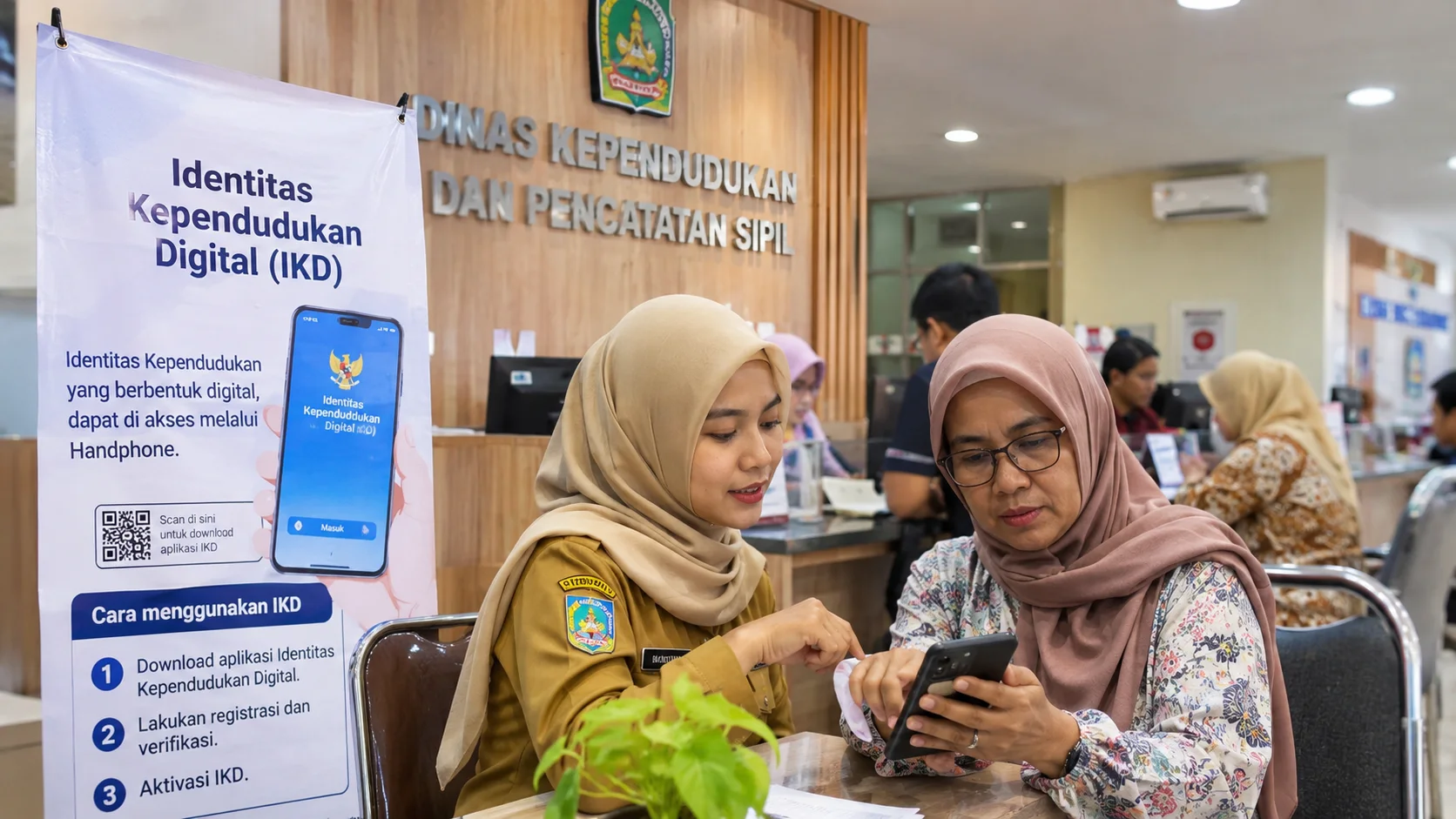
Analysis of Digital Population Identity Acceptance using UTAUT and UTAUT 2 approaches.
Illustration: Inclusive public service digital transformation through UTAUT and UTAUT 2 technology acceptance approaches.
Digital transformation has become a vital component in improving the quality of public services in Indonesia. Various government agencies continue to develop information systems and digital-based applications to accelerate administrative processes, increase efficiency, and expand public access to services.
However, the existence of digital applications does not always reflect the success of service transformation. A system may be developed with adequate technology, but it is not necessarily used optimally by the public.
This issue indicates that the success of digitalization must be understood from a broader perspective. Evaluation should not be limited to the number of applications launched, features available, or registered user accounts. The public's experience in accessing, understanding, and utilizing services must also be a primary focus.
In the context of population administration, the Digital Population Identity (IKD) is a form of technology utilization to support public service delivery. The implementation of IKD is regulated by the Minister of Home Affairs Regulation Number 72 of 2022.
The presence of IKD demonstrates the development of population administration digitalization. However, the effectiveness of its implementation needs to be reviewed not only from a technological standpoint but also based on public readiness, ease of use, and the support provided by service providers.
To understand this issue, the theory of Unified Theory of Acceptance and Use of Technology (UTAUT) and its development, UTAUT 2, can be used as a conceptual approach to analyze factors of technology acceptance.
Technology Acceptance as a Factor in Digitalization Success
User acceptance is a critical aspect of information system implementation. Technology designed to improve organizational efficiency may fail to provide optimal benefits if users find it difficult to operate.
Venkatesh et al. (2003) introduced the UTAUT model to explain the factors influencing the intention and behavior of technology use. The model integrates several previous approaches and identifies four main constructs: performance expectancy, effort expectancy, social influence, and facilitating conditions.
These four constructs provide a perspective that technology usage is not solely determined by the availability of devices or applications. User perceptions of benefits, ease of use, social environment influence, and the availability of supporting facilities all influence the acceptance of a system.
In the implementation of IKD, performance expectancy relates to the public's belief that using a digital identity provides benefits in accessing population administration services.
These benefits must be communicated concretely. The public needs information regarding the functions of digital identity, usage procedures, and service situations that support the utilization of IKD.
Furthermore, effort expectancy reflects the perception of the level of ease in using the technology. In public services, ease of use relates not only to the application interface but also to the registration process, activation, understanding features, and resolving technical issues.
Complicated procedures can be a barrier for the public, especially for users who are not accustomed to digital-based services. Therefore, simplifying processes and providing systematic instructions are essential parts of improving the user experience.
The third construct, social influence , explains how the views and support of the surrounding environment can influence a person's decision to use technology.
In the context of IKD, family, colleagues, the community, and service officers can potentially play a role in introducing the benefits of the application and helping the public understand its usage procedures.
However, assistance processes must still prioritize information security. Education regarding personal data protection must be provided so that users understand the importance of maintaining the confidentiality of population information.
Meanwhile, facilitating conditions relate to the availability of resources and infrastructure that allow technology to be used effectively.
These conditions include owning compatible devices, internet access, digital literacy, availability of information, and help desk services when users encounter obstacles.
Thus, technology acceptance cannot be viewed as the sole responsibility of the public. Service providers also have a role in providing an environment that allows technology to be utilized inclusively.
UTAUT 2 and the Expansion of User Behavior Perspectives
The development of research on technology acceptance led to the expansion of the UTAUT model into UTAUT 2.
Venkatesh, Thong, and Xu (2012) developed this model primarily to explain the acceptance and use of technology in a consumer context. Three additional constructs introduced are hedonic motivation, price value, and habit.
Hedonic motivation relates to the pleasure or positive experience gained when using technology. In the context of public services, this construct needs to be interpreted carefully because the use of administrative applications is generally oriented toward fulfilling needs rather than seeking entertainment.
Nevertheless, a comfortable, non-confusing usage experience that provides certainty can be a relevant aspect to examine in digital service evaluations.
Meanwhile, price value describes the user's consideration of the benefits obtained compared to the costs incurred.
In public service applications like IKD, costs are not always direct payments. Users may also consider internet quota requirements, compatible devices, activation time, and the effort required to understand service procedures.
The next construct is habit , which relates to a person's tendency to use technology as part of activities formed through previous experience.
In population administration services, the formation of usage habits may differ from applications used daily. Therefore, the presence of an application on a device cannot be immediately considered evidence of a formed usage habit.
The application of UTAUT 2 to IKD requires conceptual adjustments to the characteristics of public services. Relevant constructs need to be determined based on the context, evaluation objectives, and the characteristics of the public as service users.
Furthermore, it is necessary to distinguish between the intention to use technology, actual usage, and service success. These three aspects are interrelated but do not have the same meaning.
Digitalization Evaluation Must Be Oriented Toward Public Experience
One of the challenges in evaluating digital transformation is the tendency to use administrative indicators as the primary measure of success.
The number of application downloads, registered accounts, or socialization activities can indeed provide information on implementation progress. However, these indicators do not fully show whether the public has successfully utilized the service according to their needs.
User-oriented evaluation needs to consider several aspects, such as the success rate of completing service processes, time required, ease of understanding information, accessibility, and the quality of complaint handling.
Such measurements can also be supported through user experience surveys, application usability testing, interviews, and analysis of obstacles reported by the public.
This evaluation approach allows providers to identify barriers that may not be visible through user count reports.
For example, an increase in application registration does not necessarily reflect an increase in service quality if users still face difficulties in the activation process or do not understand the benefits of the available system.
In addition, differences in digital literacy and infrastructure availability must be taken into account in policy design.
Not all members of the public have equivalent devices, internet networks, or digital skills. Therefore, the development of technology-based services must be accompanied by assistance and service mechanisms that remain mindful of the needs of groups with limited access.
Providers also need to ensure that changes in features or procedures are followed by updated information and improved competence of service officers.
Thus, digitalization evaluation is not only intended to measure technology acceptance but also to provide a basis for continuous service improvement.
Relevance of UTAUT in Accounting Information Systems
The study of technology acceptance is not only relevant in population administration but also has links to the implementation of accounting information systems in various organizations.
The digitalization of accounting processes, such as transaction recording, budget management, financial reporting, and internal control, requires user involvement so that the system can function optimally.
The implementation of accounting applications does not automatically improve information quality if users experience difficulties in operating features, understanding procedures, or inputting data.
In this case, UTAUT can help organizations understand user perceptions of system benefits, ease of use, the influence of the work environment, and the support of available facilities.
For example, employees may have access to financial reporting applications. However, account ownership cannot be used as the sole measure of implementation success.
Organizations need to ensure that users understand the data input flow, are able to complete work accurately, and receive technical support when facing problems.
On the other hand, a high level of technology acceptance does not automatically guarantee the quality of accounting data. The system still requires internal controls, data validation, access rights management, and evaluation mechanisms to maintain the reliability of the information produced.
Therefore, the study of technology acceptance needs to be combined with evaluations of system quality, information security, and business process effectiveness.
This perspective shows that the success of digital transformation, both in the public sector and organizations, is the result of the interaction between technology, people, and the governance that supports it.
Placing Users at the Center of Digital Transformation
Digitalization of public services should be understood as a process of improving service quality through the use of technology, not merely replacing manual procedures with electronic applications.
IKD can be a relevant context for understanding the importance of technology acceptance in the administration of population services.
Through the UTAUT and UTAUT 2 approaches, providers can identify factors that potentially influence the public's decision to accept and use digital services.
However, the use of both models needs to be accompanied by empirical testing if the goal is to conclude which factors truly influence a specific user group. Conceptual analysis alone cannot prove the level of acceptance or the success of IKD implementation.
Therefore, technology development must go hand in hand with collecting feedback, increasing digital literacy, strengthening information security, and providing easily accessible service support.
Ultimately, the success of digital transformation is not measured solely by the number of innovations introduced. A more substantive measure lies in the extent to which technology is able to simplify service processes, improve the quality of user experience, and provide benefits that can be felt by the public in a fair and sustainable manner.
Technology can be a means of change, but human experience and needs must remain at the center of every digital transformation process.
References
Ministry of Home Affairs of the Republic of Indonesia. (2022). Minister of Home Affairs Regulation Number 72 of 2022 concerning Standards and Specifications for Hardware, Software, and Electronic ID Card Blanks as well as the Implementation of Digital Population Identity. https://peraturan.bpk.go.id/Details/247759/permendagri-no-72-tahun-2022
Venkatesh, V., Morris, M. G., Davis, G. B., & Davis, F. D. (2003). User acceptance of information technology: Toward a unified view. MIS Quarterly, 27(3), 425–478. https://doi.org/10.2307/30036540
Venkatesh, V., Thong, J. Y. L., & Xu, X. (2012). Consumer acceptance and use of information technology: Extending the unified theory of acceptance and use of technology. MIS Quarterly, 36(1), 157–178. https://doi.org/10.2307/41410412


Comments 0
Write a Comment Share your response